Commentary - (2025) Volume 14, Issue 5
Received: 01-Oct-2025, Manuscript No. jbfa-25-176826;
Editor assigned: 03-Oct-2025, Pre QC No. P-176826;
Reviewed: 17-Oct-2025, QC No. Q-176826;
Revised: 22-Oct-2025, Manuscript No. R-176826;
Published:
29-Oct-2025
, DOI: 10.37421/2161-0673.2025.14.551
Citation: Youssef, Sara Ben. ”Global Inflation: Multifaceted Drivers and Policy Responses.” J Bus Fin Aff 14 (2025):551.
Copyright: © 2025 Youssef B. Sara This is an open-access article distributed under the terms of the Creative Commons Attribution License, which permits unrestricted use, distribution and reproduction in any medium, provided the original author and source are credited.
Understanding the mechanisms behind global inflation dynamics, especially in the post-pandemic era, is a pressing concern for economists and policymakers worldwide. Initial analyses indicate that both demand-side and supply-side factors contribute significantly, with an early surge often attributed to supply disruptions, later compounded by robust demand [{1}]. A critical aspect of inflation analysis involves deciphering how household expectations influence broader economic behavior. Empirical evidence demonstrates a clear link between consumers' perceived future price levels and their current spending decisions, offering valuable insights for crafting effective monetary policy communications [{2}]. Drawing lessons from history remains vital in navigating periods of elevated inflation. Historical accounts of successful monetary policy interventions provide a framework for central banks to formulate strategies that effectively bring inflationary pressures under control in contemporary contexts [{3}]. Recent inflationary episodes have underscored the profound impact of global supply chain disruptions. Quantitative assessments reveal how bottlenecks and escalating shipping costs translate directly into higher consumer prices across diverse economies, illustrating the deep interconnectedness of global production systems [{4}]. The question of inflation persistence, particularly within regions like the Euro Area, is central to forecasting and policy formulation. Research endeavors to determine whether current inflationary trends are transient or represent a more entrenched phenomenon, with significant implications for future price stability and the efficacy of monetary policy tools [{5}]. The relationship between fiscal policy and inflation in advanced economies is another area of active research. New empirical evidence sheds light on how government spending, taxation, and debt levels shape price dynamics, especially during periods of substantial fiscal expansion, influencing overall macroeconomic stability [{6}]. Global commodity markets, particularly food prices, also play a significant role in domestic inflation. Cross-country analyses identify specific channels through which international food price volatility impacts Consumer Price Indices, particularly affecting developing economies and necessitating targeted policy responses to mitigate such pressures [{7}]. The concept of the wage-price spiral has re-entered policy debates amidst recent inflation surges. Re-examining this dynamic involves assessing whether rising wages are primarily a cause or a consequence of inflation, informing central bank strategies aimed at stabilizing prices without precipitating severe economic downturns [{8}]. Furthermore, housing market dynamics present another complex dimension to inflation. Studies across Euro Area countries, for instance, explore how factors like rising house prices, rents, and housing investments contribute to overall inflationary pressures, providing crucial insights for policymakers tasked with maintaining stability in both housing and price levels [{9}]. Finally, emerging areas of research consider the macroeconomic ramifications of climate change policies. Through global economic models, the potential inflationary impacts of carbon pricing, green investments, and regulatory measures on aggregate supply and demand are being assessed, offering a forward-looking perspective on price stability and sustainable growth [{10}].
Current research provides a comprehensive view of inflation, identifying it as a complex phenomenon driven by multiple factors. One major line of inquiry focuses on disentangling the relative contributions of demand-side and supply-side forces, especially in the wake of recent global economic upheavals. Analyses suggest that initial inflationary spikes often stemmed from supply disruptions, which were subsequently amplified by robust demand conditions across economies. This perspective helps in understanding the evolving nature of price pressures from a global standpoint [{1}]. In parallel, specific investigations highlight global supply chain disruptions as a primary catalyst for rising inflation. Bottlenecks and increased shipping costs have a quantifiable impact, translating directly into higher consumer prices and illustrating the profound interconnectedness of global production networks [{4}]. These findings are crucial for policymakers trying to manage the external drivers of domestic inflation.
Monetary policy plays a pivotal role in inflation management. Studies delve into historical episodes of high inflation, extracting valuable lessons on effective central bank responses and strategies to bring prices under control. These historical perspectives offer a roadmap for contemporary challenges, guiding central banks in their efforts to stabilize economies [{3}]. Complementing this, the role of household inflation expectations is under scrutiny. Research using randomized control trials demonstrates how changes in consumer beliefs about future price levels significantly influence current spending behavior, providing empirical grounds for refining monetary policy communication strategies to anchor expectations effectively [{2}]. Furthermore, the interaction between fiscal policy and inflation in advanced economies is gaining attention. New evidence examines how government spending, taxation, and debt levels contribute to price dynamics, particularly during periods of substantial fiscal expansion, offering insights into macroeconomic stability concerns [{6}]. This emphasizes the need for coordinated monetary and fiscal approaches.
Regional inflation dynamics, such as those observed in the Euro Area, are subject to detailed investigation. Researchers assess whether recent inflationary pressures are temporary or signal a more entrenched pattern, which has significant ramifications for future price stability and the appropriate course for monetary policy interventions [{5}]. Beyond broad economic factors, specific sectors also contribute distinctively to inflation. For instance, global food price shocks are a recognized channel through which international volatility impacts domestic Consumer Price Indices, particularly in developing economies. Identifying these transmission mechanisms is key to formulating policies that mitigate food-related inflationary pressures [{7}]. Similarly, the intricate relationship between housing market dynamics and inflation is being explored, with studies showing how rising house prices, rents, and housing investments can fuel overall inflationary trends in regions like the Euro Area, urging policymakers to monitor both housing and price levels concurrently [{9}].
The re-examination of traditional economic concepts, such as the wage-price spiral, is essential in the current inflationary climate. Investigations seek to clarify whether rising wages act as a cause or a consequence of inflation, with direct implications for central bank strategies aiming to stabilize prices without triggering an economic downturn [{8}]. Looking ahead, novel research extends to the macroeconomic consequences of climate change policies. By utilizing global economic models, studies analyze how measures like carbon pricing, green investments, and regulatory frameworks influence aggregate supply and demand, thereby affecting overall price stability and long-term economic growth [{10}]. This highlights the expanding scope of factors that need to be considered in comprehensive inflation analyses, from traditional economic levers to emerging global challenges.
Recent economic research extensively explores the multifaceted drivers and implications of global inflation, particularly in the post-pandemic era. Studies highlight the interplay of demand-side and supply-side factors, where initial surges were often linked to supply disruptions, followed by robust demand. Global supply chain bottlenecks and increased shipping costs are identified as significant contributors to higher consumer prices across economies, emphasizing interconnected global production. Monetary and fiscal policy responses are crucial in managing inflation. Historical analyses offer lessons on effective central bank strategies for controlling elevated inflation, while contemporary research investigates the impact of government spending, taxation, and debt levels on price dynamics. The Euro Area, for instance, is a focus for understanding inflation persistence and its implications for price stability. Furthermore, individual behaviors, like household inflation expectations, are shown to directly influence consumer spending and, consequently, demand-side pressures. Other influential factors include global food price shocks, which transmit to domestic inflation, especially in developing economies. Beyond traditional economic levers, the complex relationship between housing market dynamics and inflation is examined, noting how rising house prices and rents can fuel broader inflationary trends. The relevance of the wage-price spiral is also re-evaluated, looking at whether rising wages are a cause or effect of inflation, and what this means for monetary policy aiming to stabilize prices without causing recession. Finally, novel research explores the macroeconomic impact of climate change policies, assessing how measures like carbon pricing and green investments influence aggregate supply and demand, thereby affecting price stability and economic growth. This body of work collectively provides comprehensive insights into the evolving landscape of inflationary pressures and the policy tools available to address them.
None
None
Indexed at, Google Scholar, Crossref
Indexed at, Google Scholar, Crossref
Indexed at, Google Scholar, Crossref
Indexed at, Google Scholar, Crossref
Indexed at, Google Scholar, Crossref
Indexed at, Google Scholar, Crossref
Indexed at, Google Scholar, Crossref
Indexed at, Google Scholar, Crossref
Indexed at, Google Scholar, Crossref
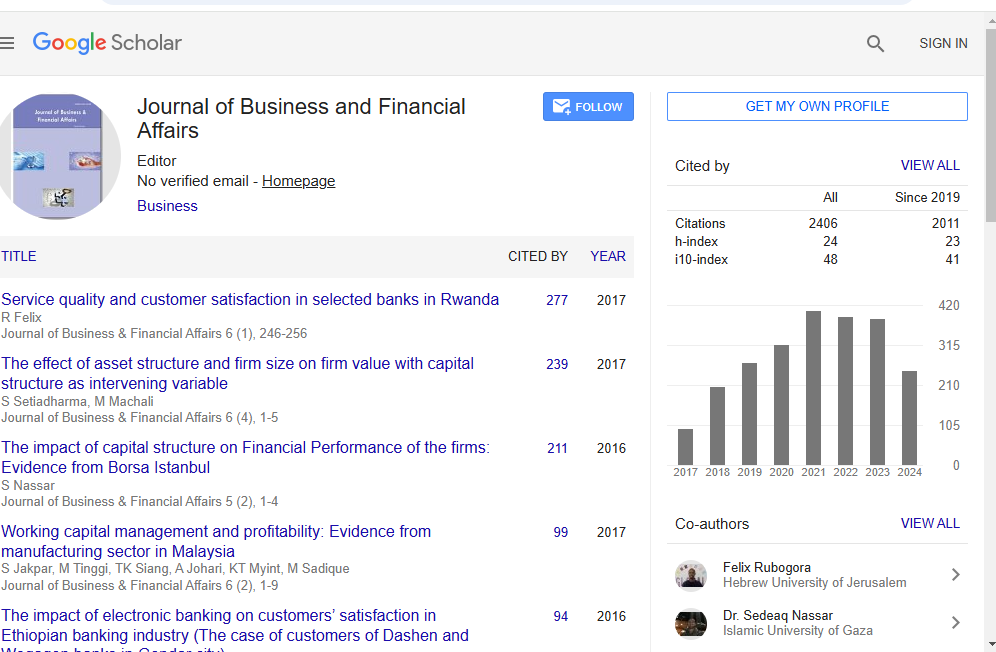
Journal of Business & Financial Affairs received 1726 citations as per Google Scholar report