Opinion - (2025) Volume 15, Issue 5
Received: 01-Sep-2025, Manuscript No. jccr-25-173661;
Editor assigned: 03-Sep-2025, Pre QC No. P-173661;
Reviewed: 17-Sep-2025, QC No. Q-173661;
Revised: 22-Sep-2025, Manuscript No. R-173661;
Published:
29-Sep-2025
, DOI: 10.37421-2165-7920.2025.15.1685
Citation: Owusu, Samuel. ”Global Health: Diverse Cases, Resource Constraints, Vigilance.” J Clin Case Rep 15 (2025):1685.
Copyright: © 2025 Owusu S. This is an open-access article distributed under the terms of the Creative Commons Attribution License, which permits unrestricted use, distribution and reproduction in any medium, provided the original author and source are credited.
This case report details a rare occurrence of severe falciparum malaria complicated by both acute pancreatitis and thrombotic microangiopathy in a non-immune traveler. It highlights the importance of considering atypical presentations of severe malaria, especially in travelers returning from endemic areas, emphasizing rapid diagnosis and comprehensive management in complex cases [1].
This case describes chronic Chagas cardiomyopathy in an asymptomatic patient, presenting acutely with refractory ventricular arrhythmia. It underscores the silent progression of Chagas disease and the challenges in managing severe cardiac complications, particularly for individuals in endemic regions or migrants, emphasizing the need for early screening and advanced cardiac care [2].
This report details a unique presentation of tuberculous meningitis in an immunocompetent patient, initially mimicking carcinomatosis. The case highlights the diagnostic challenges of tuberculosis, particularly in regions where it remains prevalent, underscoring the importance of considering TB in atypical neurological presentations despite apparent immunocompetence [3].
This case report documents the first Marburg Virus Disease outbreak in Equatorial Guinea in 2023, providing critical insights into its clinical presentation and rapid spread. It underscores the urgent need for robust surveillance, rapid response mechanisms, and international collaboration to contain highly pathogenic emerging infectious diseases in resource-limited settings [4].
This case report describes diabetic ketoacidosis in a newly diagnosed young adult with type 2 diabetes in a low-resource setting. It highlights the challenges in early diagnosis and management of diabetes complications in such environments, emphasizing the need for improved health education and accessible care to prevent severe, life-threatening outcomes [5].
This case report illustrates the successful management of severe catatonia during hospitalization in a rural Rwandan setting with limited resources. It highlights the ingenuity and resourcefulness required to provide effective psychiatric care in challenging environments, emphasizing the critical role of clinical skills and adaptable protocols in global mental health [6].
This report describes a complex case of ballistic injury to the head and neck, managed in a low-resource setting. It exemplifies the extreme challenges faced by healthcare providers in such environments, highlighting the need for basic but effective trauma care protocols, innovative surgical approaches, and capacity building for handling severe injuries globally [7].
This case report details a Zika virus infection in a non-pregnant traveler returning from Thailand to South Korea. It emphasizes the ongoing risk of imported arboviral infections, even in non-endemic regions, and the necessity for vigilance in screening travelers. This underscores the global interconnectedness of disease transmission and the importance of travel health advisories [8].
This report highlights the successful treatment of severe complicated malaria with artesunate in a neonate in Ethiopia, a challenging clinical scenario. It demonstrates that with appropriate antimalarial therapy, even vulnerable populations like neonates can achieve positive outcomes in high-burden settings, reinforcing the importance of accessible and effective treatments [9].
This case report describes human leptospirosis in a peri-urban slum of Nairobi, Kenya, underscoring the disease's prevalence in underserved communities. It emphasizes the diagnostic challenges in settings with limited resources and highlights the need for increased awareness, surveillance, and improved sanitation infrastructure to prevent zoonotic diseases in vulnerable urban populations [10].
A significant portion of global health challenges involves infectious diseases, often presenting atypically or in vulnerable populations, demanding heightened clinical suspicion. For instance, a detailed case describes a rare occurrence of severe falciparum malaria complicated by both acute pancreatitis and thrombotic microangiopathy in a non-immune traveler [1]. This unusual presentation critically highlights the importance of considering diverse manifestations of severe malaria, particularly in individuals returning from endemic areas, thereby emphasizing the necessity for rapid diagnosis and comprehensive, multidisciplinary management in such complex clinical scenarios. Similarly, the insidious nature of chronic Chagas disease is brought to light by a case of chronic Chagas cardiomyopathy in an asymptomatic patient, presenting acutely with refractory ventricular arrhythmia [2]. This situation profoundly underscores the silent progression characteristic of Chagas disease and the inherent challenges in managing its severe cardiac complications, especially for individuals residing in endemic regions or migrant populations, pointing to the imperative for early screening and advanced cardiac care interventions. In another compelling instance, tuberculous meningitis presented uniquely, mimicking carcinomatosis in an otherwise immunocompetent patient [3]. This particular case effectively highlights the persistent diagnostic challenges associated with tuberculosis, particularly in regions where it remains highly prevalent, underscoring the crucial importance of considering TB in atypical neurological presentations, even in patients who appear immunocompetent.
Emerging infectious diseases and outbreaks pose critical, time-sensitive threats that necessitate robust public health surveillance and rapid response mechanisms. The seminal report documenting the first Marburg Virus Disease outbreak in Equatorial Guinea in 2023 provides critical, real-world insights into its clinical presentation, epidemiological patterns, and rapid potential for spread [4]. This significant event unequivocally underscores the urgent and pressing need for enhanced surveillance capabilities, highly efficient rapid response mechanisms, and strong international collaboration to effectively contain highly pathogenic emerging infectious diseases, particularly in resource-limited settings where healthcare infrastructure may be fragile. Furthermore, the global interconnectedness of disease transmission is starkly illustrated by the ongoing risk of imported arboviral infections. This is exemplified by a Zika virus infection identified in a non-pregnant traveler returning from Thailand to South Korea [8]. This case powerfully emphasizes the continuous necessity for heightened vigilance in screening international travelers and reinforces the critical role of comprehensive travel health advisories in mitigating disease spread across borders.
The management of both chronic conditions and acute medical emergencies in low-resource settings presents a unique set of formidable challenges, demanding ingenuity and adaptable clinical approaches. A compelling case report describes diabetic ketoacidosis in a newly diagnosed young adult with Type 2 Diabetes Mellitus within a low-resource environment [5]. This scenario prominently highlights the inherent difficulties encountered in the early diagnosis and subsequent effective management of severe diabetes complications in such environments, emphatically underscoring the vital need for improved community health education programs and the provision of more accessible healthcare services to prevent potentially severe and life-threatening outcomes. Despite these significant resource limitations, remarkable successes can be achieved. For instance, the successful management of severe catatonia during hospitalization in a rural Rwandan setting demonstrates the profound ingenuity and resourcefulness required to provide effective psychiatric care in challenging environments [6]. This case accentuates the critical role of advanced clinical skills and adaptable protocols in advancing global mental health. Moreover, successful treatment of severe complicated malaria with artesunate in a neonate in Ethiopia represents a challenging clinical scenario where appropriate antimalarial therapy led to positive outcomes, reinforcing the critical importance of accessible and effective treatments even for the most vulnerable populations like neonates in high-burden settings [9].
Trauma and zoonotic diseases frequently disproportionately affect underserved and vulnerable communities, requiring specialized and often innovative healthcare interventions. A complex case detailing a ballistic injury to the head and neck, expertly managed in a low-resource setting, starkly exemplifies the extreme challenges confronted by healthcare providers in such environments [7]. This situation profoundly highlights the urgent need for implementing basic but highly effective trauma care protocols, exploring innovative surgical approaches where possible, and significantly building local capacity for handling severe injuries on a global scale. Simultaneously, the pervasive threat of zoonotic diseases in urban environments is underscored by a case of human leptospirosis described in a peri-urban slum of Nairobi, Kenya [10]. This report not only sheds light on the disease's silent prevalence in underserved communities but also emphasizes the formidable diagnostic challenges encountered in settings with limited resources. Consequently, it highlights the paramount need for increased public health awareness, robust disease surveillance systems, and substantial improvements in sanitation infrastructure to effectively prevent the spread of zoonotic diseases among vulnerable urban populations. Together, these reports collectively advocate for significantly improved diagnostic capabilities, the development and implementation of tailored management strategies, and the enhancement of public health infrastructure to address the complex and diverse health challenges observed globally, with a distinct and crucial focus on resource-constrained regions and mobile populations.
These case reports collectively highlight critical global health challenges, spanning a diverse range of infectious and non-infectious diseases, often complicated by resource limitations or atypical presentations. They detail conditions such as severe falciparum malaria with unusual complications in a traveler, chronic Chagas cardiomyopathy in an asymptomatic patient, and tuberculous meningitis mimicking carcinomatosis in an immunocompetent individual. The collection also covers the first Marburg Virus Disease outbreak in Equatorial Guinea, emphasizing the need for rapid outbreak response. Further reports include diabetic ketoacidosis in a young adult in a low-resource setting, and the successful management of severe catatonia in rural Rwanda despite limited resources. Complex cases of ballistic injury in underserved areas, Zika virus infection in a traveler, and successful malaria treatment in a neonate in Ethiopia are also discussed. A final report describes human leptospirosis in a Nairobi slum, underscoring the prevalence of zoonotic diseases in vulnerable urban populations. These cases collectively underscore the persistent challenges in diagnosis, management, and public health interventions, particularly in regions with limited infrastructure or for mobile populations like travelers and migrants. They stress the importance of vigilance, early screening, adaptable care protocols, and international collaboration to address complex health scenarios globally.
None
None
1. Sabrina FT, Kerstin A, Holger P. "Severe malaria with concomitant acute pancreatitis and thrombotic microangiopathy in a non-immune traveller: a case report.".BMC Infect Dis 22 (2022):147.
Indexed at, Google Scholar, Crossref
2. Livia NMS, Jaqueline AVP, Ana CVLNS. "Chronic Chagas Cardiomyopathy Presenting With Refractory Ventricular Arrhythmia in an Asymptomatic Patient: A Case Report.".Am J Trop Med Hyg 109 (2023):602-605.
Indexed at, Google Scholar, Crossref
3. Xiaoxiao Z, Fengting F, Ying S. "Tuberculous Meningitis Mimicking Carcinomatosis in an Immunocompetent Patient: A Case Report.".Am J Case Rep 24 (2023):e939227.
Indexed at, Google Scholar, Crossref
4. Adalina RP, Jean CFN, Maria EOE. "The First Marburg Virus Disease Outbreak in Equatorial Guinea, 2023: A Case Report.".N Engl J Med 390 (2024):279-281.
Indexed at, Google Scholar, Crossref
5. Francis EN, Joel ERTRM, Grace MEN. "Diabetic ketoacidosis in a newly diagnosed young adult with type 2 diabetes mellitus in a low-resource setting: a case report.".J Med Case Rep 17 (2023):254.
Indexed at, Google Scholar, Crossref
6. Daniel MK, Jean DNI, Eugene N. "Management of Catatonia During Hospitalization in the Context of Limited Resources: A Case Report From Rural Rwanda.".Glob Ment Health Rep 10 (2023):e29.
Indexed at, Google Scholar, Crossref
7. Andrew MO, Wilson CO, Phillip EA. "A complex case of ballistic injury to the head and neck in a low-resource setting: a case report.".J Med Case Rep 16 (2022):44.
Indexed at, Google Scholar, Crossref
8. Gyeong HC, Young SH, Su AL. "Zika virus infection in a non-pregnant traveler returning from Thailand to South Korea: a case report.".J Med Case Rep 16 (2022):42.
Indexed at, Google Scholar, Crossref
9. Mesfin WA, Asrat DH, Hanna H. "Successful treatment of severe complicated malaria with artesunate in a neonate in Ethiopia: a case report.".Malar J 22 (2023):135.
Indexed at, Google Scholar, Crossref
10. George CTAK, Benson KBK, Joyce MK. "A case of human leptospirosis in a peri-urban slum of Nairobi, Kenya: a case report.".J Med Case Rep 16 (2022):153.
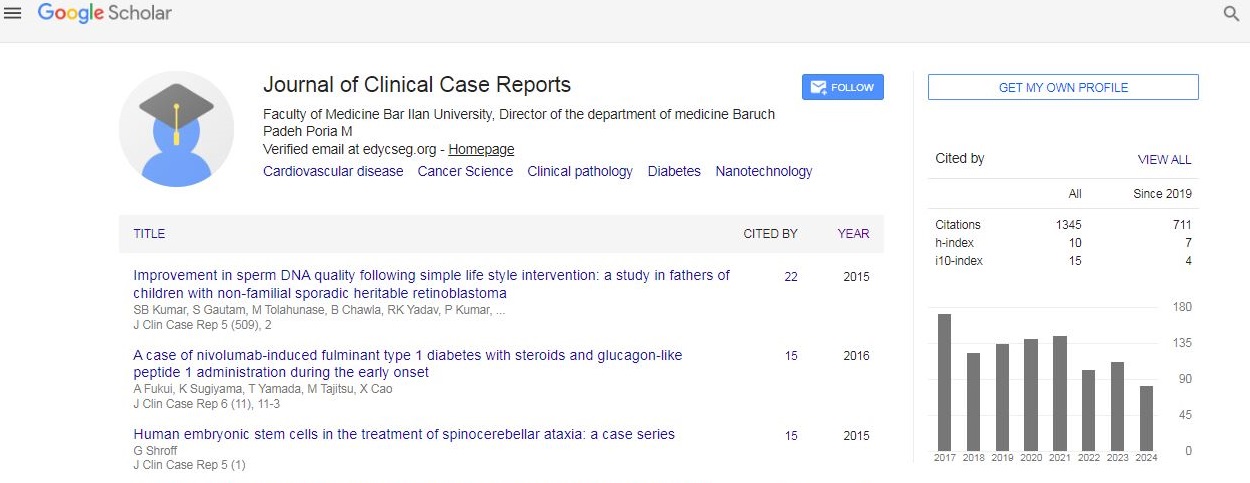
Journal of Clinical Case Reports received 1345 citations as per Google Scholar report