Perspective - (2025) Volume 19, Issue 6
Received: 01-Dec-2025, Manuscript No. jmgm-26-188393;
Editor assigned: 03-Dec-2025, Pre QC No. P-188393;
Reviewed: 17-Dec-2025, QC No. Q-188393;
Revised: 22-Dec-2025, Manuscript No. R-188393;
Published:
29-Dec-2025
, DOI: 10.37421/1747-0862.2025.19.758
Citation: Deshpande, Priyanka. ”Global Genomics: Revolutionizing Health, Personalized Care, Ethical Future.” J Mol Genet Med 19 (2025):758.
Copyright: © 2025 Deshpande P. This is an open-access article distributed under the terms of the Creative Commons Attribution License, which permits unrestricted use, distribution and reproduction in any medium, provided the original author and source are credited.
Genomic sequencing at the global population level is fundamentally transforming our comprehension of human health and disease dynamics. By meticulously analyzing genetic variations that span diverse human populations, researchers are empowered to identify predispositions to various ailments, elucidate the complex mechanisms of drug responses, and engineer precisely targeted public health interventions. This comprehensive approach is proving indispensable for effectively addressing existing health disparities and for propelling the advancement of precision medicine on a worldwide scale. [1] Large-scale population genomics studies are emerging as a vital cornerstone in the quest to unravel the intricate genetic architecture underlying complex human diseases. These extensive research endeavors uniquely enable scientists to pinpoint specific genetic variants that significantly contribute to the development of conditions such as cardiovascular disease, diabetes mellitus, and various forms of cancer, observed across a multitude of ethnic groups. A profound understanding of these fundamental genetic underpinnings represents the critical initial step toward the development of genuinely effective preventative strategies and truly personalized therapeutic treatments. [2] The ethical, legal, and social implications (ELSI) associated with the burgeoning field of global genomics are of paramount importance and demand careful consideration. As the collection and analysis of vast amounts of genetic data from an increasingly diverse array of global populations become more widespread, it is absolutely essential to rigorously ensure the robust protection of data privacy, the stringent security of sensitive information, and the establishment of equitable access to the myriad benefits that genomic advancements promise. Proactively and thoughtfully addressing these multifaceted ELSI concerns is critically important for cultivating essential trust among participants and for fostering a landscape of responsible and sustainable innovation within the entire field. [3] Pharmacogenomics, the specialized scientific discipline focused on understanding how an individual's unique genetic makeup influences their response to pharmaceutical agents, holds immense and largely untapped potential for substantially improving global health outcomes. By gaining a deeper comprehension of the specific genetic variations that can profoundly influence drug efficacy and the potential for toxicity, healthcare professionals can achieve the remarkable feat of tailoring drug prescriptions to individual patients, thereby leading to treatments that are both safer and significantly more effective across the globe. This personalized approach is particularly critical for populations that currently experience limited access to advanced and sophisticated healthcare resources. [4] The strategic integration of genomic data into established public health surveillance systems represents a critical and rapidly evolving frontier in contemporary public health practice. This seamless integration empowers public health agencies to more effectively track the emergence and spread of infectious disease outbreaks, accurately identify emerging antimicrobial resistance patterns, and diligently monitor for genetic predispositions to various non-communicable diseases across entire populations. Such comprehensive and data-driven efforts are absolutely essential for the development of proactive, responsive, and ultimately more effective public health strategies designed to protect and improve community well-being. [5] The continuous development and widespread dissemination of accessible and economically viable genomic technologies stand as a key determinant in the crucial effort to democratize the application of genetic insights for the benefit of population health worldwide. Significant innovations in sophisticated sequencing platforms and advanced data analysis tools are progressively making it feasible to conduct large-scale genomic studies even in low- and middle-income countries, thereby substantially broadening our collective understanding of global genetic diversity and its profound impact on human health outcomes. [6] Comprehending the intricate genetic basis of rare diseases presents a particularly significant scientific and clinical challenge, especially when attempting to study these conditions within the context of diverse global populations. Collaborative and coordinated efforts in the field of genomics are therefore absolutely essential for pooling valuable research resources and critical data, which in turn facilitates the identification of the specific genetic causes underlying these often debilitating conditions. This enhanced understanding, in turn, holds the promise of leading to substantially improved diagnostic capabilities and the potential discovery of novel therapeutic avenues for individuals affected by rare diseases worldwide. [7] The profound impact that environmental factors exert on gene expression, a phenomenon known as epigenetics, plays an undeniably crucial role in shaping population health trajectories. Emerging scientific studies that meticulously examine how varied environmental exposures dynamically interact with inherent genetic predispositions across a wide spectrum of diverse global communities are progressively revealing complex biological pathways that demonstrably contribute to the ultimate development of various diseases. This vital knowledge is indispensable for the effective design and implementation of truly comprehensive and impactful health interventions. [8] Genomic literacy and robust educational initiatives are foundational elements required for the successful and effective implementation of genomic science and technology within the broader context of global population health. Ensuring that healthcare professionals, influential policymakers, and the general public possess a clear and accurate understanding of both the remarkable capabilities and the inherent limitations of sophisticated genomic technologies is absolutely crucial for fostering informed decision-making processes and for promoting the equitable adoption and application of these powerful tools. [9] The pivotal role that genomics plays in deciphering the complex patterns of human migration throughout history and understanding their subsequent impact on disease susceptibility is rapidly emerging as a significant and exciting area of scientific research. By meticulously tracing both ancient and more recent human movements across continents through the analysis of genetic markers, scientists are gaining invaluable insights into how various populations have historically adapted to vastly different environmental conditions and how these evolutionary adaptations continue to influence contemporary human health outcomes today. [10]
Genomic sequencing conducted at a global population scale is ushering in a new era of understanding concerning human health and the diverse factors contributing to disease. Through the detailed analysis of genetic variations present across a wide spectrum of human populations, researchers are gaining unprecedented ability to identify individual predispositions to specific diseases, elucidate how individuals respond to different drugs, and develop public health interventions that are precisely tailored to the needs of specific communities. This comprehensive, population-level approach is becoming increasingly critical for effectively addressing persistent health disparities and for advancing the principles of precision medicine on a truly global level. [1] Large-scale studies focusing on population genomics are proving to be an indispensable resource for uncovering the complex genetic underpinnings of common human diseases. These extensive research efforts provide the necessary tools and data to pinpoint specific genetic variations that significantly influence an individual's risk for developing conditions such as cardiovascular disease, diabetes, and cancer, particularly when examining these across different ethnic groups. A thorough understanding of these underlying genetic factors is the essential first step toward creating effective strategies for disease prevention and developing personalized treatment plans. [2] When engaging with global genomics initiatives, the ethical, legal, and social implications (ELSI) are of paramount importance and require careful and ongoing consideration. As genetic data from diverse populations is increasingly collected and analyzed, it is crucial to establish and maintain robust systems that ensure the privacy of this sensitive information, its security against unauthorized access, and the equitable distribution of the benefits derived from genomic research. Addressing these ELSI concerns proactively is fundamental to building public trust and fostering an environment where innovation in genomics can proceed responsibly and ethically. [3] Pharmacogenomics, the scientific study dedicated to understanding how an individual's genetic makeup affects their response to medications, offers substantial promise for enhancing global health outcomes. By identifying genetic variations that influence how effectively a drug works or whether it may cause adverse reactions, it becomes possible to personalize drug prescriptions, leading to treatments that are both safer and more effective for individuals worldwide. This approach is especially valuable for populations that may have limited access to advanced healthcare services. [4] A critical area of development in public health is the integration of genomic data into existing surveillance systems. This integration allows for more effective tracking of infectious disease outbreaks, better identification of patterns of antimicrobial resistance, and continuous monitoring of genetic predispositions to non-communicable diseases within populations. Such comprehensive monitoring is essential for developing public health strategies that are both proactive in anticipating threats and responsive to evolving health challenges. [5] The ongoing advancement and increased accessibility of genomic technologies are fundamental to broadening the reach of genetic insights for population health initiatives around the world. Innovations in the design of sequencing technologies and the development of sophisticated data analysis tools are making it increasingly practical to conduct large-scale genomic studies in resource-limited settings, such as low- and middle-income countries. This expansion of research capacity significantly enhances our understanding of global genetic diversity and its multifaceted impact on health. [6] Understanding the genetic basis of rare diseases presents a considerable challenge, particularly when considering the vast genetic diversity found within global populations. To overcome this, collaborative efforts in genomics are essential for pooling resources and sharing data, which can accelerate the identification of the genetic causes responsible for these often-devastating conditions. Such collaborative endeavors are key to improving diagnostic accuracy and discovering potential therapeutic targets for affected individuals across the globe. [7] Epigenetics, which explores how environmental factors influence gene expression, plays a significant role in the health of populations. Research investigating the complex interplay between environmental exposures and genetic predispositions in diverse global communities is progressively revealing intricate biological pathways that contribute to disease development. This deeper understanding is vital for designing effective and holistic health interventions that consider both genetic and environmental influences. [8] Fostering genomic literacy and implementing comprehensive educational programs are crucial for the successful application of genomics in global population health. It is imperative that healthcare professionals, policymakers, and the general public have a clear understanding of the capabilities and limitations associated with genomic technologies. This knowledge empowers informed decision-making and supports the equitable and effective adoption of these powerful tools for health improvement. [9] Investigating the influence of human migration patterns on disease susceptibility through genomics is an expanding field of research. By analyzing genetic markers that trace ancient and recent human movements, scientists are gaining insights into how different populations have adapted to various environments over time and how these adaptations continue to affect health outcomes in the present day. This historical genetic perspective provides valuable context for understanding contemporary disease patterns. [10]
Genomic sequencing at a global scale is revolutionizing health and disease understanding by identifying genetic predispositions and informing targeted interventions. Large-scale population genomics studies are crucial for uncovering the genetic basis of complex diseases across diverse ethnic groups, paving the way for personalized treatments and preventative strategies. The ethical, legal, and social implications of global genomics are paramount, requiring careful attention to data privacy, security, and equitable access to benefits. Pharmacogenomics holds significant potential to improve global health by tailoring drug prescriptions based on individual genetic responses, benefiting populations with limited healthcare access. Integrating genomic data into public health surveillance aids in tracking infectious diseases and monitoring genetic predispositions, enabling proactive strategies. Accessible and affordable genomic technologies are democratizing genetics for global health, allowing for broader research in diverse regions. Collaborative genomics efforts are essential for understanding rare diseases, leading to improved diagnostics and therapies. Epigenetics studies highlight the impact of environmental factors on gene expression in population health, crucial for comprehensive interventions. Genomic literacy and education are fundamental for informed decision-making and equitable adoption of genomic technologies. Research into human migration patterns using genomics provides insights into disease susceptibility and adaptations. The advancement of genomic technologies and increased accessibility are key to democratizing genetic insights for population health worldwide.
None
None
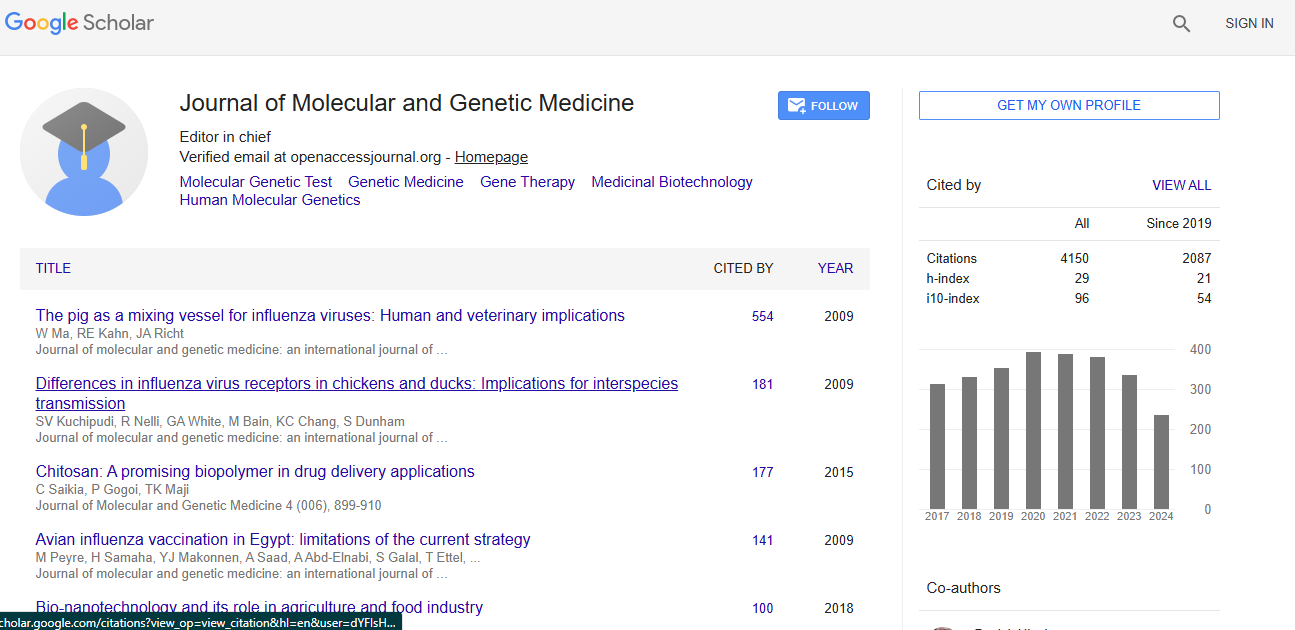
Molecular and Genetic Medicine received 3919 citations as per Google Scholar report