Perspective - (2025) Volume 14, Issue 4
Received: 01-Jul-2025, Manuscript No. pbt-25-173767;
Editor assigned: 03-Jul-2025, Pre QC No. P-173767;
Reviewed: 17-Jul-2025, QC No. Q-173767;
Revised: 22-Jul-2025, Manuscript No. R-173767;
Published:
29-Jul-2025
, DOI: 10.37421/2167-7689.2025.14.496
Citation: Al-Hassan, Yusef. ”Global Drug Approvals: Trends and Expedited Pathways.” Pharmaceut Reg Affairs 14 (2025):496.
Copyright: © 2025 Al-Hassan Y. This is an open-access article distributed under the terms of the Creative Commons Attribution License, which permits unrestricted use,
distribution and reproduction in any medium, provided the original author and source are credited.
The dynamic landscape of drug development and regulatory science is consistently shaped by the approval of new drugs and biologics, with regulatory bodies like the US Food and Drug Administration (FDA) playing a pivotal role. Annual comprehensive reviews offer crucial insights. For instance, 2022 saw a thorough analysis of new drug applications (NDAs) and biologics license applications (BLAs) approved by the FDA, categorizing approvals by therapeutic area, identifying first-in-class drugs, and delving into the utilization of expedited review pathways, thus illuminating evolving trends [1].
The characteristics of NDAs receiving priority review designation from the FDA between 2015 and 2019 have been closely examined. This study assessed the influence of priority review on approval times, orphan drug designations, and distribution across therapeutic areas, highlighting trends in accelerated drug development for serious conditions [2].
Beyond national boundaries, a comparative analysis offers a broader global perspective. From 2018 to 2020, approvals across major regulatory agencies in the US, Europe, Japan, and China were investigated, identifying commonalities and distinct differences in approved drugs, therapeutic categories, and review processes [3].
Further deep dives into specific years within the US context also prove insightful. The article detailing FDA new drug approvals in 2021 offered its own comprehensive review and analysis, categorizing approved drugs based on therapeutic area, highlighting novel mechanisms of action, and thoroughly examining various regulatory pathways, underscoring ongoing innovation [4].
Similarly, an in-depth review of new drug approvals by the FDA in 2020 concentrated on efficacy and safety profiles. This publication categorized approved treatments by disease areas and critically discussed the clinical significance and inherent innovation represented by these therapeutics, providing a strong foundation for understanding their potential impact [5].
The patterns observed in 2019 further contribute to this understanding, with a detailed summary of NDAs and BLAs approved by the FDA. This summary scrutinized characteristics like therapeutic indications, orphan drug status, and utilization of expedited review pathways, consistently reflecting broader trends in pharmaceutical innovation and regulatory efficiency [6].
Focusing on specific medical fields, an overview of FDA oncology drug approvals over a decade, culminating in 2019, revealed substantial progress. This review particularly emphasized advancements in cancer treatment, including targeted therapies and immunotherapies. It also discussed the significant impact of accelerated approval pathways within this critical therapeutic area, highlighting strategies for faster access to life-saving treatments [7].
In another specific area, the real-world effectiveness of new drug approvals for rheumatoid arthritis has been carefully studied. This research moved beyond controlled clinical trials, focusing on patient outcomes in diverse clinical settings. By analyzing data on drug survival and treatment response, it offered valuable insights into how these new therapies truly perform in everyday medical practice [8].
Expanding the global comparison, an article analyzed trends in new drug approvals across major Asian countries (Japan, China, Korea, India) and juxtaposed these findings with those from the US and Europe between 2010 and 2019. This extensive analysis identified distinct regional differences in drug development priorities, regulatory frameworks, and the types of drugs available to patients [9].
Finally, a crucial study investigated the impact of expedited review pathways not only on the speed of new drug approvals but also on subsequent postmarket safety outcomes. It sought to determine whether accelerated approval processes are associated with higher rates of safety concerns or product withdrawals, providing critical insights into the delicate balance between rapid patient access and rigorous safety standards [10].
These collective studies underscore the complex interplay of scientific advancement, regulatory processes, and global health priorities in bringing novel therapeutic agents to market.
The regulatory landscape for new drug and biologic approvals is a complex system, continuously scrutinized for efficiency, safety, and innovation. Annual reports from the US Food and Drug Administration (FDA) offer crucial transparency into these processes. A detailed review of 2022 approvals highlighted the comprehensive nature of new drug applications (NDAs) and biologics license applications (BLAs). This analysis meticulously categorized approvals by therapeutic area, identified first-in-class drugs, and critically examined expedited review pathways, providing invaluable insights into drug development and regulatory science [1]. Such detailed annual assessments are vital for tracking progress and identifying emerging pharmaceutical trends.
Priority review is a key aspect of accelerated drug development, especially for conditions with unmet medical needs. An in-depth study focused on NDAs receiving priority review designation from the FDA between 2015 and 2019. This research rigorously evaluated the direct impact of priority review on approval times, orphan drug designations, and distribution across therapeutic areas. The findings underscored consistent trends in accelerating drug development for serious conditions, aiming to bring life-saving treatments to patients more quickly [2]. This process is under constant evaluation to ensure speed does not compromise thoroughness.
Global comparisons are essential for a broader context of drug approvals. A comparative analysis from 2018 to 2020 investigated new drug approvals across the US, Europe, Japan, and China. This review identified both commonalities and significant differences in approved drugs, therapeutic categories, and regulatory review processes, crucial for understanding market access strategies [3]. Similar regional analyses, like one comparing approvals in Asian countries (Japan, China, Korea, India) with the US and Europe from 2010 to 2019, further delineate these differences, revealing variations in regulatory frameworks and development priorities across regions [9]. These studies illuminate nuanced challenges in bringing new medicines worldwide.
The yearly performance of the FDA remains a central focus. The year 2021 saw a comprehensive review of FDA new drug approvals, categorizing drugs by therapeutic area, highlighting novel mechanisms of action, and examining various regulatory pathways. This offered a clear picture of innovation driving pharmaceutical development [4]. Similarly, an in-depth review of FDA approvals in 2020 concentrated on the efficacy and safety profiles, categorizing treatments by disease areas and critically discussing their clinical significance and innovation, providing vital insights into their potential impact [5]. These annual reviews often build on past trends, like the detailed summary of NDAs and BLAs approved by the FDA in 2019, which examined characteristics such as therapeutic indications, orphan drug status, and expedited review pathways, reflecting broader trends in pharmaceutical innovation [6].
Specialized therapeutic areas frequently receive dedicated attention. FDA oncology drug approvals over a decade, focusing on 2019, provided a critical overview of advancements in cancer treatment, highlighting targeted therapies and immunotherapies. The review also discussed the profound impact of accelerated approval pathways in this critical area, illustrating how regulatory mechanisms support rapid access to life-saving treatments [7]. Furthermore, beyond controlled clinical trials, the real-world effectiveness of new drug approvals is crucial. A study evaluating new drugs for rheumatoid arthritis focused on patient outcomes in actual clinical settings, analyzing drug survival and treatment response to offer invaluable insights into how these therapies perform in diverse patient populations [8].
A critical aspect of expedited review pathways is balancing them with postmarket safety. One significant study investigated the direct impact of these accelerated review processes on new drug approvals and subsequent postmarket safety outcomes. It sought to determine if accelerated approval processes were linked to higher rates of safety concerns or product withdrawals. This research provided critical insights into the delicate but essential balance between ensuring rapid patient access to treatments and upholding rigorous patient safety standards throughout a drug's lifecycle [10].
The provided data offers a comprehensive overview of new drug and biologic approvals by the US FDA and global regulatory bodies over recent years, primarily focusing from 2010 to 2022. Several articles review annual FDA approvals, detailing trends in therapeutic areas, first-in-class drugs, novel mechanisms of action, and the utilization of expedited review pathways [1, 4, 5, 6]. These analyses highlight the evolving landscape of pharmaceutical innovation and regulatory science. A significant theme is the impact and characteristics of expedited and priority review pathways. Studies examine how priority review affects approval times, orphan drug designations, and development for serious conditions [2]. The broader implications of accelerated approval on postmarket safety outcomes are also investigated, addressing concerns about potential associations with higher rates of safety issues or product withdrawals, aiming to balance rapid access with patient safety [10]. Beyond the US, the data includes comparative analyses of new drug approvals across major regulatory agencies in Europe, Japan, China, Korea, and India [3, 9]. These comparisons identify regional differences in drug development priorities, regulatory frameworks, and the types of drugs reaching patients. Specific therapeutic areas like oncology and rheumatoid arthritis are also explored, with reviews of FDA oncology drug approvals over a decade [7] and real-world effectiveness studies for rheumatoid arthritis treatments [8]. Collectively, these articles illuminate the multifaceted nature of drug development, regulatory processes, and their impact on global patient care.
None
None
1. S. AS, Jeffrey EK, Sarah BS. "Overview of New Drug Applications and Biologics License Applications Approved by the US Food and Drug Administration in 2022".Clin Pharmacol Ther 113 (2023):304-315.
Indexed at, Google Scholar, Crossref
2. Peng L, Dejun S, Xiaotian H. "Characteristics of New Drug Applications Approved by the US Food and Drug Administration Under Priority Review From 2015 to 2019".JAMA Netw Open 4 (2021):e219759.
Indexed at, Google Scholar, Crossref
3. Hui L, Chuan C, Liping S. "Comparison of New Drug Approvals in the US, Europe, Japan, and China, 2018-2020".Front Pharmacol 13 (2022):836486.
Indexed at, Google Scholar, Crossref
4. S. AS, Jeffrey EK, Sarah BS. "FDA New Drug Approvals 2021: Review and Analysis".Clin Pharmacol Ther 111 (2022):324-336.
Indexed at, Google Scholar, Crossref
5. Sarah BS, Alexander GD, Jeffrey EK. "New Drug Approvals by the US Food and Drug Administration in 2020: A Review of Efficacy and Safety".Clin Pharmacol Ther 109 (2021):315-327.
Indexed at, Google Scholar, Crossref
6. Jeffrey EK, Alexander GD, Sarah BS. "Overview of the New Drug and Biologics License Applications Approved by the US Food and Drug Administration in 2019".Clin Pharmacol Ther 107 (2020):304-315.
Indexed at, Google Scholar, Crossref
7. Shravan A, Sara H, Mohammad MH. "US Food and Drug Administration (FDA) approvals in oncology: A decade of progress (2010-2019)".Cancer Res 80 (2020):2761-2771.
Indexed at, Google Scholar, Crossref
8. Hongmei C, Shuang H, Qiujuan Z. "Real-world effectiveness of new drug approvals for rheumatoid arthritis".Arthritis Res Ther 25 (2023):37.
Indexed at, Google Scholar, Crossref
9. Hyesung K, Jiyeon L, Hyunah K. "Trends in New Drug Approvals in Asia (Japan, China, Korea, India) and Comparison with the US and Europe Between 2010 and 2019".Ther Innov Regul Sci 54 (2020):788-797.
Indexed at, Google Scholar, Crossref
10. Michael D, David L, Monika S. "The impact of expedited review on new drug approvals and postmarket safety".Health Aff (Millwood) 38 (2019):363-371.
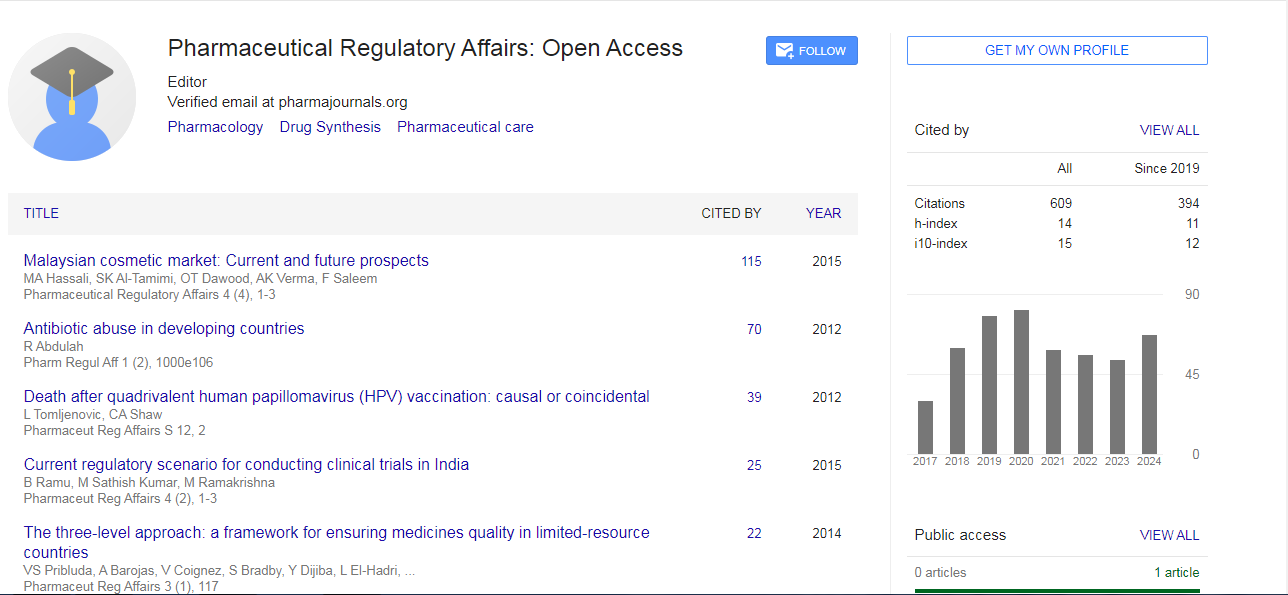
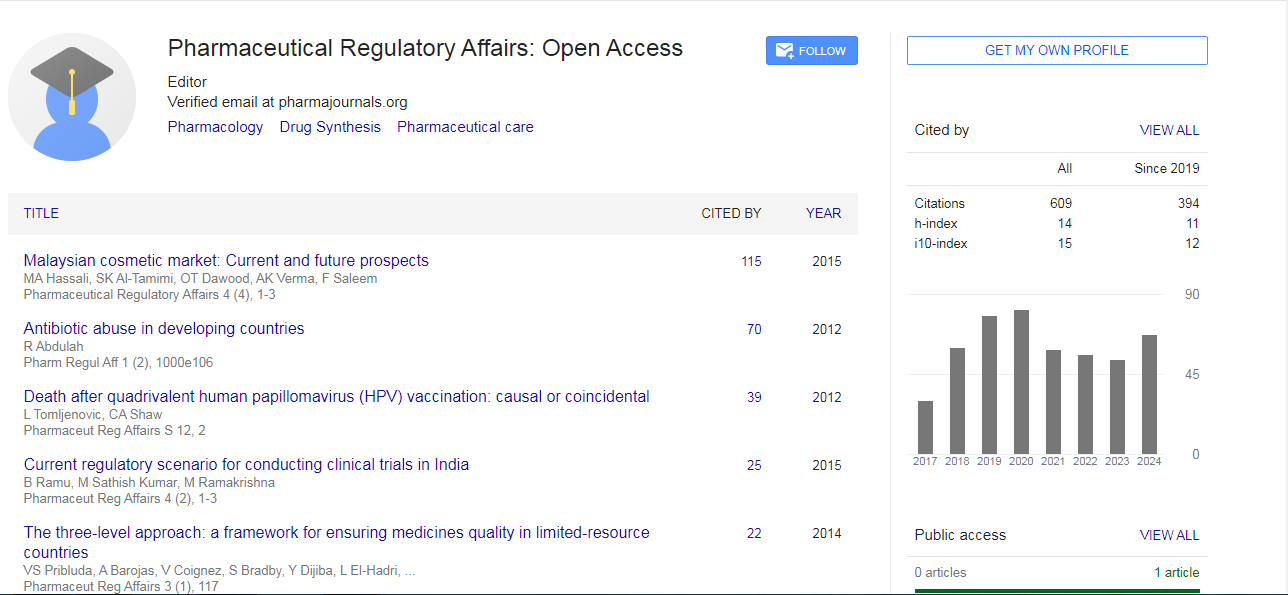
Pharmaceutical Regulatory Affairs: Open Access received 533 citations as per Google Scholar report