Perspective - (2025) Volume 17, Issue 5
Received: 01-Sep-2025, Manuscript No. jcst-25-176302;
Editor assigned: 03-Sep-2025, Pre QC No. P-176302;
Reviewed: 17-Sep-2025, QC No. Q-176302;
Revised: 22-Sep-2025, Manuscript No. R-176302;
Published:
29-Sep-2025
, DOI: 10.37421/1948-5956.2025.17.727
Citation: Berg, Thomas. ”Global Cancer Crisis: Trends, Disparities,
Interventions.” J Cancer Sci Ther 17 (2025):727.
Copyright: © 2025 Berg T. This is an open-access article distributed under the terms of the Creative Commons Attribution License, which permits unrestricted use, distribution
and reproduction in any medium, provided the original author and source are credited.
This study provides a comprehensive overview of global cancer statistics for 2020, estimating the incidence and mortality rates across 36 cancer types in 185 countries. It highlights the significant and growing burden of cancer worldwide, emphasizing the need for effective global cancer control strategies and resource allocation, particularly in regions facing increasing challenges due to demographic shifts and risk factor prevalence[1].
This research analyzes the specific cancer burden in Asia for 2019, based on data from the Global Burden of Disease Study. It identifies leading cancer types, associated risk factors, and trends in incidence and mortality within the diverse Asian continent. The findings are crucial for developing targeted cancer control initiatives tailored to the unique epidemiological profiles and healthcare infrastructures of different Asian sub-regions[2].
This commentary underscores the critical importance of prevention and early detection strategies in mitigating the rising global cancer burden. It discusses how targeted public health interventions, vaccination programs, and screening initiatives can significantly reduce cancer incidence and improve survival outcomes worldwide, advocating for increased investment in these areas as primary components of a comprehensive cancer control agenda[3].
This article presents an updated and forward-looking perspective on the global cancer burden, detailing current trends in incidence and mortality, and projecting future challenges. It examines various factors contributing to the increasing burden, including population aging, lifestyle changes, and socioeconomic disparities, while also discussing the evolving landscape of cancer treatment and prevention strategies[4].
This paper specifically addresses the disproportionate and rapidly increasing cancer burden in low- and middle-income countries (LMICs). It highlights the unique challenges faced by these regions, such as limited access to diagnostics, treatment, and palliative care, and proposes policy recommendations and strategic investments needed to bridge the equity gap in global cancer care[5].
This report provides a detailed analysis of the current state of oncology across Africa in 2022. It outlines the specific challenges, including fragmented healthcare systems, lack of specialized personnel, and limited access to essential medicines, while also identifying significant opportunities for improving cancer care through regional collaborations, capacity building, and innovative funding models[6].
This review examines the global advancements in clinical oncology up to 2023, acknowledging significant progress in treatment modalities and research. It also critically evaluates the persistent challenges, such as inequities in access to care, high treatment costs, and the growing burden of specific cancer types, calling for integrated global efforts to address these disparities[7].
This piece discusses the urgent need to reduce cancer disparities on a global scale. It highlights how socioeconomic factors, geographic location, and access to healthcare services contribute to unequal cancer outcomes and advocates for collaborative international strategies, including policy changes and resource mobilization, to achieve more equitable cancer care delivery worldwide[8].
This study, using data from the Global Burden of Disease Study, meticulously tracks the global trends in breast cancer incidence, mortality, and disability-adjusted life years from 1990 to 2019. It reveals varying patterns across different regions and demographic groups, providing essential insights for tailored public health interventions and research priorities aimed at reducing the burden of breast cancer[9].
This article brings attention to the increasing global burden of cancer in older adults, predicting it as an impending crisis due to global population aging. It emphasizes the need for specialized geriatric oncology care, research into age-specific treatments, and integrated support systems to address the unique challenges and complexities of managing cancer in an aging population[10].
The global burden of cancer represents a significant and escalating public health concern, comprehensively detailed through analyses of incidence and mortality rates across numerous cancer types and countries. For instance, global statistics from 2020 provided a thorough overview, estimating these rates for 36 cancer types across 185 nations, highlighting cancer's substantial and growing worldwide impact [1]. This research underscores the urgent need for effective global cancer control strategies and intelligent resource allocation, particularly in regions facing increased demographic shifts and rising risk factor prevalence. Looking ahead, an updated perspective on this global burden details current trends in incidence and mortality, concurrently projecting future challenges. Various contributing factors are examined, including an aging global population, evolving lifestyle choices, and persistent socioeconomic disparities, all of which continue to shape the evolving landscape of cancer treatment and prevention strategies [4].
Geographic variations in cancer burden are pronounced, necessitating region-specific approaches to control. In Asia, a 2019 study, drawing upon data from the Global Burden of Disease Study, meticulously analyzed the continent's specific cancer burden. This analysis pinpointed leading cancer types, identified associated risk factors, and tracked trends in both incidence and mortality within the vastly diverse Asian continent. These findings are considered vital for crafting targeted cancer control initiatives that are precisely tailored to the unique epidemiological profiles and healthcare infrastructures present across different Asian sub-regions [2]. Similarly, Africa faces distinct challenges, as a 2022 report detailed the current state of oncology across the continent. This analysis outlined significant hurdles, including fragmented healthcare systems, a critical shortage of specialized personnel, and limited access to essential medicines. However, it also identified crucial opportunities for enhancing cancer care through regional collaborations, capacity building efforts, and the implementation of innovative funding models [6]. A substantial portion of the global cancer burden disproportionately affects low- and middle-income countries (LMICs). Research specifically addresses this rapidly increasing burden in these regions, emphasizing unique challenges such as restricted access to diagnostics, insufficient treatment options, and inadequate palliative care. This research proposes key policy recommendations and strategic investments essential for bridging the considerable equity gap in global cancer care [5].
Addressing the rising global cancer burden critically hinges on the widespread implementation of prevention and early detection strategies. A significant commentary on this topic underscores the vital importance of these approaches, detailing how targeted public health interventions, comprehensive vaccination programs, and widespread screening initiatives can markedly reduce cancer incidence and significantly improve survival outcomes across the globe. This perspective strongly advocates for increased investment in these areas, positioning them as fundamental components of any effective, comprehensive cancer control agenda [3]. Furthermore, the urgent need to reduce cancer disparities on a global scale is a recurring theme. Socioeconomic factors, geographic location, and differential access to healthcare services are clearly highlighted as major contributors to unequal cancer outcomes. There is a strong call for collaborative international strategies, encompassing policy changes and robust resource mobilization, all aimed at achieving a more equitable delivery of cancer care worldwide [8].
While global advancements in clinical oncology up to 2023 have been substantial, acknowledging significant progress in treatment modalities and research, persistent challenges remain [7]. These include inequities in access to care, the soaring costs of treatment, and the continuously growing burden of specific cancer types. These issues necessitate integrated global efforts to address existing disparities effectively [7]. Delving into specific cancer types, a detailed study using Global Burden of Disease data meticulously tracked global trends in breast cancer incidence, mortality, and disability-adjusted life years from 1990 to 2019. This study revealed diverse patterns across various regions and demographic groups, providing essential insights for developing tailored public health interventions and prioritizing research efforts aimed at reducing the specific burden of breast cancer [9]. Another critical demographic facing an impending crisis is older adults, experiencing an increasing global burden of cancer primarily due to population aging. This situation mandates specialized geriatric oncology care, dedicated research into age-specific treatments, and the establishment of integrated support systems to address the unique complexities of managing cancer in an aging population [10].
The global cancer burden is a significant and growing challenge, with comprehensive statistics from 2020 detailing incidence and mortality across 36 cancer types in 185 countries. Projections indicate this burden will continue to rise, influenced by population aging, lifestyle shifts, and socioeconomic disparities, necessitating updated perspectives on future trends. A critical aspect of this challenge is the disproportionate impact on low- and middle-income countries (LMICs), where limited access to diagnostics, treatment, and palliative care exacerbates inequities in global cancer care. Region-specific analyses reveal unique burdens, such as in Asia, where 2019 data highlighted leading cancer types and risk factors, and Africa, facing challenges like fragmented healthcare systems and lack of specialized personnel. Efforts to mitigate this crisis emphasize prevention and early detection strategies through public health interventions, vaccination, and screening programs. Despite advancements in clinical oncology, persistent challenges include high treatment costs, access inequities, and the growing burden of specific cancers, demanding integrated global efforts. Disparities are also driven by socioeconomic factors and geographic location, underscoring the need for collaborative international strategies. Specific demographic groups, such as older adults, face an impending crisis due to the increasing cancer burden, requiring specialized geriatric oncology care. Furthermore, detailed tracking of specific cancers, like breast cancer, reveals varying global trends and underscores the need for tailored interventions.
Indexed at, Google Scholar, Crossref
Indexed at, Google Scholar, Crossref
Indexed at, Google Scholar, Crossref
Indexed at, Google Scholar, Crossref
Indexed at, Google Scholar, Crossref
Indexed at, Google Scholar, Crossref
Indexed at, Google Scholar, Crossref
Indexed at, Google Scholar, Crossref
Indexed at, Google Scholar, Crossref
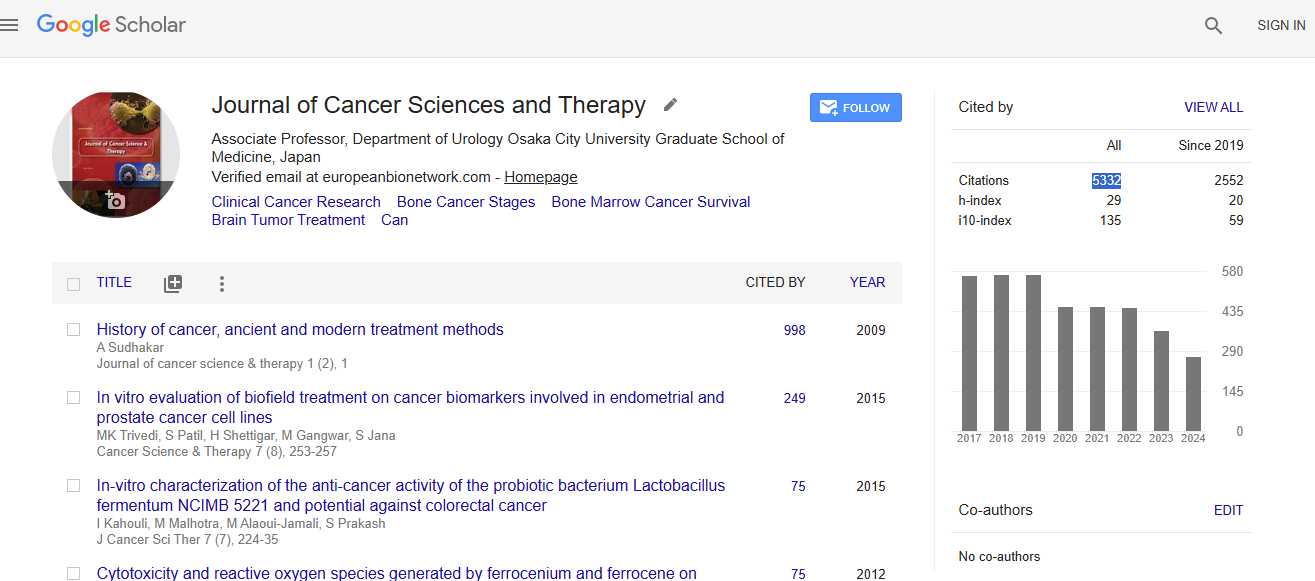
Cancer Science & Therapy received 5332 citations as per Google Scholar report