Perspective - (2025) Volume 10, Issue 4
Received: 01-Aug-2025, Manuscript No. jomp-26-185102;
Editor assigned: 04-Aug-2025, Pre QC No. P-185102;
Reviewed: 18-Aug-2025, QC No. Q-185102;
Revised: 22-Aug-2025, Manuscript No. R-185102;
Published:
29-Aug-2025
, DOI: 10.37421/2576-3857.2025.10.319
Citation: Fernandez, Gabriela. ”Glioma Oncolytic Virus Therapy: Preclinical Promise Advances.” J Oncol Med and Pract 10 (2025):319.
Copyright: © 2025 Fernandez G. This is an open-access article distributed under the terms of the Creative Commons Attribution License, which permits unrestricted use, distribution and reproduction in any medium, provided the original author and source are credited.
Preclinical research into oncolytic virus therapy for glioma is demonstrating considerable promise, driven by advancements in viral vector design, delivery methodologies, and the strategic application of combinatorial approaches. Recent investigations have illuminated the potential of engineered oncolytic viruses to selectively target and induce lysis of glioma cells, concurrently stimulating anti-tumor immune responses. Novel viral platforms are actively being developed to enhance tumor tropism and overcome the inherent immunosuppressive tumor microenvironment characteristic of gliomas. The combination of oncolytic viruses with other therapeutic modalities, such as immunotherapy and chemotherapy, has shown synergistic effects in preclinical models, suggesting a pathway toward improved clinical outcomes [1].
This review offers a comprehensive overview of the progress in developing oncolytic viruses for brain tumors, with a particular focus on overcoming significant challenges like the blood-brain barrier and the complex tumor microenvironment. It delves into a variety of viral agents, including adenoviruses, herpes simplex viruses, and reoviruses, along with their modifications designed to enhance efficacy. The article further explores emerging strategies, such as employing oncolytic viruses to deliver therapeutic payloads like cytokines or immune checkpoint inhibitors, with the aim of bolstering anti-tumor immunity. The integration of gene editing technologies is also being pursued to further refine viral tropism and safety profiles [2].
The development of genetically engineered oncolytic adenoviruses for glioma treatment represents a critical area of ongoing research. This work specifically examines the genetic modifications implemented in adenoviruses to amplify their capacity to target glioma cells, replicate effectively within them, and ultimately induce cell death. Moreover, it elaborates on strategies designed to bolster the immunogenicity of these viruses, with the objective of eliciting a robust host immune response against any residual tumor cells. The inherent potential of adenoviruses to serve as vectors for delivering therapeutic genes is also emphasized within this context [3].
A study has investigated the preclinical efficacy of a novel oncolytic herpes simplex virus (oHSV) that has been engineered to express a specific cytokine. The research findings indicate that this modified oHSV exhibits augmented oncolytic activity against glioma cell lines and leads to improved survival rates in preclinical models of glioblastoma. The study also explored the immunomodulatory effects of the delivered cytokine, proposing a dual mechanism of action that encompasses direct viral lysis and T-cell mediated anti-tumor immunity. Importantly, the research also addresses challenges associated with viral delivery and spread within the brain [4].
The combination of oncolytic viruses with immune checkpoint inhibitors (ICIs) emerges as a highly promising strategy for effectively counteracting the immunosuppressive tumor microenvironment commonly found in gliomas. This paper provides a review of preclinical data that substantiates the synergistic effects observed when these two modalities are used together. Oncolytic viruses have the capacity to induce immunogenic cell death, thereby releasing tumor antigens and activating anti-tumor immune responses. These responses can then be further amplified by ICIs, which work to block immune evasion mechanisms, ultimately enhancing the overall anti-tumor effect. The article also considers the practical challenges and future prospects for translating this combined therapeutic approach into clinical practice [5].
This research is dedicated to enhancing the delivery of oncolytic viruses specifically to brain tumors. It examines a range of strategies, including convection-enhanced delivery (CED) and the utilization of engineered viral vectors designed with improved tumor-homing capabilities. The study presents preclinical findings that conclusively demonstrate how optimized delivery methods can significantly increase viral penetration and concentration within the tumor site, leading to more potent oncolysis and improved therapeutic outcomes. Furthermore, the article discusses the potential utility of exosome-mediated delivery for oncolytic viruses [6].
The critical role of the tumor microenvironment (TME) in impeding the efficacy of oncolytic virus therapy for glioma is a central theme in current investigations. This article scrutinizes the immunosuppressive elements present within the glioma TME, such as myeloid-derived suppressor cells and regulatory T cells, and analyzes their detrimental impact on viral therapy outcomes. It further discusses various approaches, including the engineering of oncolytic viruses or their combination with other therapeutic agents, aimed at reprogramming the TME to become more receptive to viral replication and immune-mediated tumor destruction. This work strongly underscores the imperative of comprehending and effectively manipulating the TME for the successful implementation of oncolytic virotherapy [7].
This preclinical study was designed to evaluate the safety and therapeutic efficacy of a novel oncolytic reovirus intended for the treatment of gliomas. The research findings confirm that the reovirus possesses the ability to selectively infect and replicate within glioma cells, resulting in tumor regression observed in animal models. The study also conducted an investigation into the immune response elicited against both the virus and the tumor, indicating that reovirus therapy can induce both direct oncolytic effects and indirect anti-tumor immunity. Considerations regarding viral shedding and potential neurotoxicity were also carefully examined [8].
The application of modified oncolytic viruses to deliver therapeutic payloads, such as suicide genes or immune-stimulating agents, signifies a major stride forward in oncolytic virotherapy for glioma. This article provides a review of the preclinical development of these 'armed' oncolytic viruses. It elaborates on how the viral vector can be genetically engineered to express specific therapeutic molecules directly within tumor cells, thereby amplifying tumor cell killing and effectively modulating the host immune response. The review highlights the substantial potential of these advanced viral platforms to enhance treatment efficacy and successfully surmount common resistance mechanisms [9].
This study delves into the therapeutic potential of oncolytic vaccinia viruses for the treatment of glioma. The research is specifically focused on engineering vaccinia virus strains that exhibit improved tumor specificity and enhanced oncolytic activity. The preclinical data presented robustly demonstrate that these modified viruses are capable of effectively lysing glioma cells both in vitro and in vivo, while also maintaining a favorable safety profile. The article additionally discusses the inherent immunomodulatory properties of vaccinia viruses and their capacity to prime the immune system against the tumor, positioning this as a highly promising avenue for glioma therapy [10].
Preclinical research on oncolytic virus therapy for glioma is showing significant promise, with advancements in viral vector design, delivery methods, and combinatorial approaches. Recent studies highlight the potential of engineered oncolytic viruses to selectively infect and lyse glioma cells, while also stimulating anti-tumor immune responses. Novel viral platforms are being developed to enhance tumor tropism and overcome the immunosuppressive tumor microenvironment characteristic of gliomas. Combinations with other therapeutic modalities, such as immunotherapy and chemotherapy, are demonstrating synergistic effects in preclinical models, paving the way for improved clinical outcomes [1].
This review details the progress in developing oncolytic viruses for brain tumors, focusing on challenges like the blood-brain barrier and the tumor microenvironment. It explores various viral agents, including adenoviruses, herpes simplex viruses, and reoviruses, and their modifications to improve efficacy. The article also discusses emerging strategies such as using oncolytic viruses to deliver therapeutic payloads, like cytokines or immune checkpoint inhibitors, to enhance anti-tumor immunity. Gene editing technologies are also being integrated to further refine viral tropism and safety profiles [2].
The development of engineered oncolytic adenoviruses for glioma treatment is a key area of research. This work examines the genetic modifications made to adenoviruses to enhance their ability to target glioma cells, replicate within them, and induce cell death. Furthermore, it discusses strategies to improve the immunogenicity of these viruses, aiming to elicit a robust host immune response against residual tumor cells. The potential for adenoviruses to act as vectors for delivering therapeutic genes is also highlighted [3].
This study investigates the preclinical efficacy of a novel oncolytic herpes simplex virus (oHSV) engineered to express a cytokine. The research demonstrates that the modified oHSV exhibits enhanced oncolytic activity against glioma cell lines and improves survival in preclinical models of glioblastoma. The study also explores the immunomodulatory effects of the delivered cytokine, suggesting a dual mechanism of action that combines direct viral lysis with T-cell mediated anti-tumor immunity. Challenges related to viral delivery and spread within the brain are also addressed [4].
The combination of oncolytic viruses and immune checkpoint inhibitors (ICIs) is a promising strategy for overcoming the immunosuppressive tumor microenvironment in gliomas. This paper reviews preclinical data supporting the synergistic effects of this combination. Oncolytic viruses can induce immunogenic cell death, releasing tumor antigens and activating anti-tumor immune responses, which can then be further enhanced by ICIs to block immune evasion mechanisms. The article also discusses the challenges and future directions for translating this combined approach into clinical practice [5].
This research focuses on improving the delivery of oncolytic viruses to brain tumors. It explores various strategies, including convection-enhanced delivery (CED) and engineered viral vectors with enhanced tumor-homing capabilities. The study presents preclinical findings demonstrating that improved delivery methods can significantly increase viral penetration and concentration within the tumor, leading to enhanced oncolysis and improved therapeutic outcomes. The article also discusses the potential of exosome-mediated delivery for oncolytic viruses [6].
The role of the tumor microenvironment (TME) in limiting oncolytic virus efficacy for glioma is a critical area of investigation. This article examines the immunosuppressive components of the glioma TME, such as myeloid-derived suppressor cells and regulatory T cells, and their impact on viral therapy. It discusses how oncolytic viruses can be engineered or combined with other agents to reprogram the TME, rendering it more permissive to viral replication and immune-mediated tumor destruction. This work underscores the importance of understanding and manipulating the TME for successful oncolytic virotherapy [7].
This preclinical study evaluates the safety and efficacy of a novel oncolytic reovirus for treating gliomas. The research demonstrates that the reovirus can selectively infect and replicate in glioma cells, leading to tumor regression in animal models. The study also investigates the immune response generated against the virus and the tumor, suggesting that reovirus therapy can elicit both direct oncolytic effects and indirect anti-tumor immunity. Challenges related to viral shedding and potential neurotoxicity are also considered [8].
The use of modified oncolytic viruses to deliver therapeutic payloads, such as suicide genes or immune-stimulating agents, represents a significant advancement in oncolytic virotherapy for glioma. This article reviews the preclinical development of these 'armed' oncolytic viruses. It discusses how the viral vector can be engineered to express specific therapeutic molecules within tumor cells, thereby enhancing tumor cell killing and modulating the host immune response. The review highlights the potential for these advanced viral platforms to improve treatment efficacy and overcome resistance mechanisms [9].
This study explores the potential of oncolytic vaccinia viruses for treating glioma. The research focuses on engineering vaccinia virus strains with enhanced tumor specificity and oncolytic activity. Preclinical data presented demonstrate that these modified viruses can effectively lyse glioma cells in vitro and in vivo, while exhibiting a favorable safety profile. The article also discusses the immunomodulatory properties of vaccinia viruses and their potential to prime the immune system against the tumor, highlighting this as a promising avenue for glioma therapy [10].
Oncolytic virus therapy for glioma shows significant preclinical promise, with advancements in viral vector design, delivery, and combinatorial strategies. Engineered viruses can selectively target and lyse glioma cells while stimulating anti-tumor immunity. Novel platforms aim to enhance tumor tropism and overcome the immunosuppressive tumor microenvironment. Combinations with immunotherapy and chemotherapy demonstrate synergistic effects. Challenges such as the blood-brain barrier and tumor microenvironment are being addressed through various viral agents like adenoviruses, herpes simplex viruses, and reoviruses, alongside gene editing. Strategies include using viruses to deliver therapeutic payloads and combining them with immune checkpoint inhibitors. Improved delivery methods, like convection-enhanced delivery and exosome-mediated delivery, are crucial. Oncolytic viruses can reprogram the tumor microenvironment and elicit both direct oncolytic effects and indirect anti-tumor immunity. Modified viruses for delivering suicide genes or immune-stimulating agents, and oncolytic vaccinia viruses, represent further promising avenues for enhancing treatment efficacy and overcoming resistance mechanisms in glioma therapy.
None
None
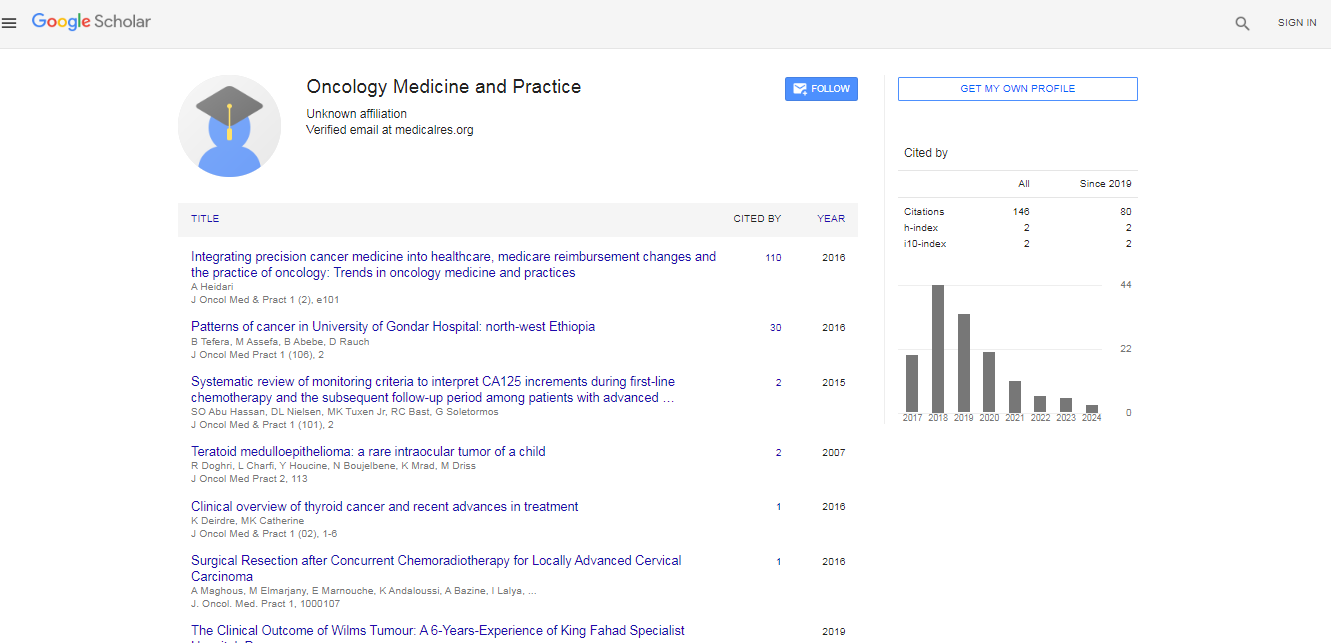
Journal of Oncology Medicine & Practice received 142 citations as per Google Scholar report