Commentary - (2025) Volume 16, Issue 2
Received: 01-May-2025, Manuscript No. hgec-25-174723;
Editor assigned: 05-May-2025, Pre QC No. P-174723;
Reviewed: 19-May-2025, QC No. Q-174723;
Revised: 22-May-2025, Manuscript No. R-174723;
Published:
29-May-2025
, DOI: 10.37421/2161-0436.2025.16.279
Citation: Moretti, Liana. ”Genomics: From HGP to Personalized Medicine.” Human Genet Embryol 16 (2025):279.
Copyright: © 2025 Moretti L. This is an open-access article distributed under the terms of the Creative Commons Attribution License, which permits unrestricted use, distribution and reproduction in any medium, provided the original author and source are credited.
The Human Genome Project's 30-year journey has fundamentally reshaped biomedical research and medicine. This review reflects on the project's lasting impact, highlighting how its principles of open science and public data have fostered global collaborations. It also explores the ongoing challenges and opportunities in genomics, particularly in integrating genomic medicine into routine healthcare and addressing societal implications like equitable access and data privacy[1].
The ongoing evolution in understanding human genetics includes the development of a pangenome reference. This significant advance captures a more comprehensive view of human genetic variation compared to the traditional linear reference genome. By integrating sequences from a diverse group of individuals, this new resource uncovers extensive structural variation and greatly improves mapping accuracy, especially in highly polymorphic regions. It marks a pivotal stride towards fully understanding the spectrum of human genetic diversity and its implications for various diseases[2].
Whole-genome sequencing is transforming how rare diseases are diagnosed. Researchers are actively exploring its effectiveness in pinpointing genetic causes in patients suspected of having Mendelian disorders, particularly when standard genetic tests haven't provided answers. Findings consistently highlight the diagnostic yield and underscore the critical role of reanalyzing genomic data as new genetic associations come to light. This process emphasizes the clinical utility of whole-genome sequencing and its potential to guide personalized treatment strategies[3].
Advancements in sequencing technologies, specifically long-read sequencing, are becoming indispensable for resolving complex genomic regions. These technologies excel at identifying structural variations that short-read methods frequently miss. Articles detail the progress in long-read platforms, such as PacBio HiFi and Oxford Nanopore, and their expanding applications. They are proving vital for identifying disease-causing variants, thoroughly studying repetitive elements, and enhancing genome assemblies, thereby offering a more complete picture of genetic alterations[4].
Here's the thing about structural variants: they represent a major source of genetic diversity and a frequent cause of human disease. Yet, their comprehensive detection remains a significant challenge. Recent discussions in the field focus on the latest methodologies for identifying these variants, including ongoing advancements in sequencing technologies and sophisticated computational tools. The importance of accurate structural variant detection is clear for understanding disease etiology, especially in conditions like neurodevelopmental disorders and congenital anomalies, and for improving overall diagnostics[7].
Another area gaining new understanding is somatic mosaicism, where an individual possesses two or more genetically distinct cell populations. This phenomenon is now recognized as a substantial contributor to human disease and development. Reviews highlight recent progress in both detecting and characterizing somatic mosaic variants across a variety of tissues. They delve into the role these variants play in conditions such as cancer, neurodevelopmental disorders, and even the nuances of healthy aging, emphasizing the dynamic nature of the human genome beyond just germline inheritance[6].
Pharmacogenomics, the study of how an individual's genes influence their response to drugs, is increasingly a core component of personalized medicine. Reviews in this area explore the current landscape of pharmacogenomic testing and its practical application in optimizing drug therapy. This includes reducing adverse drug reactions and enhancing treatment efficacy across a wide range of medical specialties. The field actively discusses the challenges and opportunities involved in its widespread implementation within clinical practice, signaling a shift towards more tailored medical interventions[8].
Single-cell genomics is providing an unprecedented level of resolution for studying cellular heterogeneity within complex tissues. This new approach offers deep insights into disease mechanisms and fundamental developmental processes. Articles in this domain detail advancements in single-cell DNA and RNA sequencing, underscoring their applications in fields like oncology, immunology, and neurobiology. The scientific community is also grappling with the computational challenges and charting future directions for effectively integrating multi-omics data at a single-cell resolution, pushing the boundaries of biological discovery[9].
Large-scale population genome sequencing initiatives are generating vast datasets that are poised to transform our understanding of human health and disease. Perspectives on this topic examine the profound impact of projects such as the UK Biobank and All of Us. These initiatives are instrumental in identifying genetic risk factors, discovering new drug targets, and developing predictive models for complex diseases. They also critically address the significant logistical and computational hurdles involved in managing and analyzing such enormous genomic information, reflecting a concerted effort to harness this data for public health[10].
What this really means is that as genomic medicine becomes more widespread, the ethical, legal, and social implications rise in critical importance. This discussion addresses key issues like informed consent, the intricacies of data sharing, privacy concerns, and the potential for discrimination that can arise from genomic information. There's a strong call for robust policy frameworks and continuous public engagement to ensure the responsible and equitable integration of genomics into both healthcare systems and broader society, safeguarding individuals while advancing science[5].
Genomics has undergone a profound transformation, significantly reshaping biomedical research and clinical medicine. The Human Genome Project, for instance, established foundational principles of open science and public data sharing, fostering global collaborations and laying the groundwork for current advancements [1]. A key evolution beyond the initial linear reference genome involves the creation of a pangenome reference. This new resource provides a far more comprehensive view of human genetic variation, incorporating diverse individual sequences to reveal extensive structural variations and enhance mapping accuracy in complex genomic regions [2]. These advances are crucial for a complete understanding of human genetic diversity and its implications for disease.
Whole-genome sequencing (WGS) is revolutionizing the diagnosis of rare diseases. It has proven highly effective in identifying genetic causes in patients with suspected Mendelian disorders, particularly in challenging cases where conventional genetic tests have failed to provide answers. The process highlights the significant diagnostic yield and the ongoing necessity of reanalyzing genomic data as new genetic associations are continuously discovered. This approach offers substantial clinical utility, guiding personalized treatment strategies [3]. Furthermore, long-read sequencing technologies, like PacBio HiFi and Oxford Nanopore, are increasingly vital for resolving complex genomic regions, especially structural variations often overlooked by shorter read methods. These technologies expand our capacity to identify disease-causing variants, study repetitive elements, and improve genome assemblies, creating a more detailed picture of genetic alterations [4].
Here's the thing, structural variants (SVs) are a major source of genetic diversity and a common cause of human disease. Despite their importance, their comprehensive detection remains a significant challenge. Current research focuses on improving methodologies for identifying SVs, leveraging advanced sequencing and computational tools to better understand their role in disease etiology, particularly in neurodevelopmental disorders and congenital anomalies [7]. Another critical area of insight is somatic mosaicism, where individuals harbor genetically distinct cell populations. This phenomenon is now recognized as a significant contributor to human disease and development. Recent advances enable better detection and characterization of somatic mosaic variants across various tissues, revealing their involvement in conditions such as cancer, neurodevelopmental disorders, and even the aging process, highlighting the dynamic nature of the human genome beyond germline inheritance [6].
Pharmacogenomics, the study of how genes influence drug response, is central to personalized medicine. This field explores current testing landscapes and its application in optimizing drug therapy, aiming to reduce adverse reactions and enhance treatment efficacy across medical specialties. It confronts the challenges and opportunities for broad clinical implementation [8]. At a finer resolution, single-cell genomics provides unprecedented insight into cellular heterogeneity within complex tissues. It reveals disease mechanisms and developmental processes through advancements in single-cell DNA and RNA sequencing, with applications spanning oncology, immunology, and neurobiology. The integration of multi-omics data at this resolution presents both computational challenges and exciting future directions [9]. On a larger scale, population-scale genome sequencing initiatives, such as the UK Biobank and All of Us, are generating immense datasets. These projects are pivotal for identifying genetic risk factors, drug targets, and developing predictive models for complex diseases. They also tackle the immense logistical and computational challenges of managing and analyzing such vast genomic information, promising to revolutionize public health [10].
As genomic medicine continues its expansion, the ethical, legal, and social implications become increasingly vital. This involves addressing crucial issues related to consent, data sharing protocols, privacy safeguards, and preventing potential discrimination stemming from genomic information. There is an ongoing advocacy for robust policy frameworks and continuous public engagement to ensure the responsible and equitable integration of genomics into healthcare and society at large [5].
The Human Genome Project significantly transformed biomedical research and medicine, advocating for open science and global collaboration, which continues to influence the field today. A critical step forward involves capturing a more complete view of human genetic variation through pangenome references, revealing extensive structural variations and improving mapping accuracy. This enhanced understanding directly impacts the diagnosis of rare diseases, where whole-genome sequencing is proving effective in identifying genetic causes, particularly in complex cases where standard tests fail. Reanalysis of genomic data remains crucial as new associations emerge, guiding personalized treatment strategies. Innovations in long-read sequencing technologies are essential for resolving intricate genomic regions and structural variations often missed by traditional methods, offering a more complete picture of genetic alterations. The detection of structural variants and somatic mosaicism, now recognized as key contributors to disease and development, benefits greatly from these advancements. Beyond diagnostics, pharmacogenomics integrates genetic insights to optimize drug therapy, reducing adverse reactions and boosting treatment efficacy, moving us closer to personalized medicine. As genomics integrates into healthcare, addressing ethical, legal, and social implicationsâ??like consent, data privacy, and equitable accessâ??becomes increasingly important for its responsible deployment. Population-scale genome sequencing initiatives are further revolutionizing our grasp of health and disease by identifying genetic risk factors and developing predictive models for complex conditions, despite inherent logistical and computational challenges. Single-cell genomics offers unprecedented resolution to study cellular heterogeneity, providing insights into disease mechanisms across various tissues.
None
None
Indexed at, Google Scholar, Crossref
Indexed at, Google Scholar, Crossref
Indexed at, Google Scholar, Crossref
Indexed at, Google Scholar, Crossref
Indexed at, Google Scholar, Crossref
Indexed at, Google Scholar, Crossref
Indexed at, Google Scholar, Crossref
Indexed at, Google Scholar, Crossref
Indexed at, Google Scholar, Crossref
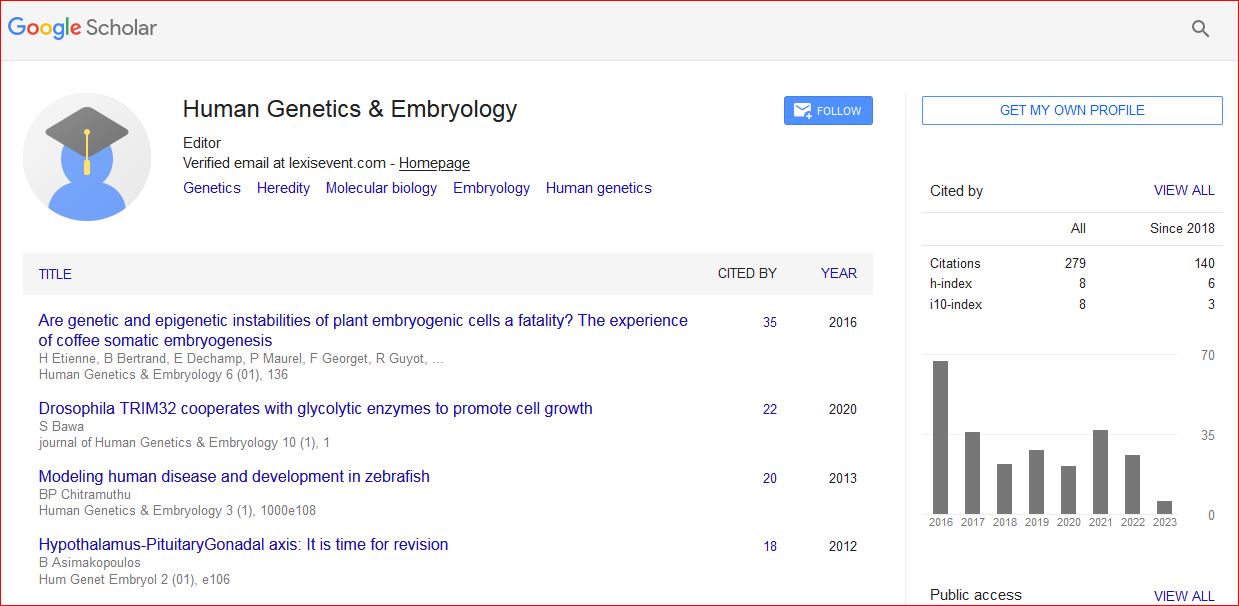
Human Genetics & Embryology received 309 citations as per Google Scholar report