Brief Report - (2025) Volume 13, Issue 2
Received: 01-Apr-2025, Manuscript No. jpgeb-25-157465;
Editor assigned: 03-Apr-2025, Pre QC No. P-157465;
Reviewed: 17-Apr-2025, QC No. Q-157465;
Revised: 22-Apr-2025, Manuscript No. R-157465;
Published:
29-Apr-2025
, DOI: 10.37421/2329-9002.2025.13.364
Citation: OâBrien, Michael. âGenomic Selection: Accelerating Sustainable Agricultural Breeding.â J Phylogenetics Evol Biol 13 (2025):364.
Copyright: © 2025 OâBrien M. This is an open-access article distributed under the terms of the Creative Commons Attribution License, which permits unrestricted use,
distribution and reproduction in any medium, provided the original author and source are credited.
Genomic selection represents a significant advancement in modern breeding, offering a powerful approach to accelerate genetic gain across a wide array of species, vital for global food security and sustainable agricultural practices. This methodology involves using molecular markers distributed across an organism's entire genome to predict an individual's breeding value, thereby streamlining the selection process and dramatically increasing the rate of genetic improvement for complex traits[1].
While immensely promising, the implementation of genomic selection faces certain hurdles, including high genotyping costs and the necessity for robust reference populations[1].
The trajectory of genomic selection in livestock illustrates remarkable progress, evolving from initial theoretical models to widespread practical application[2].
This advancement has revolutionized animal breeding by notably increasing the rate of genetic improvement for complex characteristics[2].
In dairy cattle breeding, specifically, the integration of genomic selection has fundamentally transformed the industry, leading to faster genetic progress in milk production, health traits, and reproductive efficiency[5].
Its success stems from the rapid identification of superior young animals and the reduction of the generation interval, promising continued improvements[5].
More broadly, genomic selection has significantly impacted livestock breeding by providing a more efficient way to select for desirable traits, encompassing production, health, and welfare characteristics[9].
Future perspectives for livestock involve the application of new genotyping technologies and advanced statistical models to further broaden its utility and impact across various livestock species[9].
Beyond traditional livestock, genomic selection extends its revolutionary impact to other crucial sectors. Applying this method to forest trees, which are long-lived perennial crops, offers unique advantages by shortening breeding cycles and improving selection accuracy for critical traits such as growth and wood quality[3].
Recent advancements, particularly in statistical models and phenotyping, are making this a viable and impactful strategy for sustainable forestry[3].
In maize breeding, genomic selection has transcended theoretical models to practical applications, driving significant genetic improvements[6].
It efficiently selects for complex traits like yield and disease resistance, with future advancements likely involving larger training populations and the integration of phenomic data for even greater accuracy[6].
Similarly, genomic selection is proving to be a game-changer in aquaculture, particularly for improving disease resistance and growth rates in farmed species[7].
This approach helps breeders make more informed decisions earlier in the breeding cycle, leading to healthier, more productive fish and shellfish populations, which is vital for sustainable seafood production[7].
Enhancing the accuracy of genomic prediction is crucial for the continued success of genomic selection, particularly in plant breeding[8].
Integrating multi-omic data, such as transcriptomics and metabolomics, alongside genomics provides a more comprehensive understanding of complex traits, leading to more precise and effective selection decisions[8].
Furthermore, the development and refinement of statistical models are central to the effectiveness of genomic selection[10].
Researchers are continuously working on new models that better account for complex genetic architectures, environmental interactions, and population structures, which in turn leads to more accurate genomic breeding values and improved selection outcomes[10].
The synergy between genomic selection and gene editing represents another powerful avenue for accelerating genetic gain, particularly in livestock[4].
Genomic selection provides the framework for efficiently identifying superior animals, while gene editing allows for precise modifications of specific genes, offering a complementary approach to targeted breeding improvements[4].
Looking ahead, the future of genomic selection hinges on integrating these new technologies and continuously expanding reference populations across all applied domains[2].
These concerted efforts promise to solidify genomic selectionâ??s role as an indispensable tool for advancing genetic progress and ensuring agricultural resilience.
Genomic selection fundamentally transforms breeding by leveraging molecular markers across an organism's genome to accurately predict an individual's breeding value, thereby significantly accelerating the selection process[1]. This method streamlines the development of improved varieties and breeds, leading to faster genetic gain for complex traits across diverse species[1, 2]. While promising for various agricultural applications, its implementation does face practical hurdles such as high genotyping costs and the critical need for robust reference populations to ensure reliable predictions[1].
In the realm of livestock, genomic selection has charted a remarkable evolutionary path from initial theoretical frameworks to widespread practical adoption, fundamentally reshaping animal breeding practices[2]. It has drastically increased the pace of genetic improvement for traits that were historically difficult to select for due to their complexity[2]. For instance, in dairy cattle, the integration of genomic selection has been a game-changer, fostering accelerated genetic progress in key areas such as milk production, overall animal health, and reproductive efficiency[5]. This success is largely attributable to its capacity for quickly identifying superior young animals and substantially reducing the generation interval, which sets the stage for continuous improvements within the industry[5]. The impact extends beyond dairy, with genomic selection broadly influencing livestock breeding by offering a more efficient mechanism for selecting desirable production, health, and welfare characteristics[9]. When combined with gene editing, genomic selection provides a powerful, complementary approach to achieve precise and targeted breeding improvements by first identifying superior animals and then making specific genetic modifications[4].
The benefits of genomic selection are not confined to animals but also significantly impact plant breeding and aquaculture. In maize breeding, genomic selection has moved beyond theoretical models into practical applications, generating substantial genetic improvements for traits like yield and disease resistance[6]. Future advancements here are expected to integrate larger training populations and phenomic data for even greater accuracy[6]. For forest trees, which are long-lived perennial crops with extended breeding cycles, genomic selection presents unique advantages, dramatically shortening these cycles and enhancing selection accuracy for vital traits such as growth and wood quality[3]. Recent progress in statistical modeling and phenotyping techniques is making this a highly viable and impactful strategy for sustainable forestry[3]. Similarly, aquaculture is experiencing a revolution through genomic selection, especially in boosting disease resistance and growth rates in farmed fish and shellfish[7]. This enables breeders to make more informed and earlier decisions in the breeding cycle, leading to healthier, more productive aquatic populations, which is critical for sustainable seafood production[7].
A key aspect of ensuring the ongoing success and broad applicability of genomic selection lies in continually enhancing its predictive accuracy. For plant breeding, this involves the integration of multi-omic dataâ??including transcriptomics and metabolomicsâ??alongside genomic information[8]. This comprehensive approach allows for a deeper understanding of complex traits, leading to more precise and effective selection decisions[8]. Central to the efficacy of genomic selection is also the continuous development and refinement of its underlying statistical models[10]. Researchers are actively engaged in creating new models that can better account for intricate genetic architectures, environmental interactions, and population structures, all of which contribute to more accurate genomic breeding values and ultimately, superior selection outcomes[10].
Looking forward, the future trajectory of genomic selection across all fields will heavily rely on the seamless integration of new technologies and the expansion of robust reference populations[2]. These ongoing efforts are poised to broaden its utility and impact across various species, ensuring that genetic gains continue to accelerate, thereby underpinning food security and fostering sustainable agricultural practices globally. The combined power of advanced genotyping, sophisticated statistical tools, and synergistic technologies like gene editing positions genomic selection as an indispensable driver of progress in modern biology and agriculture.
Genomic selection has become a transformative tool in accelerating breeding efforts across various agricultural sectors. This technique uses molecular markers to predict an individual's breeding value, significantly streamlining the selection process and boosting genetic improvement rates for complex traits. In plant breeding, it's crucial for enhancing disease resistance, contributing to food security, and optimizing traits in crops like maize. For long-lived perennial crops such as forest trees, genomic selection shortens breeding cycles and improves accuracy for growth and wood quality traits. In the livestock industry, genomic selection has shown remarkable progress, driving genetic gains in areas like milk production, health, and reproductive efficiency in dairy cattle. It enables the rapid identification of superior young animals and reduces the generation interval. Beyond dairy, it generally enhances desirable traits across various livestock species, and its utility is further expanded when combined with gene editing for precise genetic modifications. Aquaculture also benefits immensely, with improved disease resistance and growth rates in farmed species, leading to healthier and more productive seafood populations. However, implementing genomic selection is not without its challenges. High genotyping costs and the need for robust reference populations are key hurdles. To overcome these, advancements are focusing on integrating multi-omic data like transcriptomics and metabolomics to improve prediction accuracy, alongside the continuous development and refinement of sophisticated statistical models that account for complex genetic architectures. The ongoing evolution of genomic selection, through technological integration and expanded reference populations, holds immense promise for sustainable agricultural development.
None
None
1. Montes-Chavez, MA, Del RMA, De LJRC. "Genomic selection in breeding for disease resistance: Promises and challenges".Front Plant Sci 13 (2022):956740.
Indexed at, Google Scholar, Crossref
2. Rosa, FS, Lima, VLSD, Bezerra, HGPL. "Genomic selection in livestock: the past, present, and future".Genet Mol Biol 46 (2023):e20220245.
Indexed at, Google Scholar, Crossref
3. Singh, PA, Singh, VP, Tripathi, MK. "Genomic selection for quantitative traits in forest trees: Recent advances and prospects".Plant Biotechnol Rep 17 (2023):909-923.
Indexed at, Google Scholar, Crossref
4. Hickey, JM, O'Connor, DJP, Hayes, AM. "Genomic selection and gene editing: complementary tools for enhancing genetic gain in livestock".Front Genet 14 (2023):1118247.
Indexed at, Google Scholar, Crossref
5. Karim, MA, Zhang, G, Hu, X. "Genomic selection in dairy cattle: a review of current status and future prospects".J Anim Sci Biotechnol 13 (2022):120.
Indexed at, Google Scholar, Crossref
6. Limas VPH, Ochoa RN, Limas VK. "Genomic selection in maize: present and future".Front Plant Sci 12 (2021):660161.
Indexed at, Google Scholar, Crossref
7. Ferrando, ER, Alvarez, GC, Dieguez, A. "Genomic selection in aquaculture: a review of recent progress and future challenges".Rev Aquacult 15 (2023):1-18.
Indexed at, Google Scholar, Crossref
8. Kang, Z, Long, A, Zhou, N. "Enhancing genomic prediction accuracy in plant breeding through integration of multi-omic data".Front Plant Sci 14 (2023):1119565.
Indexed at, Google Scholar, Crossref
9. Nath, RS, Shete, SN, Kale, HK. "Genomic selection in livestock: Applications and future perspectives".J Anim Sci Biotechnol 13 (2022):115.
Indexed at, Google Scholar, Crossref
10. Vazquez, JA, Al-Sabri, SS, Al-Habsi, AH. "Statistical models for genomic selection: a review".J Anim Breed Genet 139 (2022):125-139.
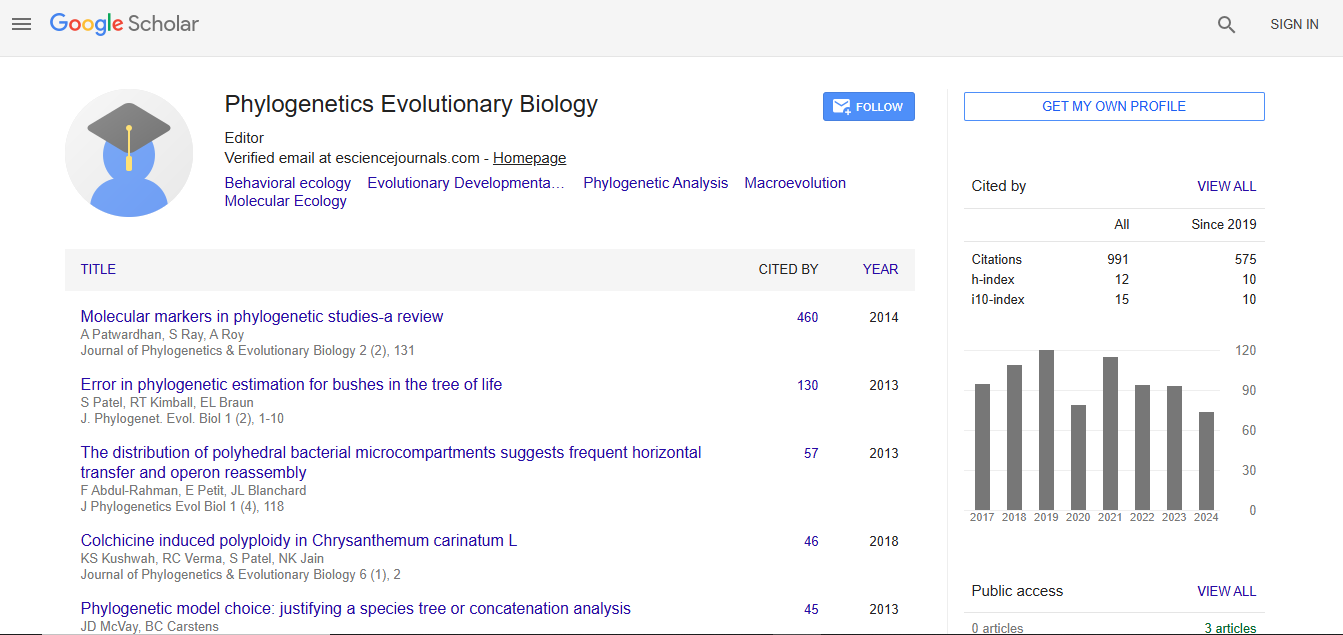
Journal of Phylogenetics & Evolutionary Biology received 911 citations as per Google Scholar report