Brief Report - (2025) Volume 13, Issue 3
Received: 01-Jun-2025, Manuscript No. JCMG-26-185535;
Editor assigned: 03-Jun-2025, Pre QC No. P-185535;
Reviewed: 17-Jun-2025, QC No. Q-185535;
Revised: 23-Jun-2025, Manuscript No. R185535;
Published:
30-Jun-2025
, DOI: 10.37421/2472-128X.2025.13.338
Citation: Ruiz, Alejandro. ”Genomic Medicine: Personalizing Health Through Genes.” J Clin Med Genomics 13 (2025):338.
Copyright: © 2025 Ruiz A. This is an open-access article distributed under the terms of the Creative Commons Attribution License, which permits unrestricted use, distribution and reproduction in any medium, provided the original author and source are credited.
Genomic medicine is fundamentally reshaping the landscape of healthcare by integrating an individual's unique genetic blueprint into the intricate process of clinical decision-making [1].
This paradigm shift facilitates a move away from generalized treatment approaches towards highly personalized strategies for risk assessment, diagnosis, and therapeutic interventions. Pharmacogenomics exemplifies this personalized approach by enabling clinicians to select and adjust drug dosages based on a patient's genetic makeup, thereby optimizing treatment efficacy and minimizing the likelihood of adverse drug reactions [1].
Progress in DNA sequencing technologies and sophisticated data analysis methods is increasingly making complex genomic insights accessible and actionable across a broad spectrum of diseases, ranging from rare genetic disorders to common multifactorial conditions such as cancer and cardiovascular disease [1].
The application of genomic profiling in oncology has become a critical driver for the development and implementation of targeted therapies [2].
By identifying specific genetic mutations or distinct gene expression patterns within tumors, clinicians can now choose treatments with a higher probability of success for individual patients, leading to improved outcomes and reduced exposure to ineffective or toxic treatments [2].
This precise diagnostic and therapeutic approach also extends to cancer prevention and early detection, particularly through germline genetic testing that identifies inherited predispositions to certain cancers [2].
A pivotal step towards the widespread clinical integration of genomic data involves its seamless incorporation into electronic health records (EHRs) [3].
Addressing challenges related to standardizing genomic data formats, developing robust clinical decision support systems, and safeguarding patient privacy are paramount for successful implementation [3].
The effective embedding of genomic information within EHRs fosters continuous learning and application, ensuring that valuable genetic insights are readily available at the point of care [3].
Rare diseases, frequently stemming from defects in single genes, represent a significant area where genomic sequencing has achieved transformative diagnostic success [4].
Techniques like whole-exome and whole-genome sequencing can efficiently pinpoint the causative genetic variants, leading to accurate diagnoses for individuals who have often undergone extensive and protracted diagnostic journeys [4].
This timely identification of the underlying genetic cause is crucial for initiating appropriate management strategies, providing essential genetic counseling, and offering opportunities for participation in relevant clinical trials [4].
Pharmacogenomics stands as a foundational pillar of personalized medicine, offering the capability to predict a patient's likely response to specific medications based on their individual genetic profile [5].
By identifying genetic variations that influence drug metabolism, transport, or interaction with molecular targets, clinicians can precisely tailor drug selections and dosages, thereby enhancing therapeutic effectiveness and mitigating the risk of adverse drug reactions [5].
This is especially vital for medications that possess narrow therapeutic windows or exhibit substantial variability in patient response [5].
The ethical, legal, and social implications (ELSI) of genomic medicine are profound and necessitate meticulous consideration as the field advances [6].
Key issues encompassing data privacy, the potential for genetic discrimination, the nuances of obtaining informed consent, and ensuring equitable access to sophisticated genomic technologies must be proactively addressed to foster responsible adoption and utilization [6].
Sustained dialogue among stakeholders and the establishment of comprehensive policy frameworks are indispensable for effectively navigating these complex challenges and ensuring equitable benefits [6].
The prediction of an individual's susceptibility to common complex diseases, including but not limited to heart disease, diabetes, and various forms of cancer, is an evolving frontier within genomic medicine [7].
Polygenic risk scores (PRS), which systematically aggregate the cumulative effects of numerous common genetic variants, are demonstrating considerable promise in identifying individuals who may be at an elevated risk for developing these conditions [7].
This predictive information can serve as a crucial catalyst for informing personalized lifestyle modifications and tailoring screening strategies to optimize preventative care [7].
The relentless pace of advancement in sequencing technologies, encompassing next-generation sequencing (NGS) and single-cell genomics, is continuously expanding the scope, depth, and affordability of genomic analysis [8].
These technological breakthroughs are indispensable for the scalable and widespread implementation of genomic medicine, paving the way for faster and more comprehensive genetic insights that benefit both research endeavors and direct clinical applications [8].
Genomic medicine is also proving instrumental in transforming the diagnosis, management, and surveillance of infectious diseases [9].
The application of pathogen genomics enables the rapid identification of causative infectious agents, facilitates the precise tracking of disease outbreaks, and enhances the understanding of evolving patterns of antimicrobial resistance [9].
This genomic surveillance capability is paramount for bolstering public health preparedness and ensuring effective responses to emerging infectious threats on a global scale [9].
The successful implementation of genomic medicine hinges significantly on cultivating a proficient and knowledgeable healthcare workforce [10].
Comprehensive training programs tailored for clinicians, genetic counselors, bioinformaticians, and laboratory professionals are essential to equip them with the necessary skills to accurately interpret and effectively apply complex genomic information in clinical practice [10].
Initiatives focused on robust education are therefore critical to ensuring that the full transformative potential of genomic medicine is realized for the ultimate benefit of patients [10].
Genomic medicine is revolutionizing healthcare by integrating an individual's genetic information into clinical decision-making, moving away from one-size-fits-all strategies towards personalized risk assessment, diagnosis, and treatment [1].
Pharmacogenomics, a key component, guides drug selection and dosage based on genetic makeup to optimize efficacy and minimize adverse reactions [1].
Advancements in sequencing technologies and data analysis are making genomic insights more accessible for a wide range of diseases, from rare genetic disorders to common complex conditions like cancer and cardiovascular disease [1].
In oncology, genomic profiling of tumors has become indispensable for developing targeted therapies [2].
Identifying specific mutations or gene expression patterns allows clinicians to select treatments most likely to be effective for a patient's cancer, improving outcomes and reducing exposure to ineffective or toxic treatments [2].
This precision approach also extends to cancer prevention and early detection through germline genetic testing for inherited predispositions [2].
A crucial step towards widespread clinical adoption is the integration of genomic data into electronic health records (EHRs) [3].
Standardizing genomic data formats, developing robust clinical decision support systems, and addressing privacy concerns are key challenges that must be overcome for successful implementation [3].
Embedding genomic information in EHRs allows for continuous learning and application, making genetic insights readily available at the point of care [3].
Rare diseases, often caused by single-gene defects, are a prime area where genomic sequencing has made a transformative impact [4].
Whole-exome and whole-genome sequencing can efficiently identify causative variants, leading to accurate diagnoses for patients who have experienced diagnostic odysseys [4].
This timely diagnosis opens doors to appropriate management, genetic counseling, and potential participation in clinical trials [4].
Pharmacogenomics serves as a cornerstone of personalized medicine, predicting how a patient will respond to specific drugs based on their genetic profile [5].
By identifying genetic variants that affect drug metabolism, transport, or target interaction, clinicians can tailor drug choices and dosages, enhancing efficacy and mitigating adverse drug reactions, which is particularly important for medications with narrow therapeutic windows or significant inter-individual variability in response [5].
The ethical, legal, and social implications (ELSI) of genomic medicine are significant and require careful consideration, including issues surrounding data privacy, genetic discrimination, informed consent, and equitable access to genomic technologies [6].
Ongoing dialogue and robust policy frameworks are essential to navigate these complex challenges and ensure responsible implementation [6].
Predicting an individual's predisposition to common complex diseases like heart disease, diabetes, and certain cancers is an emerging area of genomic medicine [7].
Polygenic risk scores (PRS), which aggregate the effects of many common genetic variants, are showing promise in identifying individuals at higher risk, informing lifestyle modifications and personalized screening strategies [7].
Rapid advancements in sequencing technologies, including next-generation sequencing (NGS) and single-cell genomics, are continually expanding the scope and affordability of genomic analysis [8].
These technological leaps are crucial for the scalable implementation of genomic medicine, enabling faster and more comprehensive genetic insights for both research and clinical applications [8].
Genomic medicine is transforming the diagnosis and management of infectious diseases by enabling rapid identification of causative agents, tracking of outbreaks, and understanding antimicrobial resistance patterns through pathogen genomics [9].
This genomic surveillance is critical for public health preparedness and response to emerging infectious threats [9].
The successful implementation of genomic medicine requires a skilled healthcare workforce [10].
Training for clinicians, genetic counselors, bioinformaticians, and laboratory professionals is essential to interpret and apply genomic information effectively, making education initiatives crucial to fully realize the potential of genomic medicine for patient benefit [10].
Genomic medicine is revolutionizing healthcare by personalizing risk assessment, diagnosis, and treatment through an individual's genetic information. Pharmacogenomics optimizes drug selection and dosage, while advancements in sequencing technologies make genomic insights more accessible for various diseases. In oncology, genomic profiling drives targeted therapies and aids in cancer prevention. Integration into electronic health records is crucial for clinical adoption. Genomic sequencing transforms rare disease diagnosis, and polygenic risk scores predict predisposition to common complex diseases. Pathogen genomics enhances infectious disease management and surveillance. Ethical considerations and workforce training are vital for responsible implementation.
None
None
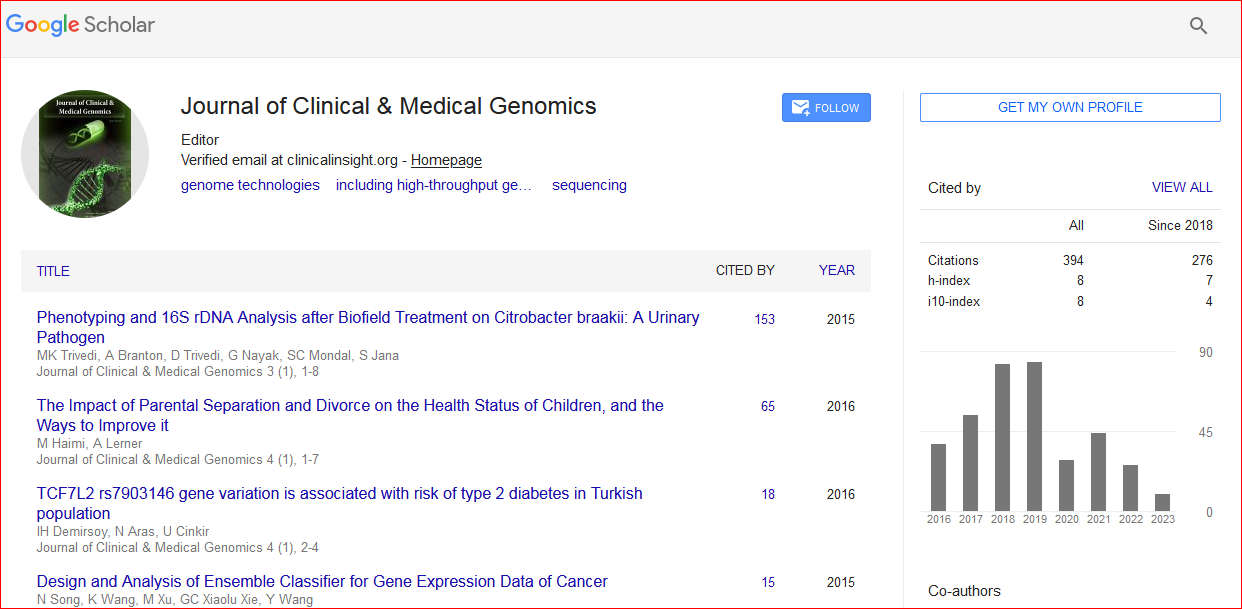
Journal of Clinical & Medical Genomics received 391 citations as per Google Scholar report