Commentary - (2025) Volume 16, Issue 3
Received: 01-Aug-2025, Manuscript No. hgec-25-174735;
Editor assigned: 04-Aug-2025, Pre QC No. P-174735;
Reviewed: 18-Aug-2025, QC No. Q-174735;
Revised: 22-Aug-2025, Manuscript No. R-174735;
Published:
29-Aug-2025
, DOI: 10.37421/2161-0436.2025.16.289
Citation: Kellerman, Adrian T.. ”Genetic Markers: Driving Precision and Personalization.” Human Genet Embryol 16 (2025):289.
Copyright: © 2025 Kellerman T. Adrian This is an open-access article distributed under the terms of the Creative Commons Attribution License, which permits unrestricted use, distribution and reproduction in any medium, provided the original author and source are credited.
Genetic markers play a crucial role in understanding and managing colorectal cancer. Research shows these markers are vital for accurately diagnosing the disease and predicting how it might progress. What this really means is doctors can use this genetic information to tailor treatments, making them more effective for individual patients. It also helps identify those at higher risk, allowing for earlier intervention and better outcomes[1].
When it comes to Alzheimer's disease, genetic markers are a significant area of study. Researchers are uncovering specific genes and variations that increase a person's susceptibility to this devastating condition. Identifying these markers helps us understand the disease mechanisms better and could eventually lead to early diagnostic tools or even targeted therapies. It's about moving from broad treatment approaches to more personalized care[2].
Polygenic risk scores (PRS) are changing how we think about predicting cardiovascular diseases. By combining information from many genetic markers across an individual's genome, PRS can estimate their inherited risk for conditions like heart attacks or strokes. This isn't about single genes, but the cumulative effect of many small genetic variations. Here's the thing: this approach offers a more comprehensive risk assessment than traditional methods, paving the way for proactive prevention strategies[3].
Pharmacogenomic testing, which uses genetic markers to predict how a person will respond to medications, is showing immense clinical utility. It helps doctors choose the right drug and the right dose for each patient, minimizing side effects and maximizing effectiveness. While there are challenges in widespread adoption, the potential to personalize drug therapy based on an individual's genetic makeup is a significant step forward in patient care[4].
Our individual genetic makeup plays a significant role in how we respond to infectious diseases, as clearly demonstrated by research into COVID-19. Certain genetic markers can predispose individuals to more severe outcomes or, conversely, offer a degree of protection. Understanding these host genetic susceptibilities is crucial for identifying vulnerable populations, developing targeted preventive measures, and refining treatment strategies during pandemics[5].
When immune systems mistakenly attack healthy tissues, we call it an autoimmune disease, and genetic markers are key to understanding why. These markers help pinpoint genetic predispositions that increase the risk of developing conditions like rheumatoid arthritis or lupus. Identifying these genetic signposts offers valuable insights into disease pathogenesis and holds promise for earlier diagnosis and the development of more personalized therapeutic interventions[6].
Diagnosing rare diseases has historically been a challenging and lengthy process, but genetic testing is revolutionizing this field. By looking for specific genetic markers, clinicians can identify the underlying cause of many rare conditions much faster and more accurately. What this really means is fewer diagnostic odysseys for patients and families, allowing for earlier access to appropriate management and support. It's about bringing clarity to complex medical puzzles[7].
Genetic markers are becoming increasingly important in forensic science, especially with the advent of next-generation sequencing (NGS). This technology allows forensic experts to extract more detailed genetic information from crime scene samples than ever before, moving beyond simple identity matching. Here's the thing: NGS can analyze markers that help predict physical traits like hair and eye color, or even biogeographical ancestry, providing invaluable investigative leads when traditional DNA databases yield no matches[8].
Precision medicine for inflammatory bowel disease (IBD) is a growing field that relies heavily on genetic markers. Instead of a one-size-fits-all approach, doctors are increasingly using genetic information to understand the specific disease subtype and predict how an individual patient might respond to different treatments. This means better-tailored therapies, reduced trial-and-error, and ultimately, improved quality of life for those living with IBD[9].
In agriculture, genetic markers are a game-changer for crop improvement. By identifying specific genes associated with desirable traits like disease resistance, drought tolerance, or higher yield, breeders can selectively develop new varieties much more efficiently than traditional methods. Let's break it down: this allows for faster and more precise breeding programs, helping to address global food security challenges by producing more resilient and productive crops[10].
Genetic markers are fundamentally changing medical diagnostics and personalized treatment strategies. In colorectal cancer, these markers are critical for accurate diagnosis, prognosis, and tailoring effective treatments, enabling earlier intervention for high-risk individuals [1]. Similarly, for Alzheimer's disease, researchers identify specific genes that increase susceptibility, deepening our understanding of disease mechanisms and paving the way for early diagnostic tools and targeted therapies [2]. The diagnostic process for rare diseases, historically challenging, is now being revolutionized by genetic testing. This allows clinicians to quickly and accurately pinpoint underlying causes, reducing diagnostic delays and ensuring timely management and support for patients [7]. Precision medicine for inflammatory bowel disease (IBD) also heavily leverages genetic markers to understand specific disease subtypes and predict treatment responses, leading to better-tailored therapies and improved patient quality of life [9].
Beyond diagnosis, genetic markers provide invaluable insights into disease risk and susceptibility. Polygenic risk scores (PRS), for instance, integrate numerous genetic markers to estimate an individual's inherited risk for cardiovascular conditions like heart attacks and strokes. This offers a more comprehensive risk assessment than traditional methods, promoting proactive prevention [3]. Our genetic makeup also significantly influences responses to infectious diseases, as seen with COVID-19, where certain markers can predict severe outcomes or offer protection. Understanding these host genetic susceptibilities is vital for identifying vulnerable populations and refining treatment strategies during pandemics [5]. Autoimmune diseases, characterized by the immune system attacking healthy tissues, are also better understood through genetic markers, which pinpoint predispositions and offer insights into pathogenesis, leading to promises of earlier diagnosis and personalized interventions [6].
In the realm of treatment, pharmacogenomic testing demonstrates immense clinical utility by using genetic markers to predict drug responses. This empowers doctors to select the optimal drug and dose for each patient, minimizing side effects and maximizing therapeutic effectiveness. What this really means is a significant step forward in patient care through personalized drug therapy, despite current challenges in widespread adoption [4].
The utility of genetic markers extends far beyond human health. In forensic science, next-generation sequencing (NGS) of genetic markers provides more detailed information from crime scene samples. Here's the thing: NGS can analyze markers that help predict physical traits like hair and eye color or biogeographical ancestry, offering critical investigative leads when traditional DNA databases fall short [8]. In agriculture, genetic markers are a game-changer for crop improvement. By identifying genes linked to desirable traits like disease resistance, drought tolerance, or higher yield, breeders can develop new varieties much more efficiently, addressing global food security challenges by producing resilient and productive crops [10].
Ultimately, the widespread application of genetic markers represents a transformative shift across multiple scientific and medical disciplines. From enhancing diagnostic precision and personalizing medical treatments to improving agricultural yields and aiding forensic investigations, these markers provide unprecedented insights into biological processes. This allows for more targeted, efficient, and predictive approaches, fundamentally advancing our capabilities in understanding, managing, and intervening in complex biological systems for better outcomes.
Genetic markers are revolutionizing diverse fields, fundamentally transforming approaches in medicine, forensics, and agriculture. In healthcare, they play a crucial role in diagnosing and managing various conditions. For instance, genetic markers guide personalized treatments for colorectal cancer and inflammatory bowel disease, while also helping predict the progression of Alzheimer's disease. They are instrumental in identifying genetic predispositions for autoimmune diseases and host susceptibilities to infectious diseases like COVID-19, allowing for targeted prevention and refined treatment strategies. What this really means is that genetic information supports early and accurate diagnosis of rare diseases, cutting down on lengthy diagnostic journeys. Pharmacogenomic testing leverages these markers to tailor drug therapies, optimizing dosage and minimizing side effects for individual patients. Beyond clinical applications, genetic markers have significant utility in non-medical sectors. In forensic science, next-generation sequencing provides detailed genetic profiles for predicting physical traits and ancestry, crucial for investigations. In agriculture, these markers are essential for efficiently developing new crop varieties with enhanced resistance to diseases and drought, as well as improved yields, contributing to global food security. Here's the thing: the ability to analyze and apply genetic markers represents a powerful tool for precision and personalization, moving beyond traditional, generalized approaches to offer more effective, targeted, and proactive solutions across a broad spectrum of challenges.
None
None
Indexed at, Google Scholar, Crossref
Indexed at, Google Scholar, Crossref
Indexed at, Google Scholar, Crossref
Indexed at, Google Scholar, Crossref
Indexed at, Google Scholar, Crossref
Indexed at, Google Scholar, Crossref
Indexed at, Google Scholar, Crossref
Indexed at, Google Scholar, Crossref
Indexed at, Google Scholar, Crossref
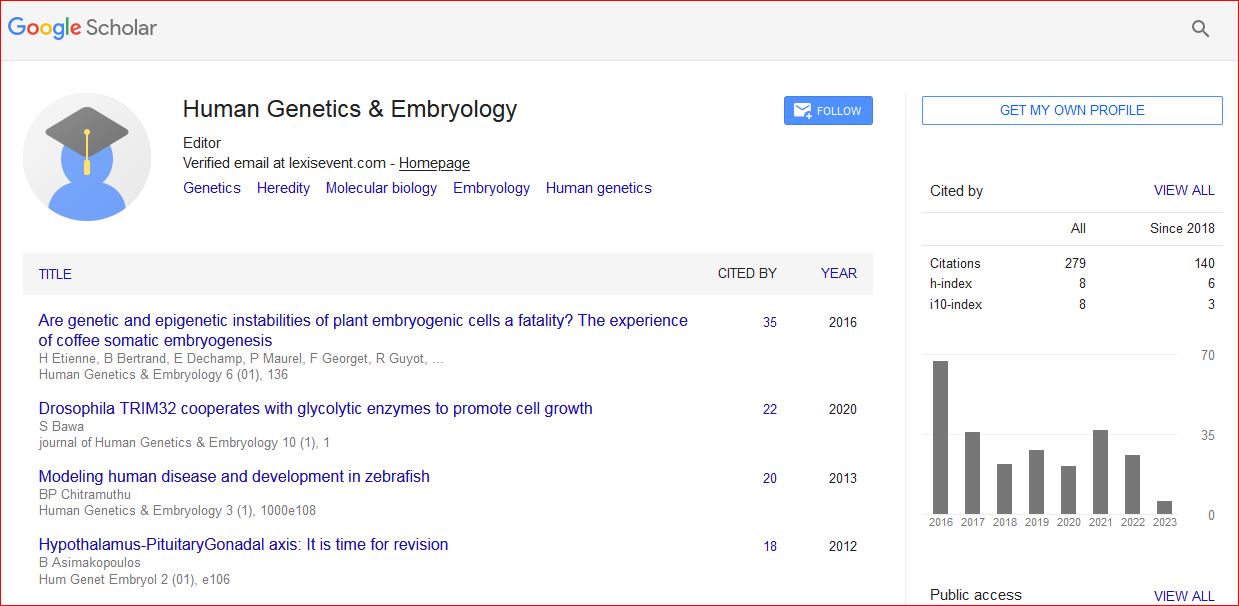
Human Genetics & Embryology received 309 citations as per Google Scholar report