Opinion - (2025) Volume 9, Issue 3
Received: 02-Jun-2025, Manuscript No. jgge-25-174480;
Editor assigned: 04-Jun-2025, Pre QC No. P-174480;
Reviewed: 18-Jun-2025, QC No. Q-174480;
Revised: 23-Jun-2025, Manuscript No. R-174480;
Published:
30-Jun-2025
, DOI: 10.37421/2684-4567.2025.9.182
Citation: Price, Maxwell. ”Genetic Disease: Diagnosis, Treatment Personalized Medicine.” J Genet Genom 09 (2025):182.
Copyright: © 2025 Price M. This is an open-access article distributed under the terms of the Creative Commons Attribution License, which permits unrestricted use, distribution
and reproduction in any medium, provided the original author and source are credited.
Understanding genetic mutations is fundamental to modern medicine, particularly in the realm of inherited diseases and personalized therapies. A comprehensive review delves into BRCA1 and BRCA2 mutations, revealing their critical role in hereditary breast and ovarian cancer [1].
This knowledge encompasses the landscape of genetic testing, emphasizes the fundamental role of genetic counseling for affected individuals and families, and guides modern management strategies, including proactive risk-reduction interventions and highly targeted therapeutic approaches. Crucially, a deep understanding of these mutations is key for personalized cancer prevention and treatment. Significant advancements are highlighted concerning the diagnosis of monogenic diseases, conditions stemming from mutations in a single gene [2].
Specifically, next-generation sequencing technologies have profoundly revolutionized the identification of causative genetic variants, resulting in earlier and considerably more precise diagnoses. Furthermore, ongoing challenges and future directions are explored in integrating these advanced diagnostic tools into routine clinical practice. Moving from diagnosis to treatment, this paper explores the immense and transformative potential of CRISPR-Cas9-based gene editing as a therapeutic strategy for various genetic diseases [3].
It systematically reviews the remarkable progress made from foundational laboratory research to tangible clinical applications, meticulously detailing how this precise gene editing tool is capable of correcting disease-causing mutations. The discussion critically examines both the promising opportunities and the significant hurdles in translating these innovative techniques into effective treatments for patients. Expanding this genetic understanding, an updated perspective is presented on the genetic underpinnings of neurodegenerative diseases like Alzheimer's and Parkinson's [4].
It thoroughly delves into the complex interplay of both common and rare genetic variants that contribute to disease susceptibility and progression. Notably, the article emphasizes how a deeper understanding of these genetic factors has the potential to pave the way for novel diagnostic markers and inspire innovative therapeutic interventions. Meanwhile, a comprehensive overview is provided of the genetic insights into inherited cardiomyopathies, a diverse group of heart muscle disorders [5].
It specifically discusses the identification of key genetic mutations inherently linked to these conditions, thereby significantly improving our understanding of underlying disease mechanisms. This profound knowledge proves crucial for facilitating early diagnosis, comprehensive family screening, and guiding highly tailored treatment strategies for affected individuals. A comprehensive review systematically delves into the intricate relationship between genetic variation and the emerging field of pharmacogenomics [6].
It lucidly elucidates how subtle yet significant individual genetic differences, especially within drug-metabolizing enzymes and drug targets, can profoundly influence drug response, efficacy, and toxicity. Crucially, the article underscores the paramount importance of integrating pharmacogenomic insights to truly personalize medicine and optimize therapeutic outcomes for patients. Recent and significant advances are presented in the diagnosis and effective management of inborn errors of metabolism, a diverse group of genetic conditions affecting metabolic pathways [7].
It discusses the profound impact of robust newborn screening programs and the undeniable utility of advanced genomic technologies in achieving early detection. Furthermore, the text highlights rapidly evolving therapeutic strategies, encompassing precise dietary interventions, innovative enzyme replacement therapies, and groundbreaking gene therapies, all of which demonstrably improve patient prognosis. This paper comprehensively explores mitochondrial DNA (mtDNA) mutations and their multifaceted role in a variety of debilitating human diseases [8].
It meticulously details the unique genetic characteristics inherent to mtDNA, explaining how its distinct mutations invariably lead to diverse clinical phenotypes, and elucidating the underlying pathogenic mechanisms. The authors also provide a thorough review of both current and emerging therapeutic strategies specifically aimed at mitigating the debilitating effects of mitochondrial dysfunction. This review synthesizes compelling insights gleaned from genome-wide association studies (GWAS) to profoundly illuminate the complex genetic basis of autoimmune diseases [9].
It discusses how these extensive studies have successfully identified numerous genetic loci clearly associated with debilitating conditions such as rheumatoid arthritis, lupus, and multiple sclerosis, frequently involving key immune system genes. Truly understanding these genetic predispositions is absolutely vital for the development of highly targeted therapies and precise, personalized risk assessments. This article provides a thorough evaluation of the current status and promising future prospects of next-generation sequencing (NGS) technologies in the precise diagnosis of Mendelian disorders [10].
It prominently highlights how NGS technologies have dramatically improved diagnostic yields for these inherited conditions by enabling the rapid and remarkably comprehensive analysis of genes. Moreover, the review candidly addresses pertinent challenges related to intricate data interpretation and critical ethical considerations inherent in clinical application.
A detailed examination of BRCA1 and BRCA2 mutations unveils their pivotal role in hereditary breast and ovarian cancer. This comprehensive understanding informs the crucial landscape of genetic testing, emphasizes the fundamental need for genetic counseling for affected individuals and their families, and shapes contemporary management strategies. These strategies encompass advanced risk-reduction interventions and highly targeted therapies, all essential for personalized cancer prevention and effective treatment [1].
Significant advancements are transforming the diagnosis of monogenic diseases, conditions arising from mutations in a single gene. Next-generation sequencing technologies have revolutionized the identification of causative genetic variants, leading to earlier and remarkably more precise diagnoses. Integrating these powerful diagnostic tools into routine clinical practice presents both ongoing challenges and exciting future directions that require careful consideration [2].
The immense potential of CRISPR-Cas9-based gene editing is being explored as a groundbreaking therapeutic strategy for various genetic diseases. Research has steadily progressed from foundational laboratory work to promising clinical applications. This precise gene editing tool holds the capability to correct disease-causing mutations, offering new hope. Researchers continue to assess the opportunities and hurdles in translating these innovative techniques into effective treatments for patients worldwide [3].
An updated perspective sheds light on the genetic underpinnings of neurodegenerative diseases, including Alzheimer's and Parkinson's. This work thoroughly delves into the complex interplay of both common and rare genetic variants contributing to disease susceptibility and progression. A deeper understanding of these genetic factors is crucial, paving the way for novel diagnostic markers and developing innovative therapeutic interventions [4].
Genetic insights are profoundly improving our understanding of inherited cardiomyopathies, a diverse group of heart muscle disorders. Key genetic mutations linked to these conditions are being identified, significantly enhancing our knowledge of disease mechanisms. This critical information is vital for early diagnosis, comprehensive family screening programs, and guiding tailored treatment strategies for individuals affected by these conditions [5].
A comprehensive review elucidates the intricate relationship between genetic variation and pharmacogenomics. It explains how individual genetic differences, particularly in drug-metabolizing enzymes and drug targets, can profoundly influence drug response, efficacy, and potential toxicity. The importance of integrating pharmacogenomic insights to personalize medicine and optimize therapeutic outcomes for patients is continually underscored [6].
Recent advances are reshaping the diagnosis and management of inborn errors of metabolism, a diverse group of genetic conditions impacting metabolic pathways. The impact of newborn screening programs and the utility of advanced genomic technologies in achieving early detection are significant. Moreover, evolving therapeutic strategies, including specific dietary interventions, enzyme replacement therapies, and gene therapies, are demonstrably improving patient prognosis [7].
Mitochondrial DNA (mtDNA) mutations and their significant role in various human diseases are extensively explored. The unique genetic characteristics of mtDNA are detailed, illustrating how its mutations lead to diverse clinical phenotypes and revealing the underlying pathogenic mechanisms. Current and emerging therapeutic strategies aimed at mitigating the detrimental effects of mitochondrial dysfunction are also thoroughly reviewed [8].
Insights derived from genome-wide association studies (GWAS) are synthesizing to illuminate the complex genetic basis of autoimmune diseases. These studies have successfully identified numerous genetic loci associated with conditions like rheumatoid arthritis, lupus, and multiple sclerosis, frequently involving critical immune system genes. Understanding these genetic predispositions is essential for developing targeted therapies and precise, personalized risk assessments [9].
The current status and future prospects of next-generation sequencing (NGS) in diagnosing Mendelian disorders are thoroughly evaluated. NGS technologies have dramatically improved diagnostic yields for these inherited conditions by enabling rapid and comprehensive gene analysis. Challenges related to data interpretation and ethical considerations in clinical application are important points of discussion [10].
Research across multiple studies highlights significant advancements in understanding, diagnosing, and treating various genetic diseases. The pivotal role of BRCA1 and BRCA2 mutations in hereditary cancers is explored, emphasizing genetic testing, counseling, and personalized management strategies for prevention and treatment. Diagnostics for monogenic diseases have seen revolutionary changes with next-generation sequencing, enabling earlier and more precise identification of causative genetic variants, though integration into clinical practice still presents challenges. Beyond diagnosis, CRISPR-Cas9-based gene editing is emerging as a promising therapeutic strategy for correcting disease-causing mutations, moving from lab research to clinical applications. The genetic underpinnings of complex neurodegenerative diseases like Alzheimer's and Parkinson's are becoming clearer, offering avenues for new diagnostic markers and interventions. Similar genetic insights are enhancing the understanding of inherited cardiomyopathies, crucial for early diagnosis and tailored treatments. The field of pharmacogenomics is gaining traction, demonstrating how individual genetic differences influence drug responses, efficacy, and toxicity, advocating for personalized medicine. Advances in diagnosing and managing inborn errors of metabolism, including the impact of newborn screening and genomic technologies, alongside evolving therapies like gene therapies, are improving patient prognoses. Mitochondrial DNA mutations are also under scrutiny for their role in diverse human diseases, with ongoing efforts to develop therapeutic strategies for mitochondrial dysfunction. Finally, genome-wide association studies provide crucial insights into the genetic basis of autoimmune diseases, supporting the development of targeted therapies. Next-Generation Sequencing continues to improve diagnostic yields for Mendelian disorders, while also raising important ethical considerations.
None
None
1. Saisai M, Yu L, Yan Z. "BRCA1 and BRCA2 Mutations: A Comprehensive Review of Genetic Testing, Counseling, and Management Strategies".Cancers 15 (2023):235.
Indexed at, Google Scholar, Crossref
2. Ping F, Shan Z, Ying C. "Advances in Genetic Diagnosis of Monogenic Diseases".Genes 13 (2022):382.
Indexed at, Google Scholar, Crossref
3. Yi M, Peng L, Cheng Y. "CRISPR-Cas9-Based Gene Editing for Genetic Diseases: From Bench to Bedside".Front Cell Dev Biol 9 (2021):704812.
Indexed at, Google Scholar, Crossref
4. Karen N, Christine VB, Patrick C. "Genetic Landscape of Neurodegenerative Diseases: An Update".Cells 9 (2020):2269.
Indexed at, Google Scholar, Crossref
5. Sanjay G, Guy M, Chia JP. "Genetic Insights into Inherited Cardiomyopathies: A State-of-the-Art Review".J Clin Med 12 (2023):730.
Indexed at, Google Scholar, Crossref
6. Shan W, Yuhui S, Weimin Z. "Genetic Variation and Pharmacogenomics: A Comprehensive Review".Genes 13 (2022):2004.
Indexed at, Google Scholar, Crossref
7. Chin-Ching H, Tung-Liang C, Hsin-Shih W. "Recent Advances in the Diagnosis and Management of Inborn Errors of Metabolism".Diagnostics 11 (2021):2097.
Indexed at, Google Scholar, Crossref
8. Weijian Z, Chao W, Chunlei L. "Mitochondrial DNA Mutations and Human Disease: Pathogenic Mechanisms and Therapeutic Strategies".Cells 12 (2023):171.
Indexed at, Google Scholar, Crossref
9. Seonju K, Yeongjun L, Jaehyung P. "Genetic Basis of Autoimmune Diseases: Insights from Genome-Wide Association Studies".Int J Mol Sci 23 (2022):11394.
Indexed at, Google Scholar, Crossref
10. Yang Y, Siqi H, Fang Z. "Next-Generation Sequencing in the Diagnosis of Mendelian Disorders: Current Status and Future Perspectives".Genes 12 (2021):1279.
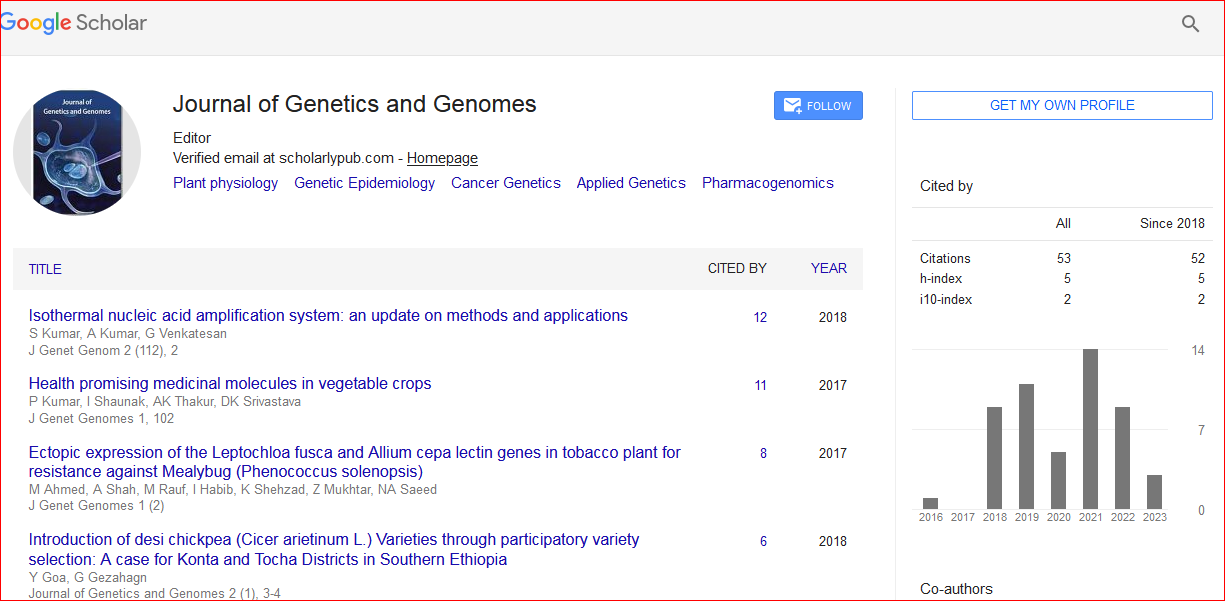
Journal of Genetics and Genomes received 65 citations as per Google Scholar report