Opinion Article - (2025) Volume 16, Issue 1
Received: 24-Jun-2024, Manuscript No. JTSE-24-139673;
Editor assigned: 26-Jun-2024, Pre QC No. JTSE-24-139673 (PQ);
Reviewed: 10-Jul-2024, QC No. JTSE-24-139673;
Revised: 26-Apr-2025, Manuscript No. JTSE-24-139673 (R);
Published:
02-May-2025
, DOI: 10.37421/2157-7552.2025.16.410
Citation: Henry, Liam. "Gene Editing Techniques in Stem Cell
Transplantation: Implications and Applications." J Tiss Sci Eng 16 (2025): 410.
Copyright: © 2025 Henry L. This is an open-access article distributed under the terms of the creative commons attribution license which permits unrestricted
use, distribution and reproduction in any medium, provided the original author and source are credited.
In recent years, advancements in gene editing technologies have revolutionized the field of medicine, particularly in the context of stem cell transplantation. Stem cells hold immense potential for regenerative medicine due to their unique ability to differentiate into various specialized cell types. However, challenges such as immune rejection and ethical concerns surrounding genetic modification have historically limited their therapeutic application. Gene editing techniques offer promising solutions to these challenges, paving the way for safer and more effective stem cell therapies.
Understanding gene editing technologies
Gene editing refers to the precise modification of an organism's DNA, typically to correct genetic defects or introduce beneficial traits. Several innovative techniques have emerged, each with its unique advantages and applications:
CRISPR-Cas9: This revolutionary technology utilizes an enzyme called Cas9 guided by RNA to precisely cut specific sequences of DNA. CRISPR-Cas9 has significantly simplified and accelerated the process of genome editing, making it a widely adopted tool in research and potentially clinical settings.
TALENs (Transcription Activator-Like Effector Nucleases): TALENs function similarly to CRISPR-Cas9 but use a different mechanism involving customizable DNA-binding proteins. They are particularly useful for targeting specific genes with high precision.
ZFNs (Zinc Finger Nucleases): Zinc finger nucleases are engineered proteins that can be programmed to target and cut specific DNA sequences. They were among the first gene editing tools developed and are still used in certain applications.
Each of these technologies offers distinct advantages and considerations regarding efficiency, specificity, and off-target effects, which are crucial for their application in stem cell transplantation.
Applications of gene editing in stem cell transplantation
Enhancing stem cell engraftment and survival: One of the major challenges in stem cell transplantation is ensuring the survival and integration of transplanted cells within the host tissue. Gene editing can be used to enhance the expression of factors that promote cell survival and engraftment, thereby improving the overall success of transplantation therapies.
Engineering immune evasion: To address immune rejection, stem cells can be edited to reduce their immunogenicity. This can involve knocking out genes responsible for Major Histocompatibility Complex (MHC) expression or introducing immune-suppressive factors. Such modifications can potentially enable the use of allogeneic stem cells from donors without requiring lifelong immunosuppression in recipients.
Correcting genetic defects: Inherited genetic disorders often result from mutations in specific genes. Gene editing techniques like CRISPR-Cas9 can correct these mutations in patient-derived stem cells, offering a personalized approach to therapy. This has profound implications for conditions such as sickle cell disease, betathalassemia, and certain types of muscular dystrophy.
Creating disease models: Stem cells edited to carry diseasespecific mutations can serve as valuable tools for studying disease mechanisms and testing potential therapies. These models can replicate the genetic diversity observed in patient populations, facilitating more accurate preclinical studies.
Gene editing techniques have revolutionized the field of stem cell transplantation, offering profound implications and promising applications. One of the most significant advancements is the ability to precisely modify the genome of stem cells, enhancing their therapeutic potential. Techniques like CRISPR-Cas9 have made it feasible to correct genetic mutations responsible for inherited diseases, thereby paving the way for personalized medicine approaches.
In the context of stem cell transplantation, gene editing allows for the creation of modified stem cells that can evade immune rejection, a critical barrier in transplantation therapy. This is achieved by knocking out genes responsible for immune recognition or by introducing protective genetic modifications. Moreover, gene editing enables the enhancement of stem cell properties such as proliferation, differentiation, and engraftment efficiency, which are crucial for successful transplantation outcomes.
Beyond therapeutic applications, gene editing in stem cells holds promise for advancing our understanding of disease mechanisms through the creation of disease models and studying gene function. This dual role of gene editing in both therapy and research underscores its transformative potential in medicine.
However, ethical considerations, such as the off-target effects of gene editing and the implications of permanent genetic modifications, must be carefully addressed. Nevertheless, the rapid progress in gene editing technologies continues to expand the horizons of stem cell transplantation, offering new hope for patients with previously untreatable genetic disorders and chronic diseases.
Gene editing technologies represent a transformative tool in the field of stem cell transplantation, offering solutions to longstanding challenges and opening new avenues for therapeutic innovation. As research progresses and technologies evolve, the integration of gene-edited stem cell therapies into clinical practice holds the promise of personalized medicine and improved patient outcomes.
By leveraging these advancements responsibly and ethically, we can envision a future where gene editing plays a central role in curing genetic diseases and advancing regenerative medicine.
While gene editing holds tremendous promise, ethical considerations regarding safety, equity of access, and unintended consequences must be carefully addressed. Regulatory frameworks are essential to ensure that gene-edited stem cell therapies are developed and implemented responsibly.
Looking forward, ongoing research aims to further refine gene editing techniques, improve their efficiency and safety profiles, and explore new applications. Collaboration between scientists, clinicians, ethicists, and regulatory bodies will be crucial in harnessing the full potential of gene editing in stem cell transplantation.
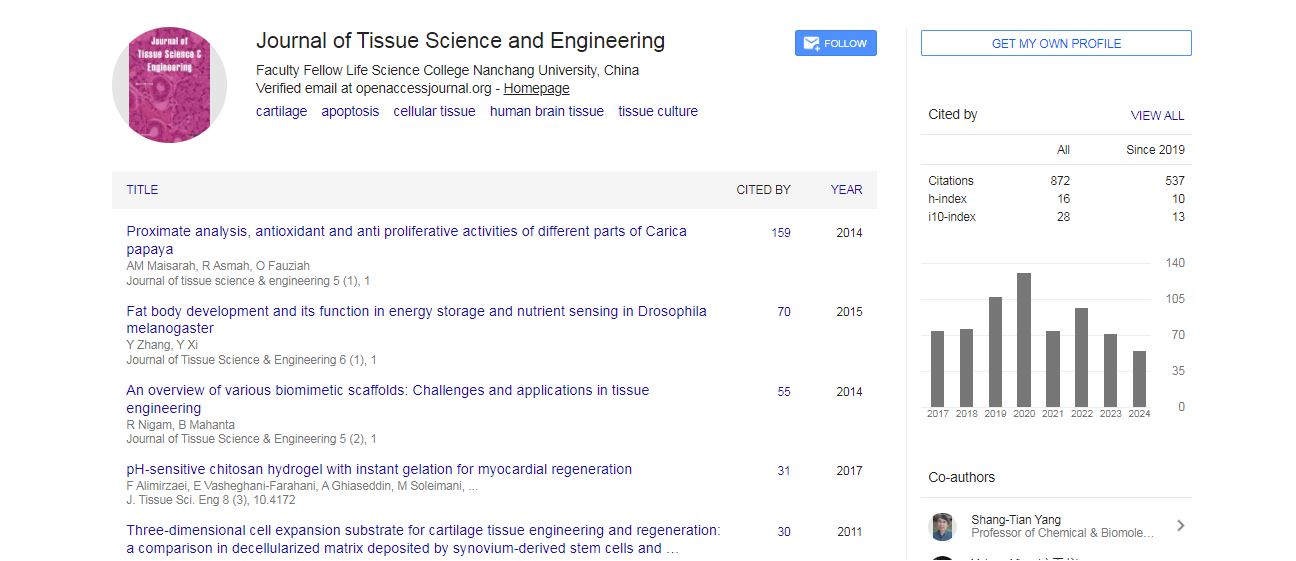
Journal of Tissue Science and Engineering received 807 citations as per Google Scholar report