Brief Report - (2025) Volume 14, Issue 4
Received: 01-Jul-2025, Manuscript No. pbt-25-173762;
Editor assigned: 03-Jul-2025, Pre QC No. P-173762;
Reviewed: 17-Jul-2025, QC No. Q-173762;
Revised: 22-Jul-2025, Manuscript No. R-173762;
Published:
29-Jul-2025
, DOI: 10.37421/2167-7689.2025.14.491
Citation: Hoffman, Linda K.. ”GCP: Adapting for Global Clinical Research Integrity.” Pharmaceut Reg Affairs 14 (2025):491.
Copyright: © 2025 Hoffman K. Linda This is an open-access article distributed under the terms of the Creative Commons Attribution License, which permits unrestricted use,
distribution and reproduction in any medium, provided the original author and source are credited.
Good Clinical Practice (GCP) guidelines stand as the cornerstone for ensuring the ethical conduct, scientific integrity, and public credibility of clinical trials. These foundational principles are meticulously designed to safeguard research subjects and guarantee the reliability of data throughout every stage of a study, from initial design to final reporting [1].
In a world increasingly shaped by technological advancements, GCP must continuously adapt. The burgeoning field of digital health presents both formidable challenges and unique opportunities for maintaining GCP standards. This evolving landscape necessitates a thoughtful adaptation of traditional GCP principles to ensure robust data integrity, paramount patient safety, and unwavering regulatory compliance within clinical research that leverages digital tools [2].
Building on this, the strategic integration of digital tools into clinical trials highlights their significant benefits, including streamlined operational processes, enhanced data quality, and improved participant engagement. Crucially, these technological advancements must always be implemented in a manner that steadfastly upholds the ethical and regulatory benchmarks established by GCP [9].
Effective training remains a vital component of successful GCP implementation. Across various regions, such as China, there are notable discussions surrounding the current status and inherent challenges of GCP training for clinical research professionals. Identifying disparities in training quality and accessibility, many advocate for the establishment of standardized, continuous education programs. The goal is clear: to significantly enhance adherence to international GCP guidelines and, by extension, elevate the overall quality of clinical research [3].
Beyond training, the operational backbone of clinical research relies heavily on robust quality management systems. A systematic review focused on these systems in clinical research meticulously evaluates their alignment with GCP guidelines. This review reveals common practices while also identifying critical gaps. The overarching conclusion is that a strong, integrated approach to quality management is absolutely fundamental for preserving the integrity and achieving the compliance levels that GCP rigorously demands [4].
Investigators, as frontline practitioners, carry a profound set of responsibilities under Good Clinical Practice. Their duties encompass a meticulous management of essential trial documents and, more broadly, ensuring unwavering patient safety, upholding the highest ethical conduct, and guaranteeing accurate data collection from the moment a study commences to its ultimate conclusion [5].
This commitment to ethical conduct extends to the broader framework of ethical oversight in clinical trials. Current perspectives underscore the indispensable role of ethics committees and institutional review boards. These bodies are crucial in protecting human subjects, securing truly informed consent, and consistently maintaining the highest ethical standards throughout the entire research endeavor, aligning perfectly with GCP guidelines [10].
GCP principles have also demonstrated remarkable resilience and adaptability, particularly when faced with unprecedented global challenges. The COVID-19 pandemic served as a stark example, prompting rapid adaptations such as the implementation of decentralized trial components, widespread remote monitoring, and increased regulatory flexibility. These swift changes showcased the inherent ability of GCP to maintain rigorous ethical and scientific standards even amidst a crisis [6].
This adaptability is equally vital in modern clinical trial methodologies, notably in adaptive clinical trial designs. Here, GCP ensures both the ethical conduct and scientific rigor of trials that incorporate real-time modifications, thereby maintaining participant safety and data validity through inherently flexible protocols [8].
Finally, specific populations often necessitate heightened consideration within the GCP framework. For instance, patient safety and Good Clinical Practice in pediatric clinical trials involve a unique array of ethical considerations and stringent regulatory requirements. These are all meticulously crafted to ensure the utmost protection for children, a particularly vulnerable population, while simultaneously advancing critical medical knowledge [7].
This comprehensive approach underscores GCP's dedication to safeguarding all participants in the pursuit of scientific progress.
Good Clinical Practice (GCP) guidelines are the bedrock of modern clinical research, established to uphold ethical conduct, scientific integrity, and public trust in clinical trials. They meticulously outline the principles and processes required to protect subjects and ensure the reliability of all data generated, from the initial planning stages through to the final analysis and reporting [C001]. These guidelines are constantly reviewed and adapted to address new challenges and opportunities in the dynamic field of medical research.
The rapid advancements in digital health present a significant frontier for GCP. The integration of digital tools introduces both novel challenges and substantial opportunities for clinical trials. Adapting traditional GCP principles is crucial to safeguard data integrity, maintain patient safety, and ensure regulatory compliance in these increasingly digitally-driven research environments [C002]. For example, the incorporation of digital tools can profoundly streamline processes, elevate data quality, and significantly enhance participant engagement. However, ensuring strict compliance with the ethical and regulatory standards of GCP is paramount when deploying such technologies in clinical settings [C009].
Ensuring a high standard of adherence to GCP relies heavily on effective training and robust quality management. In many regions, the quality and accessibility of GCP training for clinical research professionals pose significant challenges. This situation underscores the need for standardized, continuous education programs designed to improve understanding and consistent application of international GCP guidelines, thereby enhancing overall research quality [C003]. Complementing this, comprehensive quality management systems (QMS) are indispensable. A systematic review examining QMS in clinical research highlights common practices while also identifying gaps in their implementation. The consistent finding is that an integrated and robust QMS is fundamental for upholding the integrity and meeting the stringent compliance requirements of GCP [C004].
Investigators, who are at the heart of every clinical trial, bear extensive responsibilities under GCP. These responsibilities are not merely procedural but extend to the fundamental aspects of patient welfare. They are tasked with managing all essential trial documents diligently, ensuring patient safety as the highest priority, upholding ethical conduct without compromise, and meticulously collecting accurate data throughout the entire study lifecycle, from initiation to conclusion [C005]. Integral to this framework of responsibility is ethical oversight. This critical function is typically provided by ethics committees and institutional review boards. These bodies play an invaluable role in protecting human subjects, verifying that informed consent is truly obtained, and maintaining the highest ethical standards across all research activities, thereby reinforcing the core tenets of GCP [C010].
The adaptability of GCP principles was profoundly tested during the unprecedented global health crisis of the COVID-19 pandemic. This period necessitated swift and significant adjustments, including the rapid implementation of decentralized trial components and the widespread adoption of remote monitoring solutions. Regulatory bodies also demonstrated considerable flexibility. These adaptations not only highlighted the resilience of GCP but also underscored its inherent ability to maintain both ethical and scientific standards even under severe pressure and crisis conditions [C006]. This flexibility ensures that research can continue safely and ethically, even when traditional methods are unfeasible.
Moreover, GCP principles are vital in shaping the application of sophisticated research designs, such as adaptive clinical trials. These designs, which allow for real-time modifications based on accumulating data, require careful application of GCP to ensure that ethical conduct and scientific rigor are maintained throughout. GCP provides the framework to manage these flexible protocols while consistently safeguarding participant safety and data validity [C008]. This ensures that innovations in trial design do not compromise the fundamental ethical commitments of clinical research. Furthermore, special considerations are frequently required for vulnerable populations. For instance, patient safety within pediatric clinical trials demands unique ethical considerations and specialized regulatory requirements. These measures are specifically designed to ensure the robust protection of children while still facilitating the advancement of vital medical knowledge, illustrating GCP's comprehensive scope [C007].
Good Clinical Practice (GCP) guidelines are essential for upholding the ethical and scientific integrity of clinical trials, ensuring patient protection and data reliability. Recent literature highlights their continuous evolution, particularly with the integration of digital health tools, which offer opportunities for streamlined processes and enhanced data quality but also necessitate adapting traditional principles for regulatory compliance and patient safety. Challenges such as disparities in GCP training, especially in regions like China, underscore the need for standardized, continuous education programs. Furthermore, robust quality management systems are crucial for maintaining adherence to GCP standards and ensuring research integrity. Investigators play a pivotal role, with responsibilities spanning essential document management, patient safety, ethical conduct, and accurate data collection. Ethical oversight, provided by committees and review boards, remains central to protecting human subjects and securing informed consent. The flexibility of GCP was prominently demonstrated during the COVID-19 pandemic, where rapid adaptations like decentralized trials and remote monitoring preserved ethical and scientific standards amidst crisis. Similarly, GCP principles guide adaptive clinical trial designs, ensuring ethical conduct and data validity through flexible protocols. Specialized considerations for vulnerable populations, such as pediatric patients, further illustrate GCP's comprehensive commitment to safeguarding participants while advancing medical knowledge. This body of work collectively emphasizes GCP's dynamic nature and its indispensable role in the responsible conduct of clinical research globally.
None
None
1. Manoj S, Raghvendra KS, Prafull KS. "Good Clinical Practice Guidelines for Clinical Trials: A Narrative Review".Indian J Pharm Sci 85 (2023):755-763.
Indexed at, Google Scholar, Crossref
2. Daniel Z, Jana WK, Nicole CW. "Challenges and Opportunities for Good Clinical Practice in the Era of Digital Health".J Clin Pharmacol 62 (2022):S139-S146.
Indexed at, Google Scholar, Crossref
3. Meiyang L, Chunli L, Dongmei W. "Current Status and Challenges of Good Clinical Practice Training for Clinical Research Professionals in China".Biomed Res Int 2021 (2021):6654924.
Indexed at, Google Scholar, Crossref
4. Melissa VdL, Steven VB, Miet VdE. "A Systematic Review of Quality Management Systems in Clinical Research: Adherence to Good Clinical Practice".Contemp Clin Trials Commun 18 (2020):100539.
Indexed at, Google Scholar, Crossref
5. Kanchan J, Nita S, Satyapal PG. "Good Clinical Practice: Investigator's Responsibilities and Essential Documents".J Clin Orthop Trauma 11 (2020):S156-S159.
Indexed at, Google Scholar, Crossref
6. Ali A, Sulieman A, Mohammad MSA. "Good Clinical Practice in the COVID-19 Era: Challenges and Adaptations".Front Public Health 9 (2021):705462.
Indexed at, Google Scholar, Crossref
7. Colleen O, Elizabeth ML, Kalpana RB. "Patient Safety and Good Clinical Practice in Pediatric Clinical Trials".Ther Innov Regul Sci 56 (2022):716-724.
Indexed at, Google Scholar, Crossref
8. Suresh M, Ravi KP, Veena S. "Good Clinical Practice in Adaptive Clinical Trial Designs".Perspect Clin Res 11 (2020):63-69.
Indexed at, Google Scholar, Crossref
9. Jeongyoon K, Sungryeop L, Hyunwook P. "Digital Tools in Clinical Trials: Ensuring Good Clinical Practice Compliance".J Korean Med Sci 37 (2022):e265.
Indexed at, Google Scholar, Crossref
10. Liam G, Martha T, Robert W. "Ethical Oversight of Clinical Trials Under Good Clinical Practice: Current Perspectives".J Med Ethics 45 (2019):739-744.
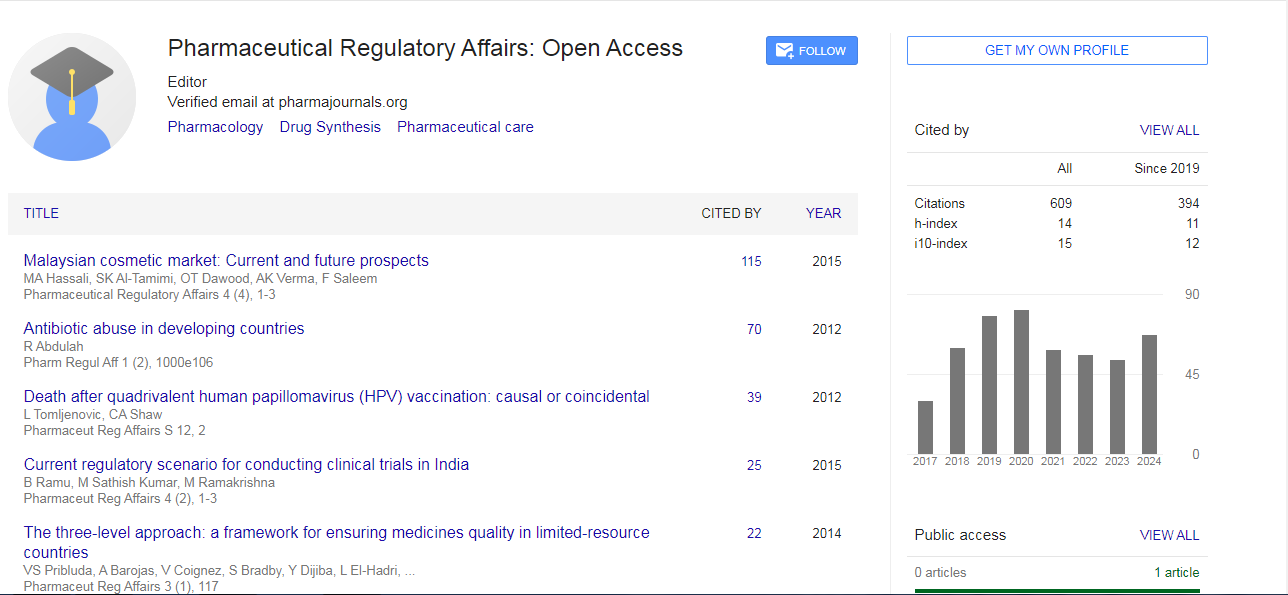
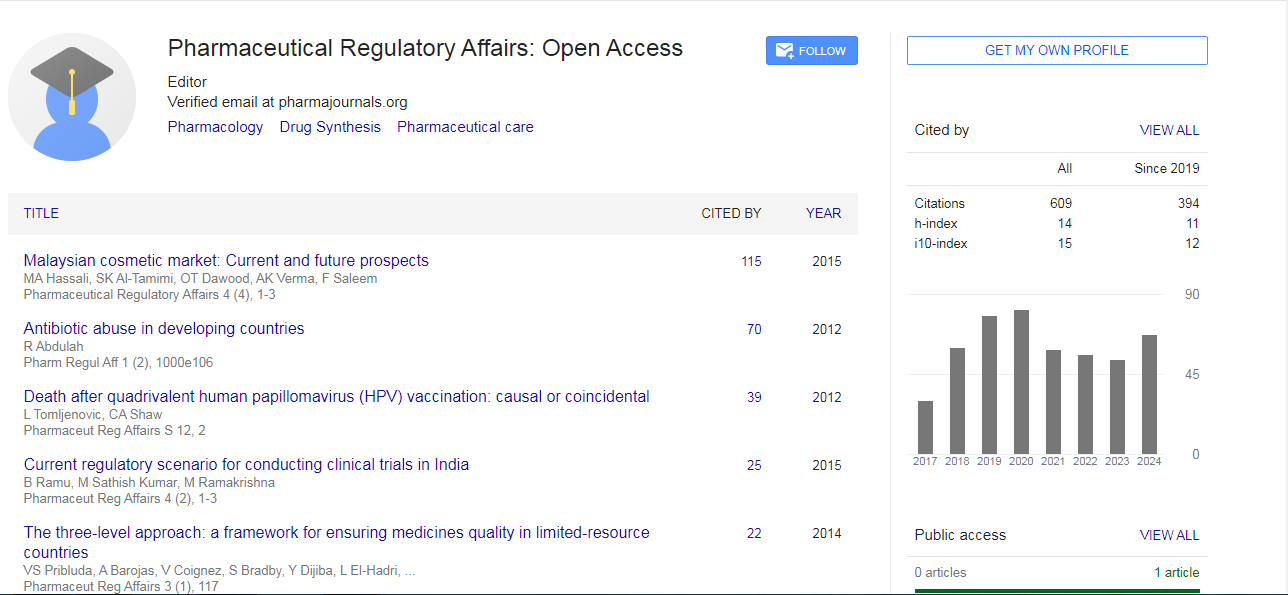
Pharmaceutical Regulatory Affairs: Open Access received 533 citations as per Google Scholar report