Commentary - (2025) Volume 19, Issue 2
Received: 01-Apr-2025, Manuscript No. jmgm-26-185642;
Editor assigned: 03-Apr-2025, Pre QC No. P-185642;
Reviewed: 17-Apr-2025, QC No. Q-185642;
Revised: 22-Apr-2025, Manuscript No. R-185642;
Published:
29-Apr-2025
, DOI: 10.37421/1747-0862.2025.19.716
Citation: Ndlovu, Amara. ”Genomics: Revolutionizing Cancer Treatment And Patient Outcomes.” J Mol Genet Med 19 (2025):716.
Copyright: © 2025 Ndlovu A. This is an open-access article distributed under the terms of the Creative Commons Attribution License, which permits unrestricted use, distribution and reproduction in any medium, provided the original author and source are credited.
Cancer genomics is fundamentally reshaping cancer treatment by enabling a deeper understanding of the molecular underpinnings of tumors. This knowledge allows for personalized therapeutic strategies, targeting specific genetic alterations within a patient's cancer. Innovations in sequencing technologies have made comprehensive genomic profiling of tumors feasible, identifying actionable mutations, predicting drug response, and monitoring disease progression. This molecular medicine approach is moving oncology towards more precise, effective, and less toxic treatments. [1] The integration of liquid biopsies, such as circulating tumor DNA (ctDNA) analysis, is a significant advancement in cancer genomics. These non-invasive tests can detect cancer early, monitor treatment response, and identify resistance mechanisms by analyzing tumor-derived material in blood. This technology offers a dynamic view of tumor evolution and has the potential to personalize treatment decisions more effectively than traditional tissue biopsies. [2] Genomic profiling of tumors is essential for identifying targetable driver mutations in various cancers. This includes alterations in genes like EGFR, ALK, BRAF, and HER2, which have specific inhibitors available. The increasing availability of pan-cancer genomic panels allows for a broader search for these actionable targets, guiding treatment selection in both common and rare malignancies, and improving patient outcomes. [3] Tumor mutational burden (TMB) is emerging as a predictive biomarker for response to immune checkpoint inhibitors. High TMB, indicative of a greater number of neoantigens, often correlates with a stronger anti-tumor immune response. Genomic platforms that accurately measure TMB are crucial for selecting patients who are most likely to benefit from immunotherapy, a cornerstone of modern cancer therapy. [4] Understanding the genomic basis of drug resistance is critical for long-term cancer management. Acquired resistance mechanisms, often driven by secondary mutations or clonal selection, can emerge during treatment. Continuous genomic monitoring through liquid biopsies can help detect these changes early, allowing for timely adjustments in therapy or the introduction of alternative treatment strategies. [5] The landscape of cancer genomes is complex, involving not only point mutations but also copy number variations, structural rearrangements, and epigenetic modifications. Advanced sequencing technologies, such as whole-genome and whole-exome sequencing, are crucial for capturing this complexity. Integrating multi-omic data provides a more comprehensive picture of tumor biology, leading to novel therapeutic targets and biomarkers. [6] Artificial intelligence (AI) and machine learning (ML) are increasingly being applied to cancer genomics data. These tools can help identify complex patterns, predict patient outcomes, and stratify patients for clinical trials. AI can accelerate the discovery of new drug targets and improve the interpretation of vast genomic datasets, making personalized medicine more scalable. [7] The development of targeted therapies has been directly driven by advances in cancer genomics. By identifying specific genetic mutations that drive cancer growth, researchers can develop drugs that precisely inhibit these pathways, leading to more effective treatments with fewer side effects. This paradigm shift from broad chemotherapy to targeted therapy exemplifies the revolution in oncology. [8] Cancer genomics also plays a crucial role in understanding inherited predispositions to cancer. Germline genetic testing can identify individuals at higher risk, allowing for early detection and preventive strategies. This personalized approach extends beyond treatment to encompass proactive cancer risk management for families with a history of cancer. [9] The translation of cancer genomics research into clinical practice requires robust bioinformatics pipelines and expert interpretation. Challenges remain in data standardization, integration, and equitable access to genomic technologies. Addressing these issues is key to fully realizing the potential of molecular medicine in improving cancer care globally. [10]
Cancer genomics is fundamentally transforming cancer treatment through a deeper understanding of tumor molecular characteristics. This molecular insight enables personalized therapeutic approaches that target specific genetic alterations within a patient's cancer, moving oncology towards more precise and effective interventions. Advances in sequencing technologies have made comprehensive genomic profiling of tumors feasible, facilitating the identification of actionable mutations, prediction of drug responses, and monitoring of disease progression, thereby ushering in an era of molecular medicine with reduced toxicity. [1] Significant progress in cancer genomics has been marked by the integration of liquid biopsies, particularly circulating tumor DNA (ctDNA) analysis. These non-invasive tests offer the capability for early cancer detection, monitoring of treatment efficacy, and identification of resistance mechanisms by examining tumor-derived material in the bloodstream. This technology provides a dynamic perspective on tumor evolution and enhances the potential for more effective personalization of treatment decisions compared to conventional tissue biopsies. [2] Genomic profiling of tumors is indispensable for pinpointing targetable driver mutations across a spectrum of cancers. This includes identifying alterations in genes such as EGFR, ALK, BRAF, and HER2, for which specific inhibitors are available. The expanding accessibility of pan-cancer genomic panels supports a broader search for these actionable targets, thereby guiding treatment selection for both common and rare malignancies and ultimately improving patient outcomes. [3] Tumor mutational burden (TMB) is increasingly recognized as a valuable predictive biomarker for the response to immune checkpoint inhibitors. A high TMB, signifying a greater number of neoantigens, is often associated with a more robust anti-tumor immune response. The accuracy of genomic platforms in measuring TMB is critical for identifying patients most likely to benefit from immunotherapy, which has become a central pillar of contemporary cancer therapy. [4] A thorough understanding of the genomic underpinnings of drug resistance is paramount for the long-term management of cancer. Acquired resistance, frequently driven by secondary mutations or clonal selection, can manifest during treatment. Ongoing genomic surveillance, particularly through liquid biopsies, can facilitate the early detection of these genetic changes, enabling prompt therapeutic adjustments or the implementation of alternative treatment strategies. [5] The intricate landscape of cancer genomes encompasses not only point mutations but also variations in copy number, structural rearrangements, and epigenetic modifications. Sophisticated sequencing technologies, including whole-genome and whole-exome sequencing, are essential for comprehensively capturing this complexity. The integration of multi-omic data offers a more holistic view of tumor biology, which is crucial for discovering novel therapeutic targets and biomarkers. [6] The application of artificial intelligence (AI) and machine learning (ML) to cancer genomics data is steadily growing. These advanced analytical tools assist in identifying complex patterns, predicting patient prognoses, and stratifying patients for participation in clinical trials. AI has the potential to expedite the discovery of new drug targets and enhance the interpretation of extensive genomic datasets, thereby facilitating the scalability of personalized medicine. [7] The advancement of targeted therapies has been directly propelled by progress in cancer genomics. By identifying the specific genetic mutations that fuel cancer proliferation, researchers can engineer drugs that precisely inhibit these oncogenic pathways, resulting in more efficacious treatments with diminished side effects. This fundamental shift from conventional chemotherapy to targeted therapy epitomizes the profound revolution occurring in oncology. [8] Cancer genomics also plays a vital role in elucidating inherited predispositions to cancer. Germline genetic testing can identify individuals at elevated risk, thereby enabling early detection and the implementation of preventive measures. This personalized approach extends beyond therapeutic interventions to include proactive cancer risk management for individuals and families with a known history of the disease. [9] Successfully translating cancer genomics research into routine clinical practice necessitates the establishment of robust bioinformatics pipelines and the availability of expert interpretation. Significant challenges persist concerning data standardization, integration, and ensuring equitable access to genomic technologies. Addressing these fundamental issues is indispensable for fully realizing the transformative potential of molecular medicine in enhancing cancer care worldwide. [10]
Cancer genomics is revolutionizing cancer treatment by providing deep insights into tumor molecular characteristics, enabling personalized therapies targeting specific genetic alterations. Innovations in sequencing and the use of liquid biopsies like ctDNA analysis are crucial for early detection, treatment monitoring, and identifying resistance mechanisms. Identifying targetable mutations through genomic profiling guides treatment selection and improves outcomes. Tumor mutational burden (TMB) is a key biomarker for immunotherapy response. Understanding drug resistance through continuous genomic monitoring allows for timely treatment adjustments. Advanced sequencing and multi-omic data integration reveal tumor complexity, leading to new targets. AI and machine learning are accelerating discoveries and patient stratification. Targeted therapies, driven by genomic insights, offer more effective and less toxic treatments. Germline genetic testing aids in identifying inherited cancer predispositions for early detection and prevention. The clinical translation of genomics requires robust bioinformatics and expert interpretation to ensure global access and equitable care.
None
None
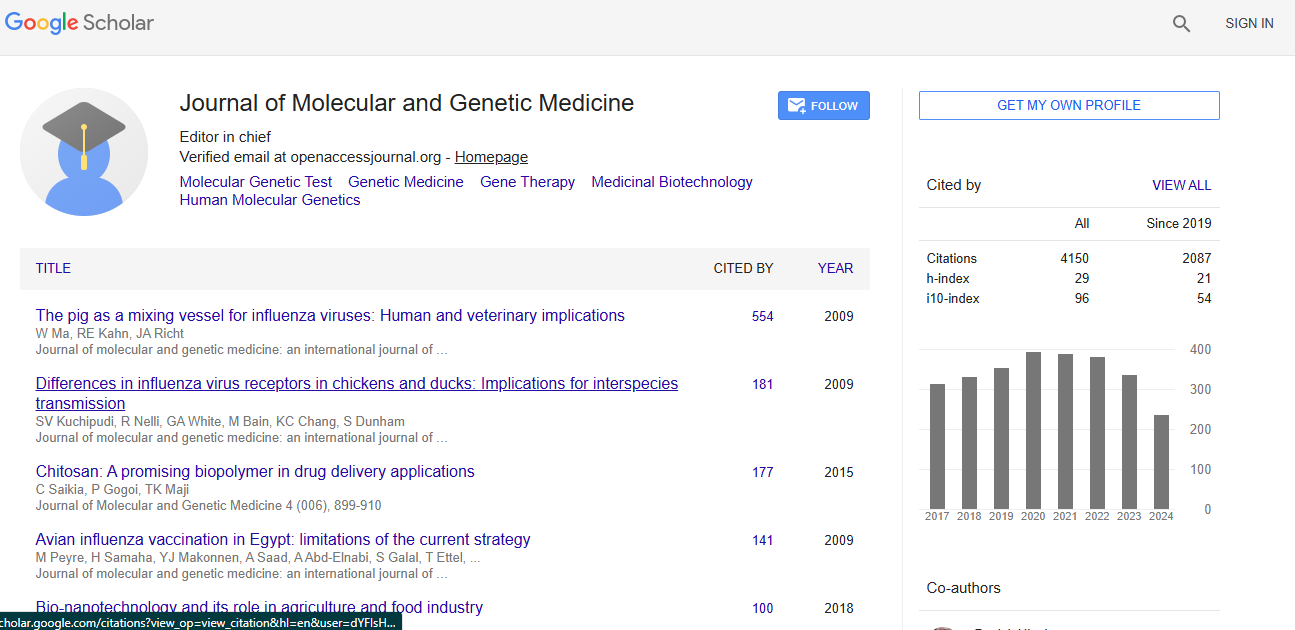
Molecular and Genetic Medicine received 3919 citations as per Google Scholar report