Brief Report - (2025) Volume 16, Issue 5
Received: 01-Sep-2025, Manuscript No. jch-26-178783;
Editor assigned: 03-Sep-2025, Pre QC No. P-178783;
Reviewed: 17-Sep-2025, QC No. Q-178783;
Revised: 22-Sep-2025, Manuscript No. R-178783;
Published:
29-Sep-2025
, DOI: 10.37421/2157-7099.2025.16.815
Citation: El‑Haddad, Amina. ”Frozen Section Advancements: Speed, Accuracy, and Digital Integration.” J Cytol Histol 16 (2025):815.
Copyright: © 2025 El‑Haddad A. This is an open-access article distributed under the terms of the Creative Commons Attribution License, which permits unrestricted use, distribution and reproduction in any medium, provided the original author and source are credited.
Recent advancements in frozen section techniques are significantly enhancing diagnostic speed and accuracy within intraoperative pathology. Innovations are focusing on improving cryoprotection methods, streamlining staining protocols, and integrating digital imaging for remote consultation and archiving purposes. These developments are absolutely crucial for enabling rapid intraoperative diagnosis, effectively guiding surgical decisions in real-time, and ultimately improving overall patient outcomes in a timely manner. [1] The development of new cryoprotective agents, alongside refined sectioning methods, has been instrumental in significantly reducing the occurrence of ice crystal artifacts in frozen sections. This leads to a marked improvement in morphological preservation, which is vital for the accurate identification of subtle pathological changes that might otherwise be obscured. These crucial improvements are particularly vital for oncological resections and other critical surgical procedures where precision is paramount. [2] Digital pathology and telepathology are increasingly being integrated into existing frozen section workflows, transforming how these samples are processed and diagnosed. This integration enables real-time consultation with expert pathologists, irrespective of their geographical location, which can expedite the delivery of second opinions and facilitate valuable teaching and quality control initiatives. The overarching trend is clearly towards a hybrid model that skillfully combines traditional physical specimen handling with advanced digital analysis techniques. [3] Rapid staining techniques for frozen sections are critically important for minimizing turnaround times in the operating room. New reagents and automated staining platforms are actively being developed to achieve excellent staining quality with minimal delay, which directly allows for quicker surgical decision-making and consequently, improved patient management strategies. [4] The application of molecular techniques, such as rapid immunohistochemistry or in situ hybridization directly on frozen sections, represents a significant emerging area of development. These advanced methods provide crucial information regarding specific molecular markers that can profoundly influence treatment strategies, particularly in oncology, offering direct intraoperative insights. [5] Ensuring consistent quality assurance in frozen section diagnosis is of paramount importance for reliable intraoperative assessments. New strategies focused on standardization, rigorous proficiency testing, and continuous professional development are being systematically implemented. The goal is to ensure consistently reliable intraoperative diagnoses across diverse healthcare institutions and pathology departments. [6] The burgeoning role of Artificial Intelligence (AI) in image analysis is beginning to augment the interpretation of frozen sections. Machine learning algorithms are being developed to assist pathologists by intelligently highlighting areas of interest, precisely quantifying cellular features, and potentially reducing the inherent inter-observer variability, thereby enhancing overall diagnostic efficiency and consistency. [7] The refinement of cryostat technology itself, including advancements in precise temperature control and the development of sharper blades, directly contributes to obtaining higher quality frozen sections. Furthermore, the automation of certain cryostat functions is streamlining the entire process and significantly reducing the likelihood of manual errors, leading to more reliable results. [8] The use of specialized fixatives and embedding media for frozen sections is actively being explored as a means to further enhance cellular morphology and reduce the overall processing time required for diagnostic evaluation. These novel approaches aim to effectively bridge the gap between the quality typically achieved with frozen sections and the superior quality of permanent sections. [9] The integration of fluorescence microscopy and other advanced imaging techniques allows for the rapid detection of specific cellular components or pathogens directly within frozen sections. This capability is particularly valuable in scenarios such as infectious disease diagnostics and the assessment of targeted therapy effectiveness during the surgical procedure itself. [10]
Recent advancements in frozen section techniques are significantly enhancing diagnostic speed and accuracy within intraoperative pathology. Innovations are focusing on improving cryoprotection methods, streamlining staining protocols, and integrating digital imaging for remote consultation and archiving purposes. These developments are absolutely crucial for enabling rapid intraoperative diagnosis, effectively guiding surgical decisions in real-time, and ultimately improving overall patient outcomes in a timely manner. [1] The development of new cryoprotective agents, alongside refined sectioning methods, has been instrumental in significantly reducing the occurrence of ice crystal artifacts in frozen sections. This leads to a marked improvement in morphological preservation, which is vital for the accurate identification of subtle pathological changes that might otherwise be obscured. These crucial improvements are particularly vital for oncological resections and other critical surgical procedures where precision is paramount. [2] Digital pathology and telepathology are increasingly being integrated into existing frozen section workflows, transforming how these samples are processed and diagnosed. This integration enables real-time consultation with expert pathologists, irrespective of their geographical location, which can expedite the delivery of second opinions and facilitate valuable teaching and quality control initiatives. The overarching trend is clearly towards a hybrid model that skillfully combines traditional physical specimen handling with advanced digital analysis techniques. [3] Rapid staining techniques for frozen sections are critically important for minimizing turnaround times in the operating room. New reagents and automated staining platforms are actively being developed to achieve excellent staining quality with minimal delay, which directly allows for quicker surgical decision-making and consequently, improved patient management strategies. [4] The application of molecular techniques, such as rapid immunohistochemistry or in situ hybridization directly on frozen sections, represents a significant emerging area of development. These advanced methods provide crucial information regarding specific molecular markers that can profoundly influence treatment strategies, particularly in oncology, offering direct intraoperative insights. [5] Ensuring consistent quality assurance in frozen section diagnosis is of paramount importance for reliable intraoperative assessments. New strategies focused on standardization, rigorous proficiency testing, and continuous professional development are being systematically implemented. The goal is to ensure consistently reliable intraoperative diagnoses across diverse healthcare institutions and pathology departments. [6] The burgeoning role of Artificial Intelligence (AI) in image analysis is beginning to augment the interpretation of frozen sections. Machine learning algorithms are being developed to assist pathologists by intelligently highlighting areas of interest, precisely quantifying cellular features, and potentially reducing the inherent inter-observer variability, thereby enhancing overall diagnostic efficiency and consistency. [7] The refinement of cryostat technology itself, including advancements in precise temperature control and the development of sharper blades, directly contributes to obtaining higher quality frozen sections. Furthermore, the automation of certain cryostat functions is streamlining the entire process and significantly reducing the likelihood of manual errors, leading to more reliable results. [8] The use of specialized fixatives and embedding media for frozen sections is actively being explored as a means to further enhance cellular morphology and reduce the overall processing time required for diagnostic evaluation. These novel approaches aim to effectively bridge the gap between the quality typically achieved with frozen sections and the superior quality of permanent sections. [9] The integration of fluorescence microscopy and other advanced imaging techniques allows for the rapid detection of specific cellular components or pathogens directly within frozen sections. This capability is particularly valuable in scenarios such as infectious disease diagnostics and the assessment of targeted therapy effectiveness during the surgical procedure itself. [10]
Frozen section techniques are undergoing significant advancements to improve diagnostic speed and accuracy. Innovations in cryoprotection, staining protocols, and digital imaging are enhancing intraoperative diagnosis and patient outcomes. Efforts to minimize artifacts through refined sectioning methods are crucial for precise pathological identification. Digital pathology and telepathology are being integrated to facilitate remote consultations and expedite diagnoses. Rapid staining techniques and automated platforms are reducing turnaround times, allowing for quicker surgical decisions. Emerging molecular techniques on frozen sections provide critical intraoperative molecular marker information, especially in oncology. Quality assurance strategies, including standardization and proficiency testing, are essential for reliable diagnoses. Artificial intelligence is emerging as a tool to assist pathologists in image analysis, highlighting areas of interest and reducing variability. Technological refinements in cryostats and the exploration of novel fixatives and embedding media further improve section quality. Advanced imaging modalities, like fluorescence microscopy, enable rapid detection of cellular components and pathogens, aiding in diagnostics and treatment assessment.
None
None
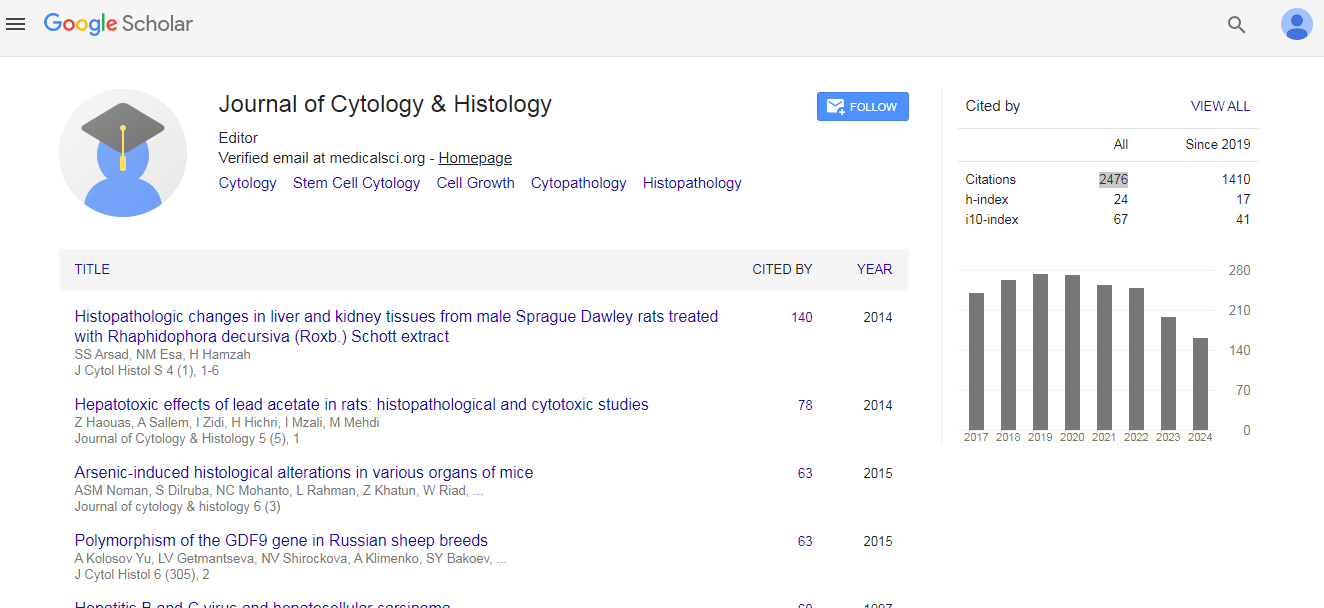
Journal of Cytology & Histology received 2476 citations as per Google Scholar report