Short Communication - (2025) Volume 16, Issue 6
Received: 01-Dec-2025, Manuscript No. jfr-26-184138;
Editor assigned: 03-Dec-2025, Pre QC No. P-184138;
Reviewed: 17-Dec-2025, QC No. Q-184138;
Revised: 22-Dec-2025, Manuscript No. R-184138;
Published:
29-Dec-2025
, DOI: 10.37421/2157-7145.2025.16.699
Citation: Kyriakou, George. ”Forensic Disciplines: Enhancing
Criminal Investigations Through Collaboration.” J Forensic Res 16 (2025):699.
Copyright: © 2025 Kyriakou G. This is an open-access article distributed under the terms of the Creative Commons Attribution License, which permits unrestricted use,
distribution and reproduction in any medium, provided the original author and source are credited.
Complex criminal cases present multifaceted challenges that extend far beyond the traditional boundaries of legal and forensic expertise. The intricate nature of evidence trails often necessitates the integration of diverse scientific disciplines to achieve a comprehensive understanding of case dynamics. Behavioral science, for instance, offers crucial insights into perpetrator motives and victim circumstances, thereby illuminating the psychological underpinnings of criminal actions. This interdisciplinary approach is vital for achieving more accurate and just resolutions in challenging legal investigations [1].
The pervasive influence of advanced digital technologies has introduced a new frontier in criminal investigations, presenting both significant hurdles and novel opportunities. Digital forensics plays an indispensable role in reconstructing events, identifying digital footprints, and analyzing vast datasets that are frequently central to complex cases. Equipping legal professionals and forensic scientists with the requisite skills to navigate this digital landscape is paramount for effective investigation [2].
Understanding the psychological dimensions of criminal behavior is fundamental to dissecting intricate cases. Forensic psychology contributes significantly by informing investigative strategies through offender profiling, victimology, and the analysis of interpersonal violence dynamics. The amalgamation of psychological assessments with other forms of forensic evidence yields a more holistic and robust perspective on the case [3].
Even the most minute and seemingly insignificant pieces of evidence can prove pivotal in complex criminal investigations. The analysis of trace evidence, employing advanced techniques such as mass spectrometry and DNA profiling, is critical for interpreting subtle clues. Effective utilization of this evidence hinges on collaborative efforts between forensic chemists, biologists, and investigators [4].
In cases involving unidentified human remains, forensic anthropology serves a critical function in identification and reconstructing the circumstances surrounding death. When combined with forensic pathology and genetics, anthropological analysis provides irrefutable evidence, aiding in victim identification and establishing crucial timelines, particularly in cases with decomposition or dismemberment [5].
The interpretation of ballistic evidence demands specialized knowledge, and its integration with other forensic disciplines significantly enhances the investigative process. Firearms expertise, when combined with crime scene reconstruction and DNA analysis, can effectively corroborate or refute witness testimonies and meticulously establish the sequence of events in violent crimes [6].
Forensic toxicology is an indispensable tool in investigations involving poisoning, drug-facilitated crimes, and post-mortem assessments. The accurate identification and quantification of substances require interdisciplinary collaboration among toxicologists, pathologists, and investigators to provide crucial insights into the cause and manner of death [7].
Crime scene reconstruction is a dynamic and complex process that draws upon multiple forensic specialties to elucidate the sequence of events. Integrating biomechanical analysis, bloodstain pattern analysis, and trajectory analysis allows for a more accurate depiction of a crime's progression, especially in scenarios where evidence may appear contradictory [8].
The field of forensic odontology offers unique contributions to identification and bite mark analysis, particularly in cases involving significant decomposition or trauma. This discipline's effectiveness is greatly amplified through collaboration with forensic pathologists and DNA analysts, ensuring accurate victim identification and reliable suspect linkage to crime scenes [9].
Investigating criminal cases involving multiple victims or serial offenses requires a highly coordinated approach that spans various forensic specializations. The integration of entomological data with toxicology, DNA analysis, and crime scene reconstruction is crucial for establishing timelines, identifying patterns, and ultimately apprehending perpetrators more efficiently [10].
The synergy of diverse forensic disciplines is paramount in the effective investigation of complex criminal cases. Integrating insights from fields such as behavioral science, digital forensics, and forensic anthropology allows for a deeper understanding of intricate evidence trails. By fostering collaborative frameworks, legal teams and investigators can achieve a more comprehensive grasp of case dynamics, perpetrator motives, and victim circumstances, leading to more accurate and just resolutions [1].
The rapid evolution of digital technologies presents both complex challenges and valuable opportunities within the realm of criminal investigations. Digital forensics has emerged as a critical discipline, essential for reconstructing events, identifying digital footprints, and meticulously analyzing the large datasets often pivotal in complex cases. This underscores the growing necessity for interdisciplinary training to equip legal professionals and forensic scientists with the expertise needed to navigate the evolving digital landscape effectively [2].
Comprehending the psychological underpinnings of criminal behavior is of paramount importance in the thorough dissection of complex cases. Forensic psychology plays a vital role in informing investigative strategies by offering critical insights into offender profiling, victimology, and the intricate dynamics of interpersonal violence. The integration of psychological assessments with other forms of forensic evidence provides a more holistic and comprehensive perspective on the case [3].
In the context of complex criminal cases, the analysis of trace evidence, which often consists of minute and seemingly insignificant materials, can be decisive. Advanced analytical techniques, including mass spectrometry and DNA profiling, are crucial for interpreting this subtle evidence. The effective utilization of trace evidence relies heavily on the collaborative efforts among forensic chemists, biologists, and investigators [4].
Forensic anthropology plays a critical role in the identification of human remains and the reconstruction of the circumstances surrounding death, especially in cases involving decomposition or dismemberment. This field's contribution is significantly amplified when integrated with forensic pathology and genetics, providing irrefutable evidence that aids in victim identification and the establishment of crucial timelines in complex cases [5].
The interpretation of ballistic evidence requires specialized knowledge, and its integration with other forensic disciplines significantly enhances the investigative process. This expertise, when combined with crime scene reconstruction and DNA analysis, can effectively corroborate or refute witness testimonies and precisely establish the sequence of events in violent crimes [6].
Forensic toxicology is an essential component of interdisciplinary case resolution, particularly in investigations involving poisoning, drug-facilitated crimes, and post-mortem examinations. Accurate identification and quantification of substances necessitate close collaboration between toxicologists, pathologists, and investigators to provide critical insights into the cause and manner of death [7].
Crime scene reconstruction, a dynamic process that synthesizes information from multiple forensic specialties, is crucial for understanding the chronological progression of events. Integrating biomechanical analysis, bloodstain pattern analysis, and trajectory analysis enables a more accurate depiction of a crime's unfolding, particularly in complex scenarios with potentially conflicting evidence [8].
Forensic odontology offers unique and valuable insights for identification and the analysis of bite marks, especially in cases characterized by severe decomposition or significant trauma. The effectiveness of this discipline is enhanced through collaboration with forensic pathologists and DNA analysts, facilitating reliable victim identification and the linkage of suspects to crime scenes [9].
Investigating criminal cases involving multiple victims or serial offenses demands a coordinated approach that leverages various forensic specializations. The integration of entomological data with toxicology, DNA analysis, and crime scene reconstruction is vital for establishing timelines, identifying patterns, and ultimately improving the efficiency of apprehending perpetrators [10].
Complex criminal investigations benefit significantly from the integration of multiple forensic disciplines. Fields such as behavioral science, digital forensics, forensic psychology, trace evidence analysis, forensic anthropology, ballistics, forensic toxicology, crime scene reconstruction, forensic odontology, and entomology all contribute unique perspectives and techniques. By fostering collaboration among these specializations, investigators can achieve a more comprehensive understanding of evidence, perpetrator motives, and victim circumstances. This interdisciplinary approach enhances the accuracy of case reconstruction, victim identification, and the establishment of timelines, ultimately leading to more just and effective resolutions in challenging legal matters. The advancement of digital technologies and sophisticated analytical methods further amplifies the capabilities of these integrated forensic efforts.
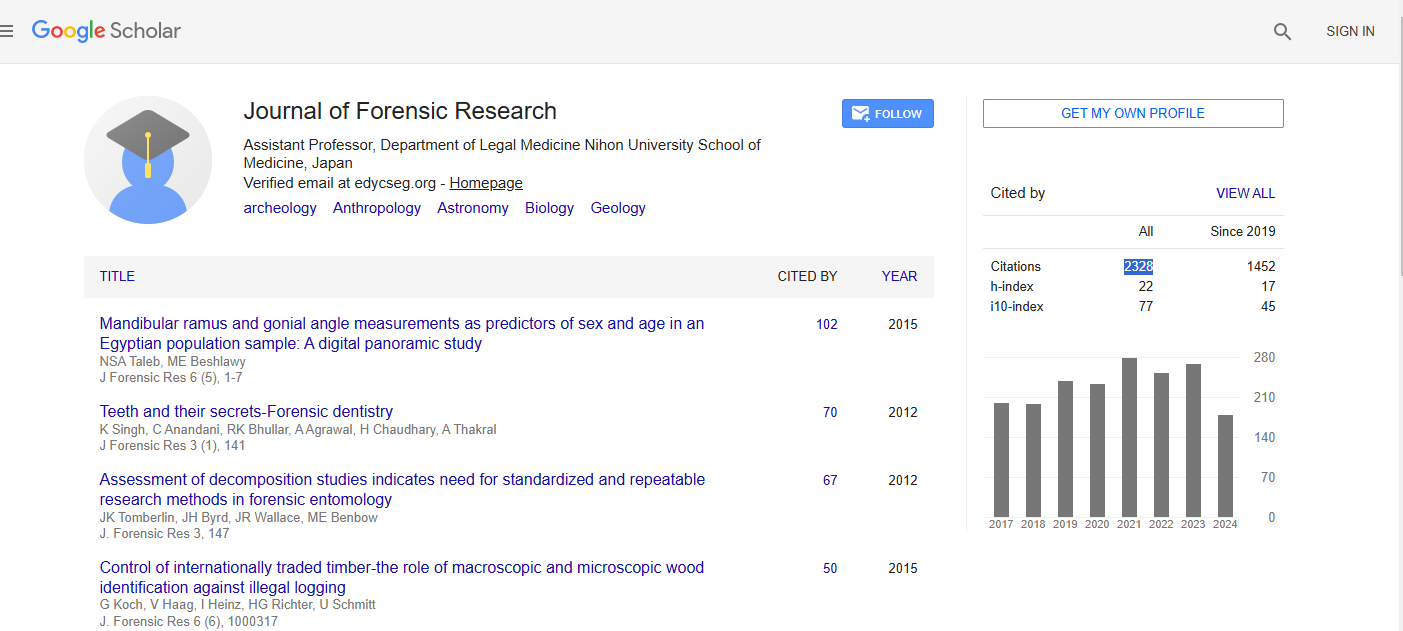
Journal of Forensic Research received 2328 citations as per Google Scholar report