Opinion - (2025) Volume 13, Issue 4
Received: 01-Jul-2025, Manuscript No. economics-26-186059;
Editor assigned: 03-Jul-2025, Pre QC No. P-186059;
Reviewed: 17-Jul-2025, QC No. Q-186059;
Revised: 22-Jul-2025, Manuscript No. R-186059;
Published:
29-Jul-2025
, DOI: 10.37421/2375-4389.2025.13.535
Citation: Papadopoulou, Eleni. ”Fiscal Policy’s Influence On Aggregate
Demand.” J Glob Econ 13 (2025):535.
Copyright: © 2025 Papadopoulou E. This is an open-access article distributed under the terms of the Creative Commons Attribution License, which permits unrestricted use,
distribution and reproduction in any medium, provided the original author and source are credited.
Fiscal policy, encompassing alterations in taxation and government expenditure, exerts a significant influence on aggregate demand. Tax reductions can bolster disposable income, thereby stimulating consumer spending and investment, leading to a rightward shift in the aggregate demand curve. Conversely, tax increases typically dampen demand. The extent and persistence of these effects are contingent upon several elements, including the marginal propensity to consume, expectations regarding future policies, and the prevailing economic climate. Government spending directly contributes to aggregate demand, with its impact potentially magnified by the multiplier effect [1].
Understanding the transmission pathways of fiscal policy is paramount to grasping its influence on aggregate demand. This research investigates how adjustments in personal income taxes, corporate taxes, and government consumption affect output and inflation. It underscores that the aggregate demand response is sensitive to the composition of fiscal policy and the economic conditions, particularly within open economies characterized by substantial international capital flows [2].
The efficacy of tax policy in stimulating aggregate demand can be modulated by the forward-looking behavior of households and corporations. This study examines how anticipated future tax changes influence current decisions regarding consumption and investment. It posits that credible and permanent fiscal policy announcements exert a more substantial impact on aggregate demand compared to temporary or uncertain ones [3].
This paper analyzes the role of fiscal policy in stabilizing aggregate demand using a New Keynesian model. It concludes that discretionary fiscal measures, specifically changes in government spending and taxes, can effectively mitigate economic downturns. The study also emphasizes the significance of the fiscal stimulus's composition, noting that measures directly boosting demand for goods and services are generally more effective [4].
The influence of tax policy on aggregate demand is explored within the context of international spillovers. This research demonstrates that domestic fiscal policies can impact not only the national economy but also its trading partners through aggregate demand channels. It highlights the interconnectedness of economies and the necessity for coordinated fiscal strategies [5].
This study investigates the effect of corporate tax policies on business investment and, consequently, on aggregate demand. It finds that reductions in corporate taxes can foster increased business expenditure, particularly in capital goods, which subsequently contributes to aggregate demand. However, this response is dependent on factors such as financing costs and projected future profitability [6].
The effects of progressive versus regressive tax policies on aggregate demand are systematically analyzed. The findings indicate that progressive tax structures, which impose a greater tax burden on higher earners, may yield a more pronounced stimulation of aggregate demand when tax rates are lowered, given that lower and middle-income households typically exhibit a higher marginal propensity to consume [7].
This research scrutinizes the effectiveness of supply-side tax cuts in influencing aggregate demand. It contends that while supply-side strategies aim to enhance production, their impact on aggregate demand is often indirect and less pronounced than that of direct demand-management fiscal interventions. The study highlights the potential for tax cuts to widen deficits without a corresponding increase in aggregate demand [8].
The influence of fiscal policy, including tax-related measures, on aggregate demand is examined through the framework of heterogeneous agents. This study reveals that distinct agent groups react differently to tax alterations, resulting in varied effects on overall consumption and investment, and consequently on aggregate demand [9].
This paper examines how uncertainty surrounding tax policy impacts aggregate demand. It ascertains that heightened uncertainty regarding future tax rates can precipitate a deferral of consumption and investment decisions, thereby diminishing current aggregate demand [10].
Fiscal policy, particularly changes in taxation and government spending, plays a pivotal role in influencing aggregate demand. Tax cuts can boost disposable income, encouraging consumer spending and investment, thereby shifting the aggregate demand curve to the right. Conversely, tax increases tend to dampen demand. The magnitude and duration of these effects depend on various factors, including the marginal propensity to consume, expectations about future policies, and the overall economic climate. Government spending directly adds to aggregate demand, with its impact amplified by the multiplier effect [1].
Examining the transmission mechanisms of fiscal policy is crucial for understanding its impact on aggregate demand. This study delves into how changes in personal income taxes, corporate taxes, and government consumption affect output and inflation. It highlights that the response of aggregate demand is sensitive to the composition of fiscal policy and the state of the economy, particularly in open economies with significant international capital flows [2].
The effectiveness of tax policy in stimulating aggregate demand can be moderated by forward-looking behavior of households and firms. This research explores how anticipated future tax changes influence current consumption and investment decisions. It suggests that credible and permanent fiscal policy announcements have a more significant impact on aggregate demand than temporary or uncertain ones [3].
This paper investigates the impact of tax policy on aggregate demand through the lens of a New Keynesian model. It finds that discretionary fiscal policy, specifically changes in government spending and taxes, can effectively stabilize the economy during recessions. The study also highlights the importance of the composition of fiscal stimulus, with measures directly boosting demand for goods and services proving more potent [4].
The impact of tax policy on aggregate demand is explored in the context of international spillovers. This research demonstrates that domestic fiscal policy can affect not only the domestic economy but also trading partners through aggregate demand channels. It emphasizes the interconnectedness of economies and the need for coordinated fiscal responses [5].
This study examines the effect of corporate tax policy on business investment and, by extension, aggregate demand. It finds that reductions in corporate taxes can lead to increased business spending, particularly on capital goods, which contributes to aggregate demand. However, the response is contingent on factors like financing costs and expected future profitability [6].
The impact of progressive vs. regressive tax policies on aggregate demand is analyzed. The findings suggest that progressive tax structures, which place a higher burden on higher earners, may lead to a stronger boost in aggregate demand when tax rates are reduced, as lower and middle-income households tend to have a higher marginal propensity to consume [7].
This research explores the effectiveness of supply-side tax cuts in influencing aggregate demand. It argues that while supply-side policies are intended to boost production, their impact on aggregate demand is often indirect and less potent than direct demand-management fiscal measures. The study emphasizes the potential for tax cuts to increase deficits without a commensurate increase in aggregate demand [8].
The impact of fiscal policy, including tax measures, on aggregate demand is examined through the lens of heterogeneous agents. This study highlights that different groups of agents respond differently to tax changes, leading to varied impacts on overall consumption and investment, and thus aggregate demand [9].
This paper investigates how uncertainty surrounding tax policy affects aggregate demand. It finds that increased uncertainty about future tax rates can lead to a postponement of consumption and investment decisions, thereby dampening current aggregate demand [10].
Fiscal policy, encompassing taxation and government spending, significantly influences aggregate demand. Tax cuts can stimulate spending and investment, while tax increases tend to dampen demand. The effectiveness of these policies is influenced by factors such as the marginal propensity to consume and economic conditions. Studies highlight that the composition of fiscal policy and the state of the economy are crucial determinants of aggregate demand response. Forward-looking behavior and the credibility of policy announcements also play a role. Direct demand-boosting measures are often more potent than indirect ones. Corporate tax cuts can encourage business investment, but their impact is contingent on financing costs and profitability expectations. Progressive tax structures may offer a stronger boost to aggregate demand. Supply-side tax cuts have a less direct and potent impact on aggregate demand compared to direct demand-management measures. Heterogeneous agent responses and uncertainty surrounding tax policy can also moderate aggregate demand effects. International spillovers of fiscal policy underscore the need for coordinated global responses.
None
None
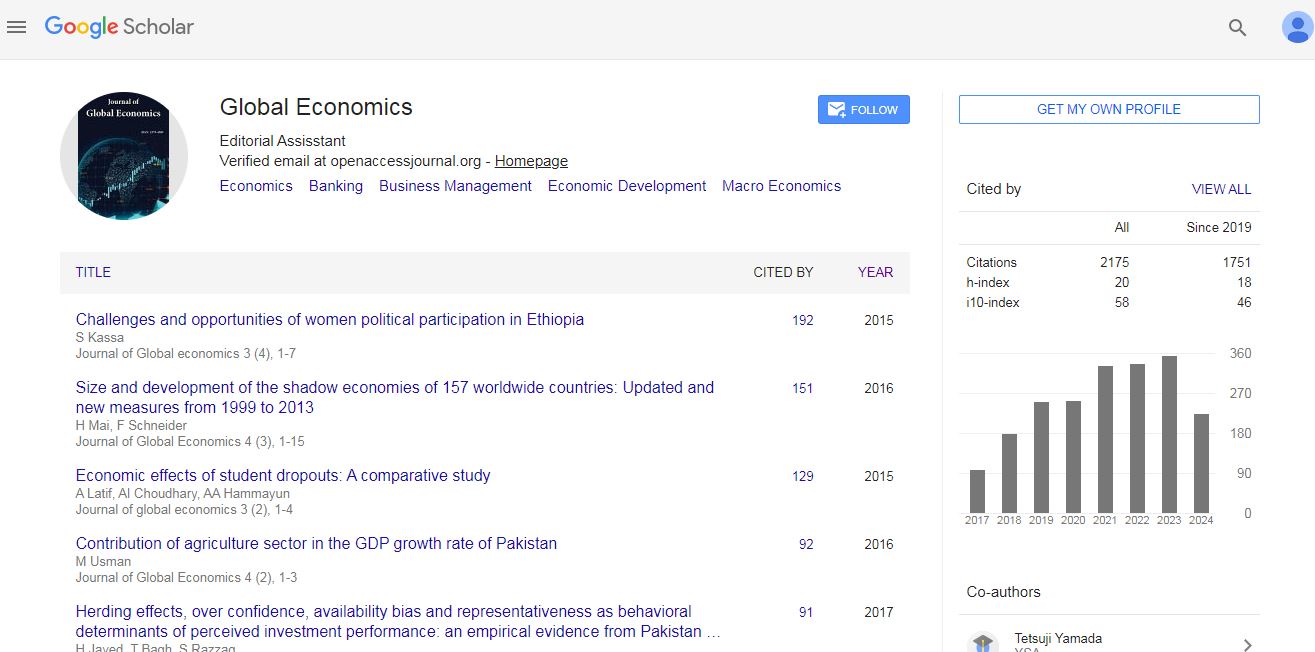
Journal of Global Economics received 2175 citations as per Google Scholar report