Short Communication - (2025) Volume 13, Issue 3
Received: 01-May-2025, Manuscript No. economics-26-186053;
Editor assigned: 05-May-2025, Pre QC No. P-186053;
Reviewed: 19-May-2025, QC No. Q-186053;
Revised: 22-May-2025, Manuscript No. R-186053;
Published:
29-May-2025
, DOI: 10.37421/2375-4389.2025.13.529
Citation: Cho, Daniel. ”Fiscal Policy, Deficits, and Macroeconomic
Stability.” J Glob Econ 13 (2025):529.
Copyright: © 2025 Cho D. This is an open-access article distributed under the terms of the Creative Commons Attribution License, which permits unrestricted use, distribution
and reproduction in any medium, provided the original author and source are credited.
The intricate relationship between public spending, budget deficits, and macroeconomic stability forms the bedrock of modern economic policy, demanding rigorous investigation into their multifaceted interactions. This field of study seeks to unravel how governmental fiscal decisions influence the broader economic landscape, encompassing growth, inflation, and overall financial health. The current body of research highlights the delicate balance governments must strike when wielding fiscal tools, emphasizing the potential benefits of stimulus against the inherent risks of unchecked deficits. Public spending, a cornerstone of government activity, directly impacts aggregate demand and resource allocation within an economy. Its composition and scale are crucial determinants of economic performance, with different types of spending yielding varied outcomes. Understanding these nuances is vital for policymakers aiming to foster sustainable growth and price stability. The phenomenon of budget deficits, often arising from the divergence between government expenditure and revenue, presents a persistent challenge. While deficits can be a necessary tool for economic management during downturns or for strategic investment, their sustained accumulation poses significant risks to macroeconomic stability. The research delves into the mechanisms through which these deficits exert their influence, affecting everything from interest rates to investor sentiment. Fiscal discipline, therefore, emerges not merely as a budgetary constraint but as a fundamental requirement for long-term economic well-being. Prudent spending strategies are essential to navigate the complexities of public finance and to ensure that government interventions contribute positively to economic resilience rather than undermining it. This involves careful planning and execution of fiscal policies. The global economic environment, characterized by its inherent uncertainties and interconnectedness, further complicates the management of public debt and deficits. Emerging challenges, such as global shocks and shifts in international financial flows, necessitate adaptable and robust fiscal frameworks that can withstand external pressures and maintain domestic stability. The need for strategic foresight is paramount. Examining the composition of public spending reveals that not all expenditures are created equal in their impact on economic outcomes. Investment-oriented public outlays, such as those directed towards infrastructure or education, are often associated with positive long-term growth effects. Conversely, consumption-oriented spending, particularly when financed through borrowing, can fuel inflationary pressures and destabilize the economy. Moreover, the specific context of developing economies often magnifies the challenges associated with fiscal deficits. In these regions, persistent deficits, frequently exacerbated by inefficient public sector management and political instability, can significantly heighten the risk of macroeconomic volatility, including currency crises and sharp output fluctuations. Strengthening fiscal rules is therefore critical. The accumulation of public debt, a direct consequence of sustained deficits, also carries profound implications for long-run economic growth. Research indicates a non-linear relationship, where moderate debt levels may be manageable, but excessive debt can stifle private investment, escalate interest payments, and ultimately reduce an economy's productive capacity. Strategic debt management is key. Fiscal policy shocks, whether through changes in government spending or taxation, transmit through various channels to affect macroeconomic variables. Understanding these transmission mechanisms, often employing sophisticated economic models, is essential for predicting and managing the consequences of fiscal interventions. The credibility of institutions plays a crucial role. Finally, the process of fiscal consolidation, while often necessary for restoring economic stability, must be approached with careful consideration. Aggressive austerity measures, particularly in the wake of financial crises, can inadvertently deepen recessions if not implemented judiciously. A balanced approach is therefore advocated to ensure a smooth transition.
The intricate relationship between public spending and budget deficits, and their subsequent influence on macroeconomic stability, constitutes a pivotal area of economic inquiry. The research underscores that while fiscal stimulus can be instrumental in fostering economic growth, a sustained pattern of high budget deficits carries substantial risks, including inflationary pressures, increased borrowing costs, and a palpable erosion of investor confidence. Consequently, the imperative for fiscal discipline and the adoption of prudent spending strategies are highlighted as cornerstones for preserving long-term economic health. This complex interplay is further complicated by the prevailing era of global economic uncertainty, which presents unique challenges in managing public debt and ensuring fiscal resilience. The composition of public spending is a critical determinant of its impact on economic growth and inflation. Studies reveal that public expenditures channeled into investment-oriented projects, such as infrastructure development and human capital enhancement, tend to yield positive and sustainable long-term economic growth. In contrast, government spending primarily focused on consumption, especially when financed through increased borrowing, can contribute to inflationary pressures and economic instability. Therefore, the emphasis is increasingly placed on the quality rather than the sheer quantity of public outlays to achieve sustainable macroeconomic stability. In the specific context of developing economies, fiscal deficits often pose a more pronounced threat to macroeconomic stability. Persistent deficits in these nations are frequently linked to underlying issues of inefficient public sector management and political instability. These factors can significantly elevate the likelihood of adverse macroeconomic events, including currency crises and substantial fluctuations in economic output. The findings strongly suggest that the implementation of robust fiscal rules and improvements in expenditure accountability are paramount for enhancing stability. The long-run consequences of accumulating public debt on economic growth and fiscal sustainability are subjects of extensive research. The observed relationship is often non-linear: while moderate levels of debt may not impede growth, excessive debt burdens can lead to a crowding out of private investment, escalate interest payment obligations, and ultimately diminish the economy's potential output. This underscores the necessity of a strategic and forward-looking approach to debt management, with a particular focus on intergenerational equity. Fiscal policy shocks, whether stemming from changes in government spending or taxation, propagate through various transmission mechanisms, impacting key macroeconomic variables such as output, inflation, and employment. Sophisticated economic models are frequently employed to illustrate how these shocks can create ripple effects throughout the economy. The effectiveness and stability implications of fiscal policy are intricately linked to a range of factors, including the credibility of governing institutions and the prevailing state of the business cycle, highlighting the complexity of policy design. The process of fiscal consolidation, often undertaken in the aftermath of financial crises, requires careful navigation to safeguard macroeconomic stability. While essential for restoring market confidence and alleviating debt burdens, overly aggressive austerity measures can, if not implemented with precision, inadvertently lead to deeper recessions and heightened unemployment. The research advocates for a balanced strategy that combines expenditure rationalization with carefully targeted stimulus measures when appropriate, ensuring a smoother economic adjustment. The quality of governance plays a pivotal role in determining the efficiency of public spending and, consequently, its impact on macroeconomic stability. Countries that exhibit stronger institutional frameworks and lower levels of corruption tend to derive greater economic benefits from their public expenditures. This enhanced efficiency translates into more stable economic environments, suggesting that institutional reforms aimed at improving governance are crucial for maximizing the positive effects of fiscal policy and ensuring enduring stability. Fiscal policy's role in managing economic cycles is often analyzed through the lens of counter-cyclical versus pro-cyclical spending patterns. Counter-cyclical fiscal policies, designed to stabilize output and employment during economic downturns, are generally considered effective. However, pro-cyclical fiscal behavior, more prevalent in certain developing economies, can exacerbate economic downturns and amplify macroeconomic volatility. Building fiscal buffers during periods of economic expansion is thus recommended. The interplay between sovereign debt levels and financial market stability is a critical concern, particularly regarding the risk of sovereign debt crises. Research identifies specific thresholds beyond which escalating debt can trigger adverse financial market reactions, including increased borrowing costs, capital flight, and contagion effects across economies. The findings underscore the importance of rigorous debt sustainability analysis and the establishment of credible fiscal frameworks. Finally, the effectiveness of monetary policy in achieving macroeconomic stability can be significantly influenced by the fiscal stance. Large and persistent fiscal deficits can introduce complexities into monetary policy operations, potentially leading to higher inflation or compelling the central bank to adopt tighter monetary conditions, which can dampen economic activity. Improved coordination between fiscal and monetary authorities is therefore deemed essential for achieving overall macroeconomic stability and fostering sustainable growth.
This collection of research explores the complex relationship between fiscal policy, public spending, budget deficits, and macroeconomic stability. Key findings indicate that while fiscal stimulus can boost growth, sustained deficits pose risks such as inflation and reduced investor confidence. The composition of public spending is crucial, with investment-oriented outlays benefiting long-term growth more than consumption-oriented ones. Developing economies face heightened volatility from deficits due to governance issues. Excessive public debt can hinder growth and financial stability. Effective fiscal policy requires strong institutions, prudent debt management, and coordination with monetary policy. Fiscal consolidation must be balanced to avoid exacerbating recessions. The quality of governance directly impacts spending efficiency and economic stability.
None
None
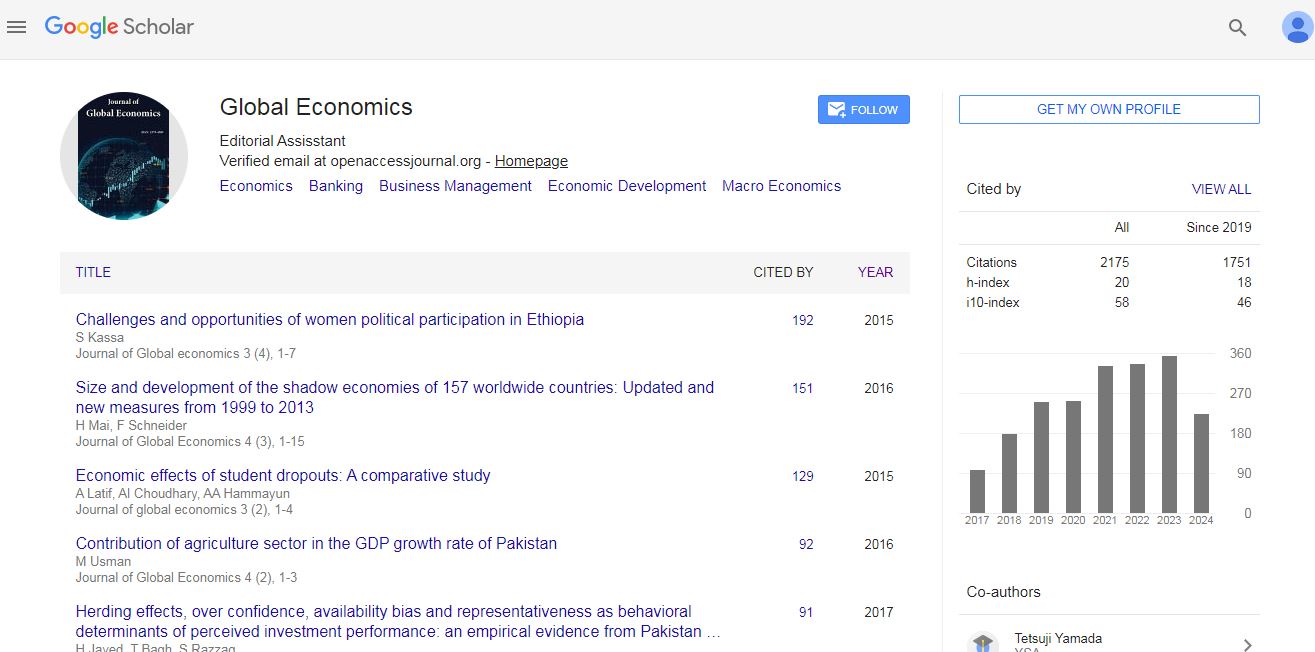
Journal of Global Economics received 2175 citations as per Google Scholar report