Commentary - (2025) Volume 13, Issue 4
Received: 01-Jul-2025, Manuscript No. economics-26-186057;
Editor assigned: 03-Jul-2025, Pre QC No. P-186057;
Reviewed: 17-Jul-2025, QC No. Q-186057;
Revised: 22-Jul-2025, Manuscript No. R-186057;
Published:
29-Jul-2025
, DOI: 10.37421/2375-4389.2025.13.533
Citation: Wei, Chen. ”Fiscal Decentralization: Driving Regional
Growth and Challenges.” J Glob Econ 13 (2025):533.
Copyright: © 2025 Wei C. This is an open-access article distributed under the terms of the Creative Commons Attribution License, which permits unrestricted use, distribution
and reproduction in any medium, provided the original author and source are credited.
Fiscal decentralization has emerged as a critical policy lever for fostering regional economic development across various global contexts [1].
This policy framework aims to devolve fiscal authority from central governments to subnational entities, thereby empowering local administrations to design and implement economic strategies tailored to their specific needs and opportunities [2].
Furthermore, the strategic allocation of fiscal resources and responsibilities to regional levels has been linked to enhanced innovation and entrepreneurial activities, vital components of a dynamic economy [3].
However, the impact of fiscal decentralization on regional income disparities remains a complex issue, with potential to either mitigate or exacerbate existing inequalities depending on the policy design and implementation [4].
Moreover, the capacity of subnational governments to engage in borrowing for development projects is significantly influenced by their level of fiscal autonomy, presenting both opportunities for growth and risks of fiscal instability [5].
The institutional architecture underpinning fiscal decentralization plays a pivotal role in determining its effectiveness, emphasizing the importance of transparency, accountability, and well-defined revenue assignments [6].
In terms of global economic engagement, fiscal decentralization has been shown to bolster regional competitiveness by enabling targeted investments in infrastructure and human capital, thereby enhancing a region's ability to attract and retain economic activity [7].
A key objective often associated with fiscal decentralization is the promotion of balanced regional development, ensuring that economic progress is not confined to a few urban centers but spreads to lagging areas [8].
Additionally, the ability of subnational governments to independently generate revenue is crucial for funding essential public services and implementing development initiatives, directly impacting regional economic vitality [9].
Finally, the influence of fiscal decentralization on regional investment patterns is substantial, as empowered local governments can create more favorable environments for both domestic and foreign direct investment through targeted incentives and infrastructure improvements [10].
The discourse surrounding fiscal decentralization often begins with its fundamental role in shaping regional economic trajectories. The empowerment of local governments to tailor policies to specific regional needs is a cornerstone of this approach, aiming to foster innovation and efficiency within localized economic landscapes [1].
This devolution of fiscal authority is intrinsically linked to the quality of local public service delivery. Increased fiscal autonomy for subnational governments can lead to more responsive and efficient provision of services, contingent on institutional capacity and adequate own-source revenues [2].
The promotion of regional innovation and entrepreneurship is another significant outcome attributed to fiscal decentralization. By granting regions fiscal control, the implementation of tailored support mechanisms for local businesses and investment attraction becomes more feasible, boosting innovative capacity [3].
Conversely, the impact of fiscal decentralization on regional income inequality presents a dual nature. While it can facilitate targeted development strategies, poorly managed fiscal transfers or uneven resource endowments may exacerbate disparities without careful consideration of intergovernmental fiscal relations [4].
The capacity for subnational borrowing for regional development projects is directly influenced by fiscal decentralization. This autonomy offers opportunities for financing infrastructure and development but also necessitates robust fiscal management frameworks to mitigate risks of instability and debt mismanagement [5].
The institutional framework governing fiscal decentralization is paramount to its success. Transparency, accountability, and clear revenue assignments are critical determinants of whether fiscal decentralization translates into positive development outcomes, preventing inefficiencies and corruption [6].
Enhancing regional competitiveness is a recognized benefit of fiscal decentralization. Regions with greater fiscal control can invest more effectively in infrastructure, education, and incentives, thereby improving their ability to compete economically, especially when policies are adapted to unique strengths [7].
Achieving balanced regional development is a complex goal where fiscal decentralization plays a role. While it can foster growth in lagging regions through context-specific policies, it requires equalization mechanisms and central support to prevent widening disparities and ensure inclusive growth [8].
The generation of local government revenue and its implications for regional development are directly affected by fiscal decentralization. Granting greater control over revenue sources incentivizes local economic activity and tax base broadening, provided there is a stable intergovernmental fiscal system [9].
Finally, the influence of fiscal decentralization on regional investment patterns is notable. Greater fiscal autonomy allows regions to offer attractive incentives and develop infrastructure, thereby encouraging domestic and foreign direct investment, contingent on good governance and sound economic strategies [10].
Fiscal decentralization is a policy that empowers local governments with greater fiscal control, aiming to improve regional economic development, public service delivery, and innovation. It can lead to more tailored policies that foster efficiency and competitiveness. However, potential challenges include widening regional disparities, fiscal instability from subnational borrowing, and the risk of exacerbating income inequality if not managed effectively. The success of fiscal decentralization is heavily dependent on strong institutional frameworks, transparency, accountability, and well-designed intergovernmental fiscal relations, including revenue generation and transfers. When implemented thoughtfully, it can stimulate investment and promote balanced regional growth.
None
None
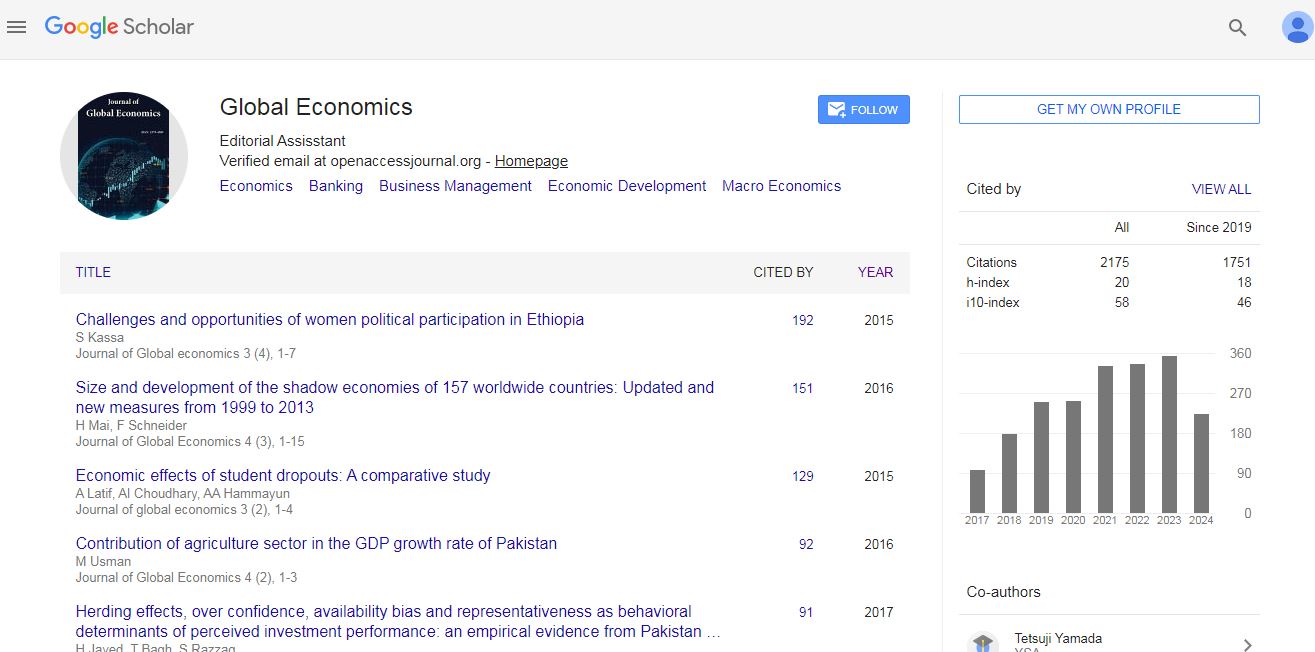
Journal of Global Economics received 2175 citations as per Google Scholar report