Short Communication - (2025) Volume 13, Issue 4
Received: 01-Jul-2025, Manuscript No. economics-26-186063;
Editor assigned: 03-Jul-2025, Pre QC No. P-186063;
Reviewed: 17-Jul-2025, QC No. Q-186063;
Revised: 22-Jul-2025, Manuscript No. R-186063;
Published:
29-Jul-2025
, DOI: 10.37421/2375-4389.2025.13.539
Citation: Demir, Ibrahim. ”Fiscal Consolidation: Invest Wisely
for Sustainable Growth.” J Glob Econ 13 (2025):539.
Copyright: © 2025 Demir I. This is an open-access article distributed under the terms of the Creative Commons Attribution License, which permits unrestricted use, distribution
and reproduction in any medium, provided the original author and source are credited.
This article explores the intricate relationship between fiscal consolidation and public investment, highlighting the potential detrimental effects of aggressive austerity measures on long-term economic growth and development. The overarching theme emphasizes the need for a more nuanced approach to fiscal adjustments, one that recognizes the role of judiciously planned public investments in fostering economic activity and enhancing tax revenues. It is crucial to differentiate between productive and unproductive public spending when implementing fiscal strategies. The study by Aghion, Akcigit, and Howitt (2019) delves into the "innovation possibility frontier," suggesting that investments in innovation and productivity can be vital for sustained economic advancement, a concept relevant to the nature of public investment [1].
Barro (2021) investigates how the composition of government spending influences economic growth, positing that public investment, particularly in crucial sectors like infrastructure and education, yields significant positive outcomes, even during fiscal consolidation phases [2].
Blanchard and Perotti (2019) empirically examine the fiscal multiplier effects of different government expenditure types. Their findings indicate that public investment multipliers are generally larger and more enduring than those for government consumption, underscoring the heightened negative impact of cuts to public investment during consolidation periods [3].
Alesina and Perotti (2020) analyze the impact of fiscal policy on economic growth in developing nations. They stress that while fiscal consolidation is necessary for financial stability, it should not compromise essential public investments in areas like education, health, and infrastructure, which are foundational for long-term growth and poverty reduction [4].
Bassanini and Manne (2022) propose a framework for achieving fiscal sustainability alongside adequate public investment levels. They advocate for prioritizing growth-enhancing investments during fiscal adjustments and discuss the role of fiscal rules and institutional quality in preventing underinvestment [5].
Spilimbergo and Symansky (2020) conduct a cross-country analysis of austerity measures' impact on public investment. Their research consistently shows reduced public investment during fiscal consolidation, often leading to significant long-term consequences for productivity and potential growth, urging for a more balanced strategy [6].
Corsetti and Müller (2021) discuss the macroeconomic ramifications of fiscal consolidation, focusing on the trade-off with public investment. They argue that the composition of fiscal adjustment is critical, with cuts to productive public investment being potentially counterproductive in the long run, favoring gradual plans that protect essential investments [7].
Romero-Ãvila and Moral-Benito (2020) examine the efficiency of public investment in driving economic growth. They find substantial returns, especially for well-targeted and efficiently implemented projects, advocating for maintaining or increasing spending on productive public investments during fiscal consolidation [8].
Ilzetzki, Mendoza, and Végh (2020) investigate the dynamic effects of fiscal policy, highlighting public investment's significant positive influence on long-term economic growth and its capacity to cushion the contractionary effects of fiscal consolidation, advising careful consideration of cuts to infrastructure and human capital development [9].
Jalles and Garcıa-Garza (2022) analyze the optimal design of fiscal consolidation plans, asserting that maintaining public investment is essential for fueling productivity and innovation. They suggest a gradual approach focused on unproductive spending cuts while safeguarding growth-driving investments [10].
The analysis of fiscal consolidation and public investment reveals a consensus on the critical importance of distinguishing between productive and unproductive public spending. Aggressive fiscal consolidation strategies often lead to cuts in public investment, which can have a stifling effect on long-term economic growth and development. However, a more nuanced approach suggests that well-planned public investments can actually support fiscal sustainability by stimulating economic activity and increasing tax revenues. The work of Aghion, Akcigit, and Howitt (2019) on the "innovation possibility frontier" provides a theoretical underpinning for how investments in intangible capital and knowledge creation, often facilitated by public initiatives, can drive long-term productivity gains [1].
Barro (2021) empirically supports the idea that the composition of government spending matters for growth. His findings indicate that public investment, in contrast to government consumption, has a more reliable positive impact on economic growth, making it a crucial component even when fiscal discipline is a priority [2].
Blanchard and Perotti (2019) provide strong empirical evidence through their analysis of fiscal multipliers. They demonstrate that public investment typically generates larger and more persistent economic responses compared to government consumption, implying that cuts to public investment are more contractionary during fiscal adjustments [3].
Alesina and Perotti (2020) extend this discussion to developing countries, emphasizing that essential public investments in areas such as education, health, and infrastructure are not luxuries but necessities for sustainable growth and poverty reduction, and should be protected during fiscal consolidation [4].
Bassanini and Manne (2022) propose practical policy frameworks, including fiscal rules and considerations of institutional quality, to ensure that fiscal consolidation does not result in detrimental underinvestment in growth-enhancing public projects [5].
Spilimbergo and Symansky (2020) confirm through cross-country analysis that austerity measures frequently lead to reductions in public investment, with significant negative implications for long-term productivity and growth potential, thus calling for a more balanced approach [6].
Corsetti and Müller (2021) highlight the trade-offs involved in fiscal consolidation, arguing that cuts targeting productive public investment can be counterproductive in the long run. They advocate for gradual fiscal adjustments that carefully safeguard essential public investments [7].
Romero-Ãvila and Moral-Benito (2020) underscore the high returns of well-executed public investments, particularly in the Euro Area. Their research suggests that maintaining and even increasing spending on high-return public investments is advisable, even amidst fiscal consolidation efforts [8].
Ilzetzki, Mendoza, and Végh (2020) provide a comprehensive overview of fiscal multipliers, reinforcing the notion that public investment plays a vital role in bolstering long-term economic growth and mitigating the negative impacts of austerity measures [9].
Jalles and Garcıa-Garza (2022), through a meta-analysis, reinforce the macroeconomic benefits of public investment, advocating for fiscal consolidation strategies that prioritize investments driving productivity and innovation while reducing unproductive expenditures [10].
Aggressive fiscal consolidation can negatively impact long-term economic growth by leading to cuts in public investment. However, a nuanced approach suggests that well-planned public investments can support fiscal sustainability by boosting economic activity and tax revenues. It is crucial to differentiate between productive and unproductive public spending during fiscal adjustments. Public investment, especially in infrastructure and education, has a significant positive impact on growth and productivity, with larger and more persistent multiplier effects than government consumption. Protecting essential public investments is vital for sustainable growth and poverty reduction, and their cuts can be counterproductive. Fiscal consolidation strategies should be gradual, focus on reducing unproductive spending, and safeguard investments that drive long-term economic prosperity, productivity, and innovation.
None
None
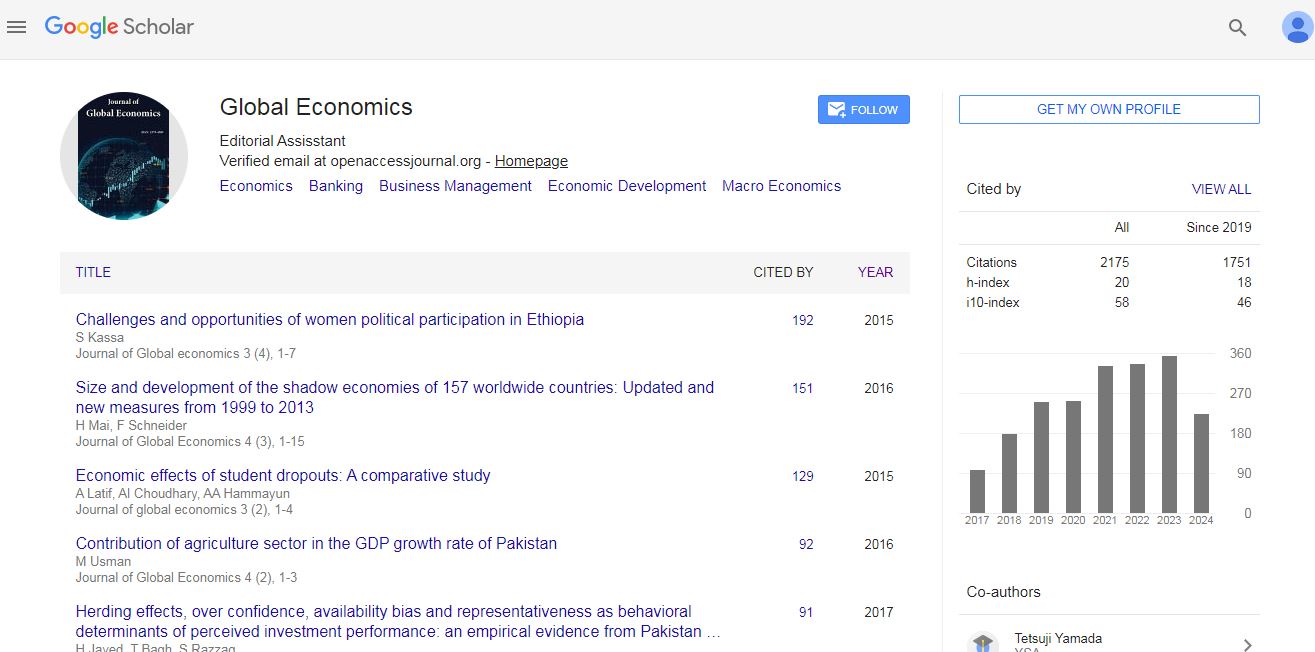
Journal of Global Economics received 2175 citations as per Google Scholar report