Commentary - (2025) Volume 14, Issue 4
Received: 01-Aug-2025, Manuscript No. jbfa-25-176807;
Editor assigned: 04-Aug-2025, Pre QC No. P-176807;
Reviewed: 18-Aug-2025, QC No. Q-176807;
Revised: 22-Aug-2025, Manuscript No. R-176807;
Published:
29-Aug-2025
, DOI: 10.37421/2167-0234.2025.14.541
Citation: Becker, Oliver. "FinTech's Dynamic Future: Innovation, Challenges, Inclusion." J Bus Fin Aff 14 (2025):541.
Copyright: © 2025 Becker O. This is an open-access article distributed under the terms of the Creative Commons Attribution License, which permits unrestricted use, distribution and reproduction in any medium, provided the original author and source are credited.
The financial technology (FinTech) sector is a rapidly evolving domain, fundamentally reshaping traditional financial services through innovative technological applications. This transformation brings about new efficiencies, enhanced services, and complex challenges, all of which are critical for understanding the industry's trajectory. A diverse body of literature addresses these various facets, from the core technologies driving innovation to the profound societal and regulatory implications. Examining these individual contributions helps build a comprehensive picture of FinTech's current state and future potential. One central theme revolves around the application of Explainable Artificial Intelligence (XAI) in FinTech. This area of study surveys the diverse XAI methods and their practical applications, such as improving transparency in credit scoring and enhancing fraud detection systems. The discussion also encompasses the significant challenges and outlines future directions crucial for developing more transparent and inherently trustworthy FinTech systems[1].
Further driving innovation is the persistent exploration of blockchain technology adoption within the FinTech sector. Research in this area synthesizes existing literature to identify key drivers facilitating its integration and the primary challenges hindering widespread use. It also proposes a robust future research agenda, crucial for guiding continued exploration into how blockchain can truly revolutionize various financial services[2].
Digital transformation plays an undeniable role in the reshaping of FinTech. This research meticulously examines the intricate interplay between digital transformation and FinTech itself. It reviews how modern digital technologies are systematically reshaping traditional financial services, simultaneously fostering significant innovation and presenting both novel challenges and immense opportunities for the entire industry to capitalize on[3].
Artificial Intelligence (AI) applications in FinTech have significant implications for financial stability. This body of work thoroughly assesses the potential impact, discussing the substantial benefits such as markedly improved efficiency and sophisticated risk management capabilities. Critically, it also addresses the potential systemic risks that could be introduced by the widespread adoption of AI across various financial services, necessitating careful oversight[4].
Regulatory Technology, known as RegTech, forms a vital nexus with FinTech, underscoring the necessity of compliance in a dynamic industry. This systematic review precisely explores the complex relationship, analyzing how various technological innovations are intelligently leveraged to effectively meet intricate regulatory compliance requirements within the financial industry. It identifies key research themes that are currently emerging and highlights essential future directions in this rapidly evolving field[5].
A growing focus within the sector is the concept of Sustainable FinTech. This paper introduces and provides a comprehensive review of its practical applications and inherent challenges. It thoughtfully proposes a conceptual framework designed to guide future research and development, specifically in the area of leveraging FinTech solutions for achieving environmentally sound and socially responsible financial practices[6].
FinTech is increasingly recognized for its critical role in promoting global financial inclusion. This systematic review rigorously explores how various FinTech innovations successfully expand access to essential financial services for traditionally underserved populations. It meticulously analyzes the mechanisms through which this inclusion is achieved and importantly, outlines significant areas that warrant substantial future research and development[7].
However, alongside innovation, FinTech faces considerable challenges, particularly in cybersecurity. This paper delivers a systematic review of the pervasive cybersecurity challenges confronting the rapidly evolving FinTech industry. It systematically categorizes common threats and vulnerabilities and diligently discusses various proposed solutions and best practices that are essential for securing FinTech operations and safeguarding sensitive customer data[8].
The integration of cloud computing technologies within the FinTech landscape represents another key development. This systematic review meticulously investigates how robust cloud infrastructure effectively supports FinTech innovation, ensuring scalability and operational efficiency. Concurrently, it diligently addresses the associated challenges, such as maintaining stringent security protocols and ensuring rigorous compliance standards[9].
Finally, the ethical dimensions of Artificial Intelligence (AI) applications are paramount within the FinTech sector. This paper delves deeply into these considerations, highlighting crucial challenges related to algorithmic bias, transparency concerns, accountability structures, and privacy protection. It strongly emphasizes the urgent need for implementing robust ethical frameworks to govern all AI-driven financial services, ensuring responsible innovation[10].
Explainable Artificial Intelligence (XAI) is emerging as a critical component in FinTech, primarily because it enhances transparency and builds trust in sophisticated applications like credit scoring and fraud detection. This field comprehensively surveys various XAI methods, delving into their practical applications, and crucially discusses the inherent challenges alongside future directions necessary for developing more transparent and inherently trustworthy FinTech systems [1]. Beyond the specific domain of XAI, the broader implications of Artificial Intelligence (AI) applications in FinTech are profoundly significant, particularly concerning overall financial stability. While AI undoubtedly offers substantial benefits, such as vastly improved operational efficiency and more sophisticated risk management capabilities, its widespread adoption also introduces potential systemic risks that demand meticulous assessment and proactive mitigation strategies [4]. Furthermore, the ethical dimensions of these advanced AI applications are paramount within the FinTech sector. This area highlights critical challenges related to algorithmic bias, the necessity of greater transparency, the establishment of clear accountability structures, and the rigorous protection of privacy. These considerations collectively emphasize the urgent need for implementing robust ethical frameworks to effectively guide all AI-driven financial services, ensuring responsible innovation and deployment [10].
Blockchain technology continues to witness growing adoption and deep integration within the FinTech sector, fundamentally revolutionizing various financial services. Existing literature comprehensively synthesizes its current state, meticulously identifying key drivers that facilitate its integration and the primary challenges that must be overcome for widespread acceptance. This foundational technology proposes a forward-looking research agenda designed to guide further exploration into its truly transformative potential across diverse financial applications [2]. Complementing this, the ongoing process of digital transformation fundamentally reshapes traditional financial services at an unprecedented pace. This involves a thorough review of how various advanced digital technologies are actively fostering innovation, while simultaneously presenting both novel challenges and immense opportunities for the entire financial industry to leverage and adapt to [3]. Furthermore, cloud computing plays an increasingly vital role, with its flexible and scalable infrastructure proving instrumental in supporting FinTech innovation, ensuring operational scalability, and driving efficiency. However, integrating cloud services introduces its own set of challenges, particularly related to maintaining stringent security protocols and ensuring rigorous regulatory compliance, which must be effectively managed to harness its full benefits securely [9].
The rapidly evolving FinTech landscape necessitates the development and implementation of sophisticated regulatory and robust security measures. RegTech, or Regulatory Technology, represents a significant innovation in this regard, applying advanced technological solutions to effectively meet increasingly complex regulatory compliance requirements within the financial industry. This systematic review not only elucidates the intricate relationship between RegTech and FinTech but also identifies key emerging research themes and outlines critical future directions in this dynamic and essential field [5]. Simultaneously, cybersecurity remains an absolutely major and persistent concern for all FinTech operations. A comprehensive systematic review identifies and rigorously categorizes common threats and vulnerabilities that financial technology firms face daily. It diligently discusses various proposed solutions and best practices that are absolutely essential for securing FinTech operations and diligently protecting sensitive customer data from an ever-evolving landscape of cyber threats [8].
Beyond operational and regulatory concerns, FinTech also serves a profoundly crucial role in promoting global financial inclusion. This systematic review rigorously explores how various FinTech innovations effectively expand access to essential financial services for traditionally underserved populations worldwide. It meticulously analyzes the mechanisms through which this inclusion is achieved and, importantly, outlines significant areas that warrant substantial future research and development to maximize its positive societal impact [7]. Moreover, the concept of Sustainable FinTech is emerging as a significant and imperative area of study. This encompasses providing a comprehensive review of its diverse applications and inherent challenges, while also thoughtfully proposing a robust conceptual framework designed to guide future research and development. The ultimate goal is to leverage FinTech for the realization of environmentally sound and socially responsible financial practices, contributing to a more sustainable global economy [6].
The FinTech industry is undergoing rapid transformation, driven by innovations across several key areas. Explainable Artificial Intelligence (XAI) is enhancing transparency in critical applications like credit scoring and fraud detection, while the broader implications of Artificial Intelligence (AI) for financial stability, including both benefits and systemic risks, are under close scrutiny. Ethical considerations, encompassing bias, transparency, accountability, and privacy, are also paramount for responsible AI deployment. Foundational technologies such as blockchain are revolutionizing financial services, with ongoing research identifying key drivers and challenges. Digital transformation is fundamentally reshaping traditional finance, fostering innovation and creating new opportunities. Cloud computing infrastructure supports FinTechâ??s scalability and efficiency, although security and compliance remain important challenges. Regulatory Technology (RegTech) addresses the increasing need for technological solutions to meet complex compliance requirements. Concurrently, cybersecurity presents significant hurdles, with reviews identifying threats and proposing best practices to secure FinTech operations and customer data. Beyond technological advancements, FinTech plays a crucial role in promoting global financial inclusion by expanding access to services for underserved populations. Emerging as well is Sustainable FinTech, which focuses on leveraging financial technology for environmentally and socially responsible practices, outlining conceptual frameworks for future development. These collective works highlight the dynamic nature of FinTech, its diverse applications, and the persistent challenges and opportunities shaping its future.
None
None
Indexed at, Google Scholar, Crossref
Indexed at, Google Scholar, Crossref
Indexed at, Google Scholar, Crossref
Indexed at, Google Scholar, Crossref
Indexed at, Google Scholar, Crossref
Indexed at, Google Scholar, Crossref
Indexed at, Google Scholar, Crossref
Indexed at, Google Scholar, Crossref
Indexed at, Google Scholar, Crossref
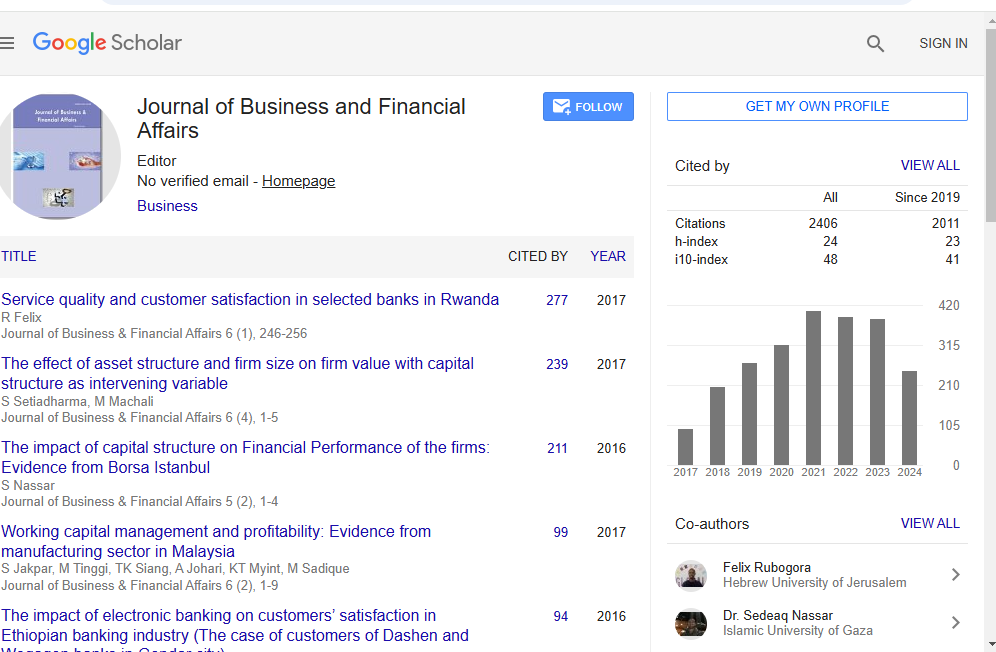
Journal of Business & Financial Affairs received 1726 citations as per Google Scholar report