Perspective - (2025) Volume 14, Issue 6
Received: 01-Dec-2025, Manuscript No. jbfa-25-176852;
Editor assigned: 03-Dec-2025, Pre QC No. P-176852;
Reviewed: 17-Dec-2025, QC No. Q-176852;
Revised: 22-Dec-2025, Manuscript No. R-176852;
Published:
29-Dec-2025
, DOI: 10.37421/2161-0673.2025.14.565
Citation: Herrera, Diego. ”FinTech: Transforming Global Finance, Opportunities & Challenges.” J Bus Fin Aff 14 (2025):565.
Copyright: © 2025 Herrera D. This is an open-access article distributed under the terms of the Creative Commons Attribution License, which permits unrestricted use, distribution and reproduction in any medium, provided the original author and source are credited.
This article explores the transformative impact of financial technology on financial services, highlighting new avenues for innovation and the inherent challenges that come with rapid technological adoption. It examines how FinTech reshapes traditional banking models, creates new market entrants, and necessitates regulatory adaptations to ensure stability and consumer protection[1].
This paper delves into the intricate relationship between financial technology, financial inclusion, and overall financial stability. It argues that while FinTech has the potential to expand access to financial services for underserved populations, its rapid evolution also poses new risks to the stability of the financial system, necessitating careful monitoring and policy responses[2].
This paper tackles the fundamental question of whether FinTech firms are collaborators or competitors for traditional banks. It analyzes how new technologies force incumbents to adapt, innovate, or risk being disrupted, providing insights into the evolving landscape of financial services and the strategic choices facing both new and established players[3].
The impact of FinTech on bank performance and risk is a critical area of study. This research uses data from global banks to empirically assess how the adoption and integration of FinTech affect profitability, efficiency, and various measures of risk, offering a data-driven perspective on the strategic implications for financial institutions worldwide[4].
This article investigates how digitalization and FinTech reshape the fundamental relationships between banks and firms. It examines the mechanisms through which technological advancements alter lending practices, information asymmetry, and the competitive dynamics within credit markets, suggesting a shift in how businesses access and manage their financial needs[5].
This research focuses on the competitive implications of FinTech within the retail banking sector. It analyzes how the emergence of FinTech solutions intensifies competition, potentially benefiting consumers through lower costs and improved services, but also challenging traditional banks to rethink their operational models and customer engagement strategies[6].
This study examines the profound influence of Big Data and FinTech on lending practices, specifically drawing evidence from the Chinese market. It illustrates how these technologies enable more granular credit assessments and faster loan disbursements, transforming the accessibility and efficiency of credit for individuals and businesses[7].
This paper considers the future trajectory of FinTech, specifically emphasizing the paradigm shift towards Distributed Ledger Technology (DLT). It discusses how blockchain and other DLT applications are poised to revolutionize financial infrastructure, offering new possibilities for secure, transparent, and efficient transactions across various financial domains[8].
This study offers empirical evidence from Europe on how FinTech is actively transforming financial services. It analyzes the adoption rates and impacts of various FinTech innovations, such as digital payments, crowdfunding, and algorithmic trading, highlighting regional specificities and broader trends in the evolution of the financial sector[9].
This research provides a global perspective on the interplay between Artificial Intelligence (AI), FinTech, and financial inclusion. It examines how AI-driven FinTech solutions can bridge gaps in financial access worldwide, particularly for underserved populations, while also addressing the ethical considerations and regulatory challenges associated with these advanced technologies[10].
Financial Technology (FinTech) has fundamentally reshaped financial services, opening new avenues for innovation while also presenting significant challenges associated with rapid technological adoption [1]. Here's the thing, while FinTech can expand access to financial services for underserved populations, its swift evolution introduces new risks to financial system stability, demanding careful monitoring and policy responses [2]. These developments necessitate regulatory adaptations to ensure both market stability and consumer protection [1, 2].
A core question within this evolving landscape centers on whether FinTech firms operate as collaborators or competitors to traditional banks [3]. New technologies compel established incumbents to adapt, innovate, or face disruption, influencing strategic choices for all players [3]. What this really means is that the impact of FinTech on bank performance and risk is a critical area, with empirical evidence from global banks showing how FinTech integration affects profitability, efficiency, and various risk measures [4]. This research offers a data-driven perspective on the strategic implications for financial institutions worldwide [4].
Digitalization and FinTech are also reshaping the fundamental relationships between banks and firms by altering lending practices, information asymmetry, and competitive dynamics within credit markets [5]. This suggests a notable shift in how businesses access and manage their financial needs [5]. Within the retail banking sector, FinTech solutions intensify competition, potentially benefiting consumers through lower costs and improved services, yet challenging traditional banks to rethink their operational models and customer engagement strategies [6].
Let's break it down: the profound influence of Big Data and FinTech on lending practices, particularly evident in the Chinese market, illustrates how these technologies enable more granular credit assessments and faster loan disbursements [7]. These advancements transform the accessibility and efficiency of credit for individuals and businesses [7]. European evidence further demonstrates FinTech's active role in transforming financial services, analyzing the adoption rates and impacts of innovations like digital payments, crowdfunding, and algorithmic trading, thereby highlighting regional specificities and broader sectoral trends [9].
Looking ahead, this paper considers the future trajectory of FinTech, specifically emphasizing a paradigm shift towards Distributed Ledger Technology (DLT) [8]. Blockchain and other DLT applications are poised to revolutionize financial infrastructure, offering new possibilities for secure, transparent, and efficient transactions across various financial domains [8]. Furthermore, Artificial Intelligence (AI) plays a crucial role in FinTechâ??s global impact, particularly concerning financial inclusion [10]. AI-driven FinTech solutions are bridging financial access gaps for underserved populations worldwide, though ethical considerations and regulatory challenges associated with these advanced technologies remain pertinent [10].
Financial Technology (FinTech) is profoundly transforming financial services, driving innovation and creating both significant opportunities and challenges. It reshapes traditional banking models, introduces new market entrants, and necessitates ongoing regulatory adaptations to ensure stability and consumer protection. While FinTech expands access to financial services for underserved populations, its rapid evolution also poses new risks to the financial system, requiring careful monitoring. A central theme is the evolving relationship between FinTech firms and traditional banks, which are forced to adapt, innovate, or face disruption. Empirical evidence shows FinTech's impact on bank performance, profitability, efficiency, and risk across global institutions. Digitalization and FinTech are also altering bank-firm relationships, lending practices, and competitive dynamics within credit markets, particularly in retail banking, benefiting consumers with lower costs and improved services while challenging incumbents. Emerging technologies like Big Data significantly enhance lending practices through more granular credit assessments. The future of FinTech is also marked by a paradigm shift towards Distributed Ledger Technology (DLT), including blockchain, promising to revolutionize financial infrastructure with secure and transparent transactions. Globally, Artificial Intelligence (AI) driven FinTech solutions are vital for bridging financial access gaps for underserved populations, though these advancements bring ethical considerations and regulatory challenges. Overall, FinTech is a dynamic force, continually reshaping the financial landscape across diverse regions.
None
None
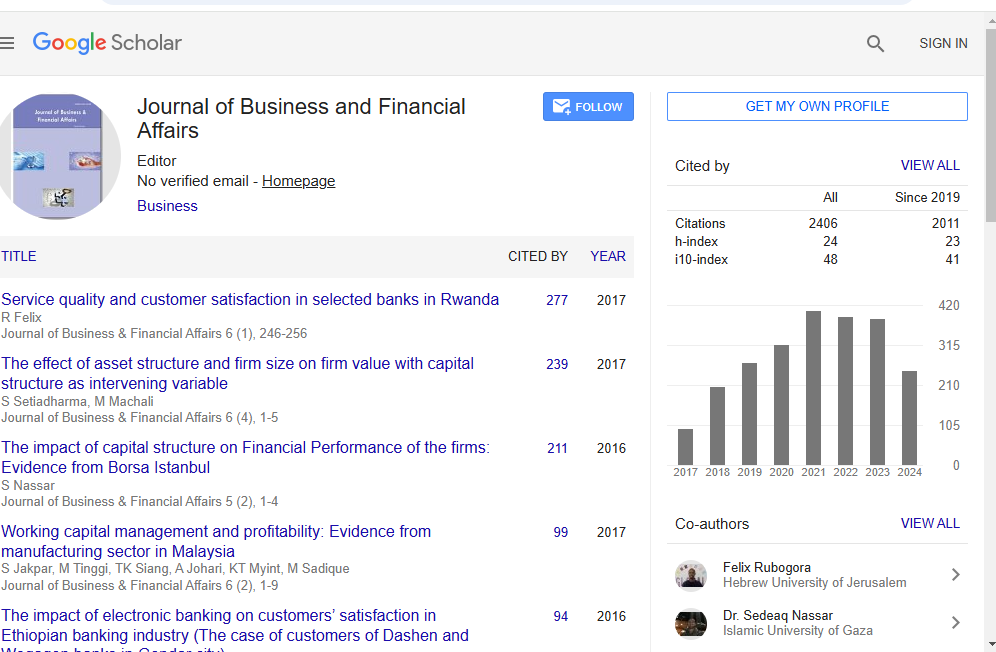
Journal of Business & Financial Affairs received 1726 citations as per Google Scholar report