Opinion - (2025) Volume 14, Issue 6
Received: 01-Dec-2025, Manuscript No. jbfa-25-176851;
Editor assigned: 03-Dec-2025, Pre QC No. P-176851;
Reviewed: 17-Dec-2025, QC No. Q-176851;
Revised: 22-Dec-2025, Manuscript No. R-176851;
Published:
29-Dec-2025
, DOI: 10.37421/2161-0673.2025.14.564
Citation: Petterson, Iris. ”FinTech Revolution: Innovation, Risks, Regulatory Challenges.” J Bus Fin Aff 14 (2025):564.
Copyright: © 2025 Petterson I. This is an open-access article distributed under the terms of the Creative Commons Attribution License, which permits unrestricted use, distribution and reproduction in any medium, provided the original author and source are credited.
The advent of financial technology, or FinTech, marks a transformative era for the global financial sector. This innovation is fundamentally reshaping the financial landscape, influencing traditional institutions and market structures in profound ways [1].
The broad spectrum of FinTech applications is actively changing conventional financial services, driven by underlying technologies that promise greater efficiency, enhanced risk management, and improved market accessibility [2].
Here's the thing: among the core technologies propelling FinTech forward, blockchain stands out for its transformative potential. This distributed ledger technology underpins new applications across payments, asset management, and capital markets, delivering enhanced security, transparency, and efficiency to financial services [3].
What this really means is that blockchain creates opportunities for disintermediation and entirely new business models, although it faces challenges related to scalability and regulatory acceptance [3].
Another powerful driver is Artificial Intelligence (AI), which, alongside FinTech, profoundly impacts the evolving financial services environment. AI-driven analytics, machine learning, and automation are optimizing critical processes, ranging from credit scoring and fraud detection to sophisticated algorithmic trading [4].
This widespread adoption of AI significantly boosts efficiency and customer experience, but it also introduces new risks and regulatory complexities that need careful consideration [4].
Let's break it down: the rapid expansion of FinTech inherently brings potential financial stability risks and significant regulatory challenges. Innovations can create new vulnerabilities through increased interconnectedness, operational risks, and the potential for systemic issues within the financial system [5].
Central banks, in particular, face critical challenges and opportunities in regulating FinTech, as rapid technological advancements demand a re-evaluation of existing regulatory frameworks to manage new risks effectively while still fostering innovation [9].
Various policy responses, such as regulatory sandboxes and innovation hubs, aim to strike a delicate balance between promoting financial stability, ensuring consumer protection, and maintaining competitive markets in this digital age [9].
The traditional banking sector is experiencing a significant upheaval from FinTech, characterized by both innovative disruptions and the need for adaptive regulatory responses. Digital solutions are redefining areas like payments, lending, and investment services, pushing banks to either innovate or risk becoming obsolete [6].
This transformation extends to the intricate relationship between FinTech advancements and the evolving market structure within the banking industry itself. New digital players and technologies influence competition, efficiency, and the concentration of power among financial institutions [10].
These scenarios suggest that FinTech can either foster greater competition and financial inclusion or lead to novel forms of market dominance, demanding strategic responses from both incumbent banks and regulators alike [10].
Beyond these areas, big data analytics plays a pivotal role in enhancing FinTech applications. The effective collection, processing, and analysis of vast datasets are crucial for personalized financial advice, precise risk assessment, and accurate market predictions [7].
The methodologies and challenges of leveraging big data in finance highlight its indispensable role in driving innovation and efficiency [7].
Moreover, the emergence of digital currencies and Decentralized Finance (DeFi) has significant implications for the future of monetary policy. These FinTech innovations challenge traditional central banking functions, opening up new avenues for financial intermediation and value exchange outside conventional systems [8].
While they promise increased financial inclusion, they also bring risks related to financial stability, consumer protection, and the effectiveness of macroeconomic management in an increasingly digital and decentralized financial landscape [8].
FinTech is fundamentally altering the global financial landscape, impacting traditional institutions and market dynamics. Key innovations, including blockchain, Artificial Intelligence (AI), and big data, possess significant disruptive potential. These technologies enhance efficiency, improve risk management, and broaden market accessibility through applications like digital payments, peer-to-peer lending, and algorithmic trading. Blockchain, for example, offers heightened security and transparency in payments, asset management, and capital markets, fostering new business models. However, this rapid expansion also brings inherent challenges. There are concerns regarding financial stability due to increased interconnectedness and potential systemic risks. Regulatory frameworks face pressure to adapt, balancing the promotion of innovation with the crucial need to safeguard financial stability and consumer protection. AI, while optimizing processes from credit scoring to fraud detection, also introduces new risks requiring careful oversight. The FinTech revolution profoundly affects the traditional banking sector, urging banks to embrace digital transformation and strategic partnerships to remain competitive. Digital currencies and Decentralized Finance (DeFi) present novel implications for monetary policy, challenging central banking functions and introducing considerations for financial inclusion and macroeconomic management. Regulators, including central banks, are exploring policy responses like sandboxes to manage new risks while fostering a competitive and stable digital financial ecosystem.
FinTech is fundamentally reshaping the financial landscape, introducing significant disruptions and innovations across various sectors. The impact is broad, affecting traditional financial institutions and market structures while driving a crucial need for adaptation through digital transformation and strategic partnerships to maintain competitiveness in an evolving ecosystem [1]. This includes a wide array of financial innovations and FinTech applications that are actively transforming traditional financial services by leveraging underlying technologies to improve efficiency, refine risk management practices, and enhance market accessibility for a broader consumer base [2]. Specific areas experiencing this transformation include digital payments, peer-to-peer lending, and algorithmic trading, offering a comprehensive look at both the opportunities and challenges FinTech presents to the financial industry [2].
A key technological underpinning this transformation is blockchain, which holds immense potential within the FinTech sector. This distributed ledger technology provides the foundation for new applications in critical areas such as payments, asset management, and capital markets. It promises enhanced security, greater transparency, and improved operational efficiency [3]. Blockchain also facilitates opportunities for disintermediation, allowing for the emergence of novel business models that challenge traditional intermediaries. However, its widespread adoption faces hurdles related to scalability and gaining full regulatory acceptance [3]. Simultaneously, Artificial Intelligence (AI) plays a pivotal role. AI-driven analytics, machine learning, and automation are optimizing numerous financial processes, from accurate credit scoring and robust fraud detection to sophisticated algorithmic trading strategies [4]. While AI significantly boosts efficiency and customer experience, its extensive integration in finance also introduces new risks and complex regulatory challenges that demand careful oversight [4].
The rapid expansion of FinTech inherently brings with it substantial financial stability risks and complex regulatory challenges. These innovations can inadvertently introduce new vulnerabilities into the financial system, primarily through increased interconnectedness among participants, the emergence of novel operational risks, and the potential for systemic issues that could impact overall stability [5]. Addressing these concerns requires the development of adaptive regulatory frameworks designed to foster innovation while rigorously safeguarding financial stability and ensuring robust consumer protection within this dynamic digital ecosystem [5]. Central banks, in particular, find themselves at a critical juncture, facing both challenges and opportunities in regulating FinTech. Rapid technological advancements necessitate a thorough re-evaluation of existing regulatory frameworks to effectively manage emerging risks and cultivate innovation [9]. Policy responses such as regulatory sandboxes and innovation hubs are vital tools for striking a necessary balance between promoting financial stability, protecting consumers, and maintaining competitive markets in the digital age [9].
FinTech's influence extends deeply into the traditional banking sector, necessitating both innovative disruptions and considered regulatory responses. Digital solutions are systematically transforming core banking areas like payments, lending, and investment services, compelling established banks to either embrace innovation or risk becoming obsolete [6]. This dynamic significantly impacts the market structure within the banking industry. New digital players and innovative technologies are reshaping competition, influencing efficiency levels, and potentially altering the concentration of power among financial institutions [10]. The outcomes could range from fostering greater competition and financial inclusion to creating new forms of market dominance, demanding strategic adaptations from incumbent banks and proactive oversight from regulators [10].
Moreover, the interplay between big data analytics and financial technology is crucial. The effective collection, processing, and analysis of vast datasets are enhancing a multitude of FinTech applications. This includes providing personalized financial advice, conducting more accurate risk assessments, and generating sophisticated market predictions [7]. Successfully leveraging big data within the financial sector involves specific methodologies and challenges, yet its role in driving innovation and efficiency is undeniable [7]. The emergence of digital currencies and Decentralized Finance (DeFi) further complicates the financial landscape, carrying significant implications for the future of monetary policy. These FinTech innovations challenge traditional central banking functions, creating alternative avenues for financial intermediation and value exchange that operate outside conventional systems [8]. While they offer the potential for increased financial inclusion, they also highlight risks concerning financial stability, consumer protection, and the efficacy of macroeconomic management in an increasingly digital and decentralized financial environment [8].
None
None
Indexed at, Google Scholar, Crossref
Indexed at, Google Scholar, Crossref
Indexed at, Google Scholar, Crossref
Indexed at, Google Scholar, Crossref
Indexed at, Google Scholar, Crossref
Indexed at, Google Scholar, Crossref
Indexed at, Google Scholar, Crossref
Indexed at, Google Scholar, Crossref
Indexed at, Google Scholar, Crossref
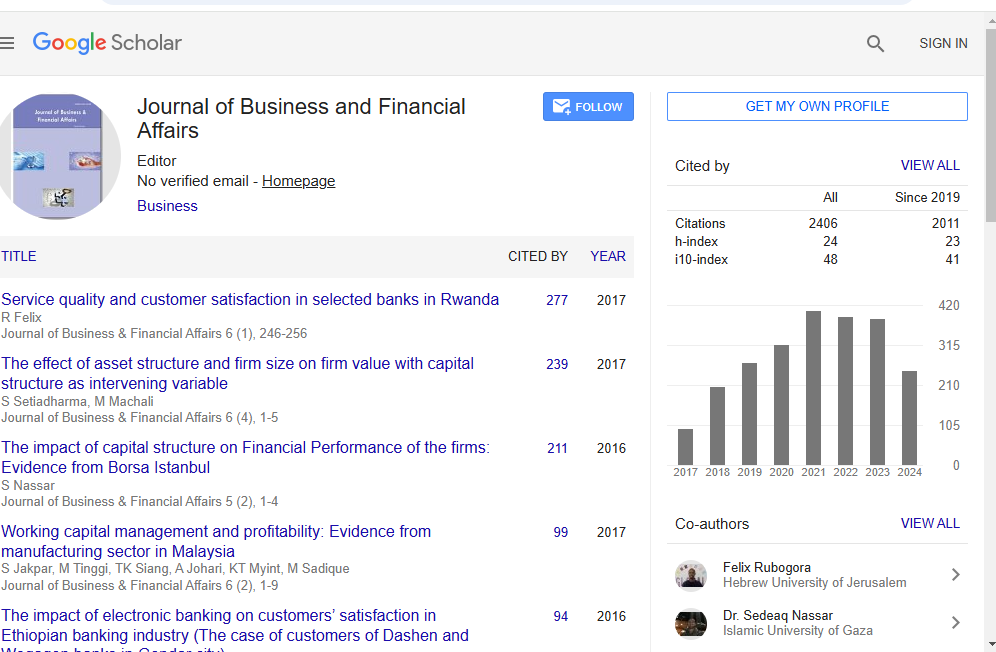
Journal of Business & Financial Affairs received 1726 citations as per Google Scholar report