Brief Report - (2025) Volume 14, Issue 4
Received: 01-Aug-2025, Manuscript No. jbfa-25-176805;
Editor assigned: 04-Aug-2025, Pre QC No. P-176805;
Reviewed: 18-Aug-2025, QC No. Q-176805;
Revised: 22-Aug-2025, Manuscript No. R-176805;
Published:
29-Aug-2025
, DOI: 10.37421/2167-0234.2025.14.540
Citation: Rahman, Farah. ”FinTech: Growth, Challenges, and Future Direction.” J Bus Fin Aff 14 (2025):540.
Copyright: © 2025 Rahman F. This is an open-access article distributed under the terms of the Creative Commons Attribution License, which permits unrestricted use, distribution and reproduction in any medium, provided the original author and source are credited.
The rapid evolution of FinTech is a defining feature of the modern financial landscape. One major area of exploration involves the intricate link between FinTech innovation and overall economic growth. Research consistently points out how financial stability significantly influences this relationship, suggesting FinTech's positive contributions to growth are often maximized within stable financial environments. This understanding is critical for shaping policy, aiming for a balanced approach to both innovation and regulatory oversight [1].
Simultaneously, the FinTech revolution has introduced a complex set of regulatory challenges. Regulators face the demanding task of fostering new innovations while effectively mitigating systemic risks that can arise from novel financial technologies. This ongoing balancing act requires developing robust frameworks that can support FinTech's potential while ensuring market integrity and consumer protection [2].
Artificial Intelligence (AI) stands as a cornerstone technology within the FinTech sector. A comprehensive review reveals the widespread applications of AI, identifying key trends and proposing future research avenues. This exploration highlights the immense transformative potential and the inherent challenges that come with integrating Artificial Intelligence in financial services [3].
Blockchain technology represents another disruptive force, with a thorough review detailing its diverse applications, spanning from enhanced payment systems to more efficient supply chain finance. However, challenges such as scalability and regulatory uncertainty persist, underscoring the need to outline clear future directions for this technology [4].
Open banking initiatives are actively reshaping FinTech innovation and market competition. These frameworks encourage data sharing, which in turn fosters the creation of new business models and services. This development also introduces new competitive dynamics, necessitating careful regulatory oversight to ensure equitable practices and fair competition within the financial ecosystem [5].
The impact extends to traditional financial institutions as well. Research focusing on empirical evidence from regions like China demonstrates that digital transformation and the adoption of FinTech solutions substantially improve the performance of traditional banks, boosting their profitability and efficiency. This makes a compelling case for established banks to adapt to these technological shifts [6].
As FinTech ecosystems grow more interconnected, cybersecurity emerges as a paramount concern. Systematic reviews highlight the pressing cybersecurity challenges inherent in the sector, categorizing prevalent threats and examining current mitigation strategies. This area requires a clear roadmap for future research to bolster the resilience and trustworthiness of FinTech against increasingly sophisticated cyber-attacks [7].
Beyond infrastructure, understanding consumer behavior is key. Studies extending models like UTAUT2 identify factors influencing consumer adoption of FinTech services, such as perceived usefulness, social influence, and facilitating conditions. These insights are invaluable for FinTech providers aiming to enhance user engagement and broaden market penetration [8].
Looking ahead, the field of Sustainable FinTech is gaining prominence, exploring how financial technologies can contribute to environmental and social sustainability goals. This involves identifying key applications, including green finance and impact investing, and outlining a research agenda to accelerate the development of responsible FinTech solutions [9].
Finally, the role of RegTech within the evolving FinTech landscape is critically important. A systematic literature review maps out how regulatory technology can significantly enhance compliance, effectively mitigate risks, and streamline operational processes for financial institutions, offering crucial insights into its adoption hurdles and future potential [10].
FinTech innovation plays a pivotal role in economic growth, with its positive effects notably amplified in stable financial environments. This dynamic relationship underscores the importance of strategic policy development to achieve a delicate balance between fostering new innovations and maintaining overall financial stability, ensuring that technological progress contributes positively to the broader economy without introducing undue risks [1]. The rapid expansion of FinTech, however, brings forth a complex and ever-evolving regulatory landscape. Authorities constantly grapple with identifying effective strategies to encourage innovation while simultaneously mitigating potential systemic risks that could destabilize financial systems. Crafting appropriate and adaptive frameworks to balance these competing objectives is therefore crucial for harnessing FinTech's full potential safely and responsibly, allowing for growth while protecting consumers and markets [2]. Furthermore, open banking initiatives are significantly shaping FinTech innovation and market competition. By enabling greater data sharing and interoperability, these initiatives facilitate the emergence of entirely new business models and services, fostering a more dynamic financial ecosystem. However, this also introduces new competitive dynamics, requiring careful regulatory oversight to ensure fairness, protect consumer data, and prevent market distortions or monopolies [5]. In this highly dynamic environment, RegTech, or regulatory technology, serves as a critical enabler. It leverages technology to enhance compliance with financial regulations, effectively mitigate risks by automating monitoring processes, and streamline operational processes for financial institutions. This offers key insights into adoption challenges and outlines the future possibilities for efficient, technology-driven regulatory management [10].
At the heart of the FinTech revolution are transformative and interconnected technologies like Artificial Intelligence (AI) and Blockchain. Comprehensive systematic reviews detail the current state of Artificial Intelligence applications within the FinTech sector, meticulously mapping out various specific AI technologies being utilized. These reviews are instrumental in identifying emerging trends and subsequently proposing a robust research agenda to delve deeper into both the immense transformative potential and the inherent challenges that come with integrating sophisticated Artificial Intelligence solutions into financial services [3]. Similarly, Blockchain technology has seen extensive and diverse integration into FinTech. Its applications range from enhancing the security and efficiency of payment systems to providing transparent and immutable records for supply chain finance. However, as with any nascent technology, significant challenges persist in areas such as scalability, ensuring transaction speed and volume, and navigating the inherent regulatory uncertainty surrounding decentralized systems. These aspects need careful consideration as we collectively outline future directions for this profoundly disruptive technology [4].
The pervasive influence of FinTech extends directly to traditional financial institutions, forcing a re-evaluation of long-standing business models. Empirical evidence, particularly from countries like China, robustly demonstrates that digital transformation and the strategic adoption of FinTech solutions can significantly enhance the performance of conventional banks. This leads to tangible improvements in both profitability and operational efficiency, showcasing the competitive advantage gained by embracing technological change. This highlights a clear imperative for incumbent financial players to adapt, innovate, and integrate these technological advancements to remain relevant and competitive in the evolving market [6]. Beyond institutional impacts, understanding consumer behavior is absolutely fundamental to FinTechâ??s widespread success and adoption. Research leveraging extended models, such as the Unified Theory of Acceptance and Use of Technology 2 (UTAUT2), pinpoints several key factors influencing the adoption of FinTech services by individuals. Perceived usefulness, social influence, and facilitating conditions are consistently identified as primary drivers. These insights are invaluable for FinTech providers seeking to refine their offerings, boost user engagement, and ultimately expand their market penetration by understanding and catering to consumer needs [8].
While offering immense opportunities for innovation and efficiency, the FinTech sector is not without its significant challenges, particularly in the critical domain of cybersecurity. Systematic reviews meticulously address the pressing cybersecurity challenges inherent in the sector, comprehensively categorizing prevalent threats, from data breaches to sophisticated fraud, and rigorously analyzing existing mitigation strategies. This critical analysis necessitates a clear roadmap for future research to strengthen the overall resilience and trustworthiness of FinTech ecosystems against increasingly sophisticated cyber-attacks, thereby ensuring data integrity, protecting assets, and bolstering user confidence [7]. A crucial and rapidly emerging frontier in FinTech is Sustainable FinTech. This specialized field actively explores how financial technologies can contribute to achieving broader environmental and social sustainability goals, moving beyond purely financial metrics. Key applications identified include green finance, which channels capital towards environmentally friendly projects, and impact investing, which aims for measurable social and environmental benefits alongside financial returns. This area suggests a vital research agenda focused on accelerating the development of responsible, ethically sound, and environmentally conscious FinTech solutions for a more sustainable global future [9].
Overall, FinTech is a multifaceted domain, continuously evolving through technological advancements, regulatory adaptations, and a deeper understanding of its societal and economic implications. The interplay of innovation, risk management, and user engagement will continue to shape its trajectory.
FinTech innovation significantly influences economic growth, with its positive impact strengthened by financial stability and proper policy direction [C001]. Regulators navigate complex challenges in fostering this innovation while managing systemic risks, suggesting a need for balanced frameworks [C002]. Key technologies like Artificial Intelligence (AI) and Blockchain are central to FinTech, with widespread applications from payments to financial services, though they also present challenges like scalability and regulatory uncertainty [C003, C004]. Open banking initiatives drive new business models and services through data sharing, altering market competition and requiring careful oversight [C005]. For traditional banks, digital transformation and FinTech adoption improve profitability and efficiency, making adaptation essential [C006]. The FinTech sector faces significant cybersecurity challenges, necessitating robust mitigation strategies and ongoing research to build trust and resilience [C007]. Consumer adoption of these services is largely driven by perceived usefulness, social influence, and facilitating conditions [C008]. Sustainable FinTech is emerging as a crucial area, leveraging financial technologies for environmental and social goals like green finance [C009]. Lastly, RegTech plays a vital role in enhancing compliance, mitigating risks, and streamlining operations for financial institutions in this dynamic environment [C010].
None
None
Indexed at, Google Scholar, Crossref
Indexed at, Google Scholar, Crossref
Indexed at, Google Scholar, Crossref
Indexed at, Google Scholar, Crossref
Indexed at, Google Scholar, Crossref
Indexed at, Google Scholar, Crossref
Indexed at, Google Scholar, Crossref
Indexed at, Google Scholar, Crossref
Indexed at, Google Scholar, Crossref
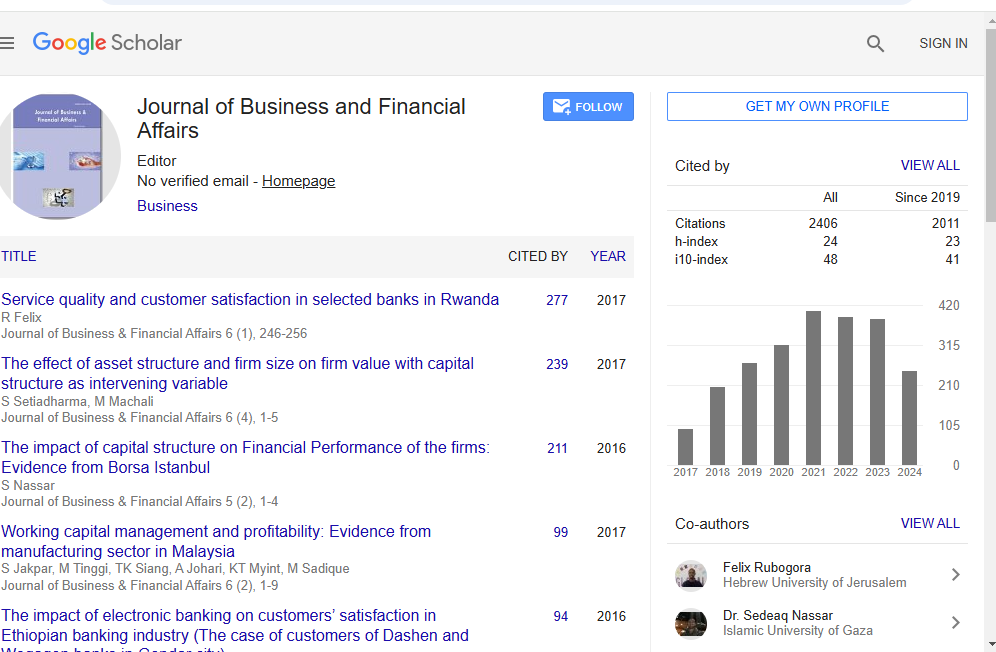
Journal of Business & Financial Affairs received 1726 citations as per Google Scholar report