Brief Report - (2025) Volume 14, Issue 4
Received: 01-Aug-2025, Manuscript No. jbfa-25-176804;
Editor assigned: 04-Aug-2025, Pre QC No. P-176804;
Reviewed: 18-Aug-2025, QC No. Q-176804;
Revised: 22-Aug-2025, Manuscript No. R-176804;
Published:
29-Aug-2025
, DOI: 10.37421/2167-0234.2025.14.539
Citation: Clark, Benjamin. ”FinTech: Global Transformation, Opportunities, and Risks.” J Bus Fin Aff 14 (2025):539.
Copyright: © 2025 Clark B. This is an open-access article distributed under the terms of the Creative Commons Attribution License, which permits unrestricted use, distribution and reproduction in any medium, provided the original author and source are credited.
This paper takes a deep look at how FinTech is reshaping the banking world. It highlights how technology-driven innovations are not just changing financial services delivery but also bringing new regulatory challenges and opportunities for both traditional banks and new entrants. [1] This study examines FinTech's role in advancing financial inclusion, looking at the tools and platforms that help underserved populations access financial services. It points out areas where FinTech has made a real difference and also identifies critical gaps in our understanding of its long-term impact. [2] This paper investigates the powerful connection between blockchain technology and FinTech. It maps out how blockchain underpins many FinTech innovations, from cryptocurrencies to smart contracts, and suggests future research directions, emphasizing its potential to transform traditional financial systems. [3] This review focuses on the complex landscape of FinTech regulation. It identifies the various regulatory approaches being adopted globally to manage the risks and opportunities presented by FinTech, emphasizing the balance between fostering innovation and protecting consumers and financial stability. [4] This paper systematically reviews the integration of Artificial Intelligence within the FinTech sector. It explores how AI drives innovations in areas like algorithmic trading, fraud detection, and personalized financial advice, and identifies key challenges and future research pathways for maximizing AI's potential in finance. [5] This research proposes a comprehensive framework to explain why consumers adopt FinTech services. It delves into factors influencing user acceptance, such as perceived usefulness, ease of use, trust, and security, providing insights crucial for FinTech firms looking to expand their user base. [6] This review explores the emerging intersection of FinTech and the United Nations' Sustainable Development Goals. It shows how FinTech innovations can drive progress in areas like poverty reduction, responsible consumption, and climate action, while also outlining challenges and opportunities for future research. [7] This systematic review provides an overview of the rapidly evolving landscape of Central Bank Digital Currencies (CBDCs) within the broader FinTech context. It examines the motivations, designs, and potential implications of CBDCs for monetary policy, financial stability, and the future of payments. [8] This study systematically reviews the critical cybersecurity risks inherent in FinTech operations. It identifies common vulnerabilities, threats, and the importance of robust security measures to protect sensitive financial data and maintain trust in innovative financial services. [9] This paper explores the intricate relationship between FinTech, broader financial innovation, and the trajectory of financial development. It synthesizes existing research to demonstrate how FinTech drives new financial products and services, fostering competition and altering the financial landscape. [10]
FinTech stands as a transformative force in the financial sector, profoundly reshaping how banking and financial services operate. It drives innovations that change service delivery models, creating both new opportunities and complex regulatory challenges for established institutions and market newcomers alike [1]. This dynamic relationship extends to broader financial innovation, where FinTech generates novel products and services, spurs competition, and fundamentally alters the financial landscape, contributing significantly to overall financial development [10].
Underpinning many of these advances are key technological breakthroughs. Blockchain technology plays a central role in FinTech innovations, from the rise of cryptocurrencies to the development of smart contracts, and it holds immense potential to revolutionize traditional financial systems [3]. Similarly, Artificial Intelligence (AI) integration within FinTech is crucial, powering innovations in algorithmic trading, sophisticated fraud detection mechanisms, and personalized financial advice. Maximizing AI's potential in finance requires addressing current challenges and exploring future research pathways [5].
Beyond technological innovation, FinTech makes a notable impact on societal goals. It has a significant role in advancing financial inclusion by providing tools and platforms that grant underserved populations access to essential financial services. While much progress is evident, critical gaps in our understanding of FinTechâ??s long-term impact persist [2]. What this really means is that FinTech doesn't just benefit the wealthy; it has the capacity to uplift entire communities. Moreover, the intersection of FinTech with the United Nations' Sustainable Development Goals is emerging as a vital area of research, showing how these innovations can drive progress in areas such as poverty reduction, responsible consumption, and climate action, alongside identifying future research opportunities [7].
The rapid evolution of FinTech also brings a complex regulatory landscape that demands careful navigation. Various regulatory approaches are being adopted globally to manage the inherent risks and opportunities presented by these new financial technologies. The goal here is a careful balance: fostering innovation while protecting consumers and ensuring financial stability [4]. Consumer adoption is another vital area, with research identifying key factors that influence user acceptance of FinTech services. Perceived usefulness, ease of use, trust, and security are paramount, offering crucial insights for firms aiming to expand their user base [6].
Emerging innovations like Central Bank Digital Currencies (CBDCs) are rapidly gaining traction within the broader FinTech context. Studies explore the motivations behind CBDCs, their design implications, and potential effects on monetary policy, financial stability, and the future of global payments [8]. However, with innovation comes increased vulnerability. Cybersecurity risks are an inherent concern in FinTech operations, requiring robust security measures to protect sensitive financial data and maintain trust in these innovative services. Identifying common vulnerabilities and threats is essential for mitigating these risks [9].
FinTech is fundamentally reshaping the financial industry, impacting everything from traditional banking models to global financial development. This technological shift, driven by innovations like blockchain and Artificial Intelligence, fosters new services, enhances competition, and addresses critical areas such as financial inclusion by enabling access for underserved populations. The evolving landscape also brings significant regulatory challenges globally, as authorities strive to balance innovation with consumer protection and financial stability. Consumer adoption is influenced by factors like trust and perceived usefulness. Furthermore, FinTech contributes to sustainable development goals and introduces new concepts like Central Bank Digital Currencies, while simultaneously necessitating a focus on cybersecurity to mitigate inherent risks and maintain confidence in digital financial services. This comprehensive overview highlights FinTech's multifaceted influence and its continuous transformation of the global financial ecosystem.
None
None
Indexed at, Google Scholar, Crossref
Indexed at, Google Scholar, Crossref
Indexed at, Google Scholar, Crossref
Indexed at, Google Scholar, Crossref
Indexed at, Google Scholar, Crossref
Indexed at, Google Scholar, Crossref
Indexed at, Google Scholar, Crossref
Indexed at, Google Scholar, Crossref
Indexed at, Google Scholar, Crossref
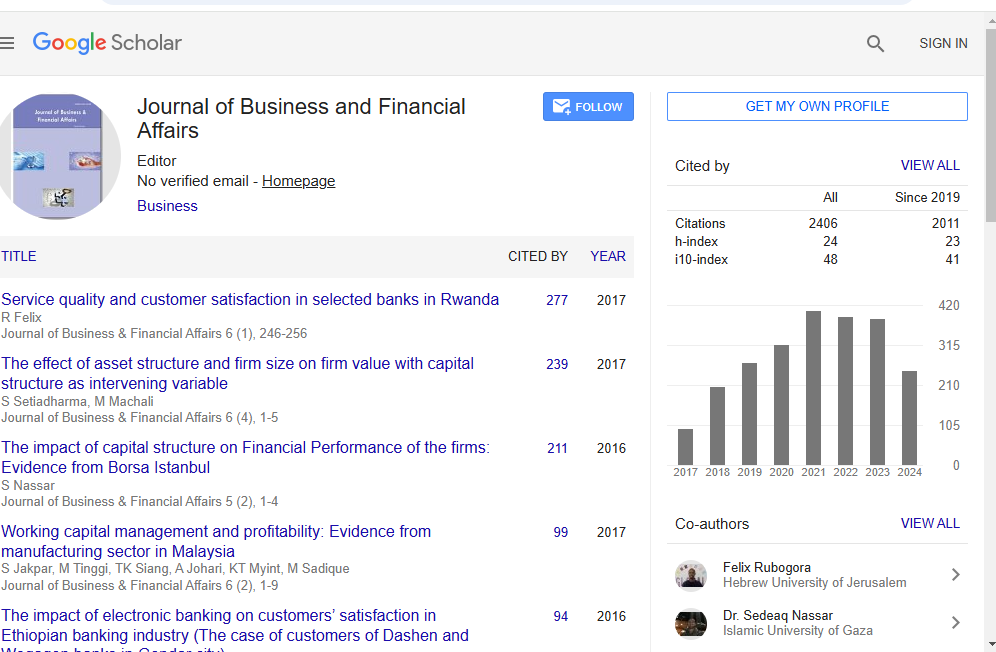
Journal of Business & Financial Affairs received 1726 citations as per Google Scholar report