Opinion - (2025) Volume 14, Issue 6
Received: 01-Dec-2025, Manuscript No. Jbfa-25-176850;
Editor assigned: 03-Dec-2025, Pre QC No. P-176850;
Reviewed: 17-Dec-2025, QC No. Q-176850;
Revised: 22-Dec-2025, Manuscript No. R-176850;
Published:
29-Dec-2025
, DOI: 10.37421/2161-0673.2025.14.563
Citation: El-Farouk, Mohammed. "FinTech, AI, Blockchain: Impact and Regulation." J Bus Fin Aff 14 (2025):563.
Copyright: © 2025 El-Farouk M. This is an open-access article distributed under the terms of the Creative Commons Attribution License, which permits unrestricted use, distribution and reproduction in any medium, provided the original author and source are credited.
This paper looks into how financial technology, or FinTech, is being adopted in emerging markets. It gives us a broad overview by reviewing existing studies and then points out where more research is needed. Essentially, it helps us understand the unique challenges and opportunities these markets face when integrating new financial technologies, highlighting factors that drive or hinder adoption [1].
It shows that FinTech affects the performance of banks globally. It shows that while FinTech can bring efficiency and innovation, its overall impact on bank stability and profitability can vary. It's a complex picture, suggesting that how banks integrate FinTech and regulatory responses are key to shaping these outcomes [2].
This article explores the connection between FinTech, Artificial Intelligence, and inclusive finance from a global viewpoint. The main takeaway is that these technologies hold significant promise for expanding financial services to underserved populations worldwide. However, it also highlights the need for careful development and regulatory frameworks to ensure these benefits are realized equitably [3].
This piece delves into how FinTech can genuinely foster financial inclusion, particularly for populations traditionally left out of mainstream financial services. The authors argue that FinTech tools offer innovative ways to reach these groups, but they also stress that effective regulatory approaches are crucial to harness this potential responsibly and sustainably [4].
This review looks at FinTech's impact on financial stability, especially concerning systemic risk and how regulators should respond. While FinTech brings innovation, it also introduces new risks that need careful monitoring. The authors discuss how policymakers can navigate these challenges to maintain a stable financial system [5].
This comprehensive review dives into FinTech's transformative role in the banking sector. It covers how new technologies are reshaping traditional banking models, from payment systems to lending and investment. The authors provide insights into how banks are adapting to this new landscape and the strategic decisions they face to remain competitive [6].
This study investigates what drives small and medium-sized enterprises (SMEs) to adopt FinTech. It identifies key factors influencing their decisions, such as perceived benefits, ease of use, and competitive pressures. Understanding these determinants is crucial for FinTech providers and policymakers looking to support SME growth and digitalization [7].
This article discusses FinTech regulation, proposing fresh perspectives on how financial oversight needs to evolve. The core idea is that traditional regulatory frameworks often fall short in addressing the unique nature of FinTech innovations. The authors suggest new approaches that balance fostering innovation with managing risks, creating a more adaptable regulatory environment [8].
This systematic review looks at blockchain technology and its wide-ranging effects on the financial services industry. It compiles insights from numerous studies to show how blockchain is disrupting various financial processes, from transactions to record-keeping, and points out the opportunities and challenges this presents for the sector's future [9].
This paper explores the role of Artificial Intelligence (AI) in finance, covering its potential, the hurdles it faces, and where it might lead. Artificial Intelligence (AI) offers significant advantages in areas like fraud detection and algorithmic trading, but issues around data privacy, bias, and regulatory compliance need careful consideration for its successful and ethical deployment [10].
Financial technology (FinTech) adoption in emerging markets is a key area of study, providing an overview of existing research and highlighting gaps for future investigation [1]. Essentially, this helps understand unique challenges and opportunities these markets face when integrating new financial technologies, along with factors that drive or hinder adoption. Meanwhile, investigating what drives Small and Medium-sized Enterprises (SMEs) to adopt FinTech identifies key factors influencing their decisions, such as perceived benefits, ease of use, and competitive pressures [7]. Understanding these determinants is crucial for FinTech providers and policymakers aiming to support SME growth and digitalization.
FinTech's impact on bank performance globally shows that while it brings efficiency and innovation, its overall effect on bank stability and profitability can vary [2]. This complex picture suggests that how banks integrate FinTech and regulatory responses are key to shaping these outcomes. A comprehensive review of FinTech's transformative role in the banking sector highlights how new technologies are reshaping traditional banking models, covering payment systems, lending, and investment [6]. The authors offer insights into how banks are adapting to this new landscape and the strategic decisions they face to remain competitive.
The connection between FinTech, Artificial Intelligence (AI), and inclusive finance is explored from a global viewpoint [3]. These technologies hold significant promise for expanding financial services to underserved populations worldwide, but careful development and regulatory frameworks are needed to ensure equitable benefits. Furthermore, FinTech can genuinely foster financial inclusion, particularly for populations traditionally left out of mainstream financial services [4]. FinTech tools offer innovative ways to reach these groups, yet effective regulatory approaches are crucial to harness this potential responsibly and sustainably.
FinTech's impact on financial stability, especially regarding systemic risk and regulatory responses, is a significant concern [5]. While FinTech brings innovation, it also introduces new risks requiring careful monitoring. Policymakers must navigate these challenges to maintain a stable financial system. Separately, FinTech regulation requires fresh perspectives on how financial oversight needs to evolve [8]. Traditional regulatory frameworks often fall short in addressing the unique nature of FinTech innovations. New approaches are suggested to balance fostering innovation with managing risks, creating a more adaptable regulatory environment.
A systematic review examines blockchain technology and its wide-ranging effects on the financial services industry [9]. It compiles insights to show how blockchain is disrupting various financial processes, from transactions to record-keeping, highlighting opportunities and challenges for the sector's future. Similarly, the role of Artificial Intelligence (AI) in finance explores its potential, hurdles, and future [10]. AI offers significant advantages in fraud detection and algorithmic trading, but issues like data privacy, bias, and regulatory compliance demand careful consideration for successful and ethical deployment.
This paper looks into how financial technology, or FinTech, is being adopted in emerging markets, reviewing existing studies and pointing out where more research is needed to understand unique challenges and opportunities. FinTech affects bank performance globally, bringing efficiency and innovation, though its overall impact on bank stability and profitability varies, depending on integration and regulatory responses. The connection between FinTech, Artificial Intelligence (AI), and inclusive finance holds significant promise for expanding financial services to underserved populations worldwide, requiring careful development and regulatory frameworks. FinTech tools also offer innovative ways to foster financial inclusion for populations traditionally left out of mainstream services, emphasizing the need for effective regulatory approaches for responsible harnessing of this potential. FinTech's impact on financial stability, particularly systemic risk, demands careful monitoring and policymaker navigation to maintain a stable financial system. The transformative power of FinTech in banking reshapes traditional models, covering payment systems, lending, and investment, requiring banks to adapt strategically to remain competitive. This study investigates what drives small and medium-sized enterprises (SMEs) to adopt FinTech, identifying perceived benefits, ease of use, and competitive pressures as key factors. Discussions around FinTech regulation propose new approaches to financial oversight, recognizing that traditional frameworks often fall short in addressing these innovations. Blockchain technology, another key FinTech component, is disrupting various financial processes from transactions to record-keeping, presenting both opportunities and challenges for the sector's future. Artificial Intelligence (AI) in finance offers significant advantages in areas like fraud detection and algorithmic trading, but issues around data privacy, bias, and regulatory compliance need careful consideration for successful deployment.
None
None
Indexed at, Google Scholar, Crossref
Indexed at, Google Scholar, Crossref
Indexed at, Google Scholar, Crossref
Indexed at, Google Scholar, Crossref
Indexed at, Google Scholar, Crossref
Indexed at, Google Scholar, Crossref
Indexed at, Google Scholar, Crossref
Indexed at, Google Scholar, Crossref
Indexed at, Google Scholar, Crossref
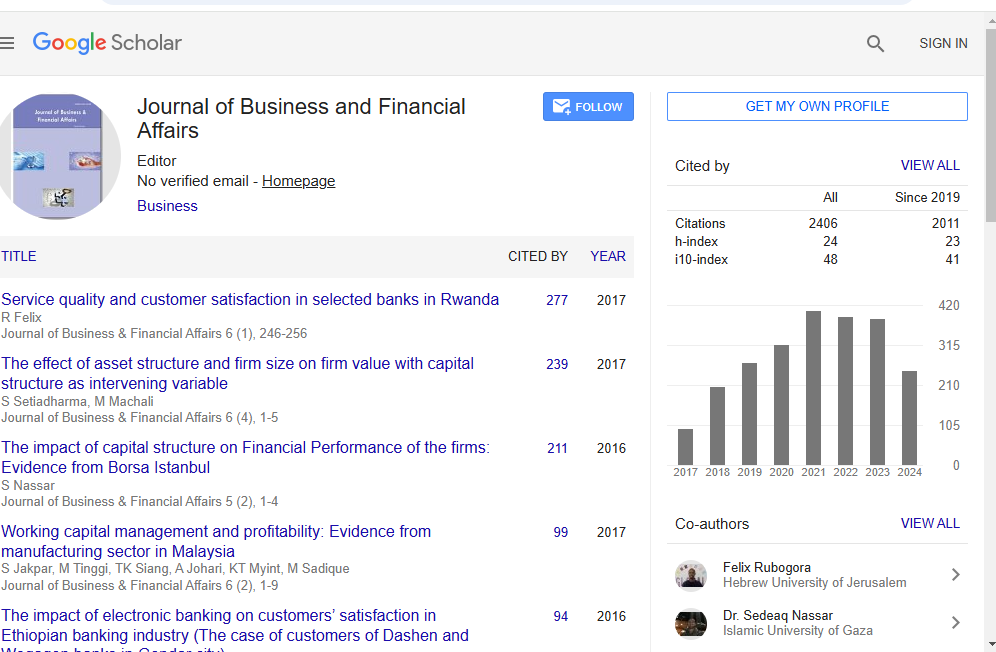
Journal of Business & Financial Affairs received 1726 citations as per Google Scholar report