Opinion - (2025) Volume 14, Issue 5
Received: 01-Oct-2025, Manuscript No. jbfa-25-176830;
Editor assigned: 03-Oct-2025, Pre QC No. P-176830;
Reviewed: 17-Oct-2025, QC No. Q-176830;
Revised: 22-Oct-2025, Manuscript No. R-176830;
Published:
29-Oct-2025
, DOI: 10.37421/2161-0673.2025.14.555
Citation: Tanabe, Hiroko. ”Financial Reporting: Tech, Governance, Performance, Challenges.” J Bus Fin Aff 14 (2025):555.
Copyright: © 2025 Tanabe H. This is an open-access article distributed under the terms of the Creative Commons Attribution License, which permits unrestricted use, distribution and reproduction in any medium, provided the original author and source are credited.
The landscape of financial reporting is constantly evolving, driven by the need for greater transparency, efficiency, and relevance in financial information. Understanding the various factors that influence the quality of financial reporting and its subsequent impact on firm performance is crucial for businesses, regulators, and investors alike. What this really means is that good financial reporting is not just about compliance; it is a strategic asset that can genuinely contribute to improved firm performance, particularly in dynamic emerging markets [1].
Here's the thing: the adoption of International Financial Reporting Standards (IFRS) can significantly influence both the quality of financial reporting and a company's overall operational success. Research in emerging markets shows that IFRS implementation often leads to better quality financial information, which in turn, positively impacts how well firms perform [2].
The role of technology in financial reporting is rapidly expanding, introducing both opportunities and challenges. What this really means is that blockchain technology isn't just for cryptocurrencies; it has significant implications for financial reporting. A systematic review of existing literature indicates that blockchain can enhance data integrity, transparency, and auditability in financial statements. However, there are still challenges and areas that need further research for fully integrating this disruptive technology into traditional accounting practices [3].
Similarly, Artificial Intelligence (AI) is changing a lot, and financial reporting is no exception. Systematic reviews map out how AI is being used in financial reporting, identifying key applications like fraud detection, predictive analytics, and automated reporting. This outlines the current state of research and sets a clear agenda for where future studies on AI's role in accounting should focus [4].
Beyond specific accounting standards, corporate governance structures truly matter for the quality of financial reporting. Empirical evidence, such as from Egypt, suggests a tangible connection between robust corporate governance mechanisms and higher quality financial reports, implying that effective oversight and accountability within a company directly translate into more credible and reliable financial disclosures [5].
Companies are also broadening their reporting scope to include non-financial information. Integrated Reporting (IR) aims to provide a holistic view of a company's performance, and while its specific impact on market valuation is still an evolving area, it can enhance transparency and stakeholder engagement, potentially leading to better investment decisions [6].
Moreover, companies are increasingly disclosing Environmental, Social, and Governance (ESG) information. Systematic reviews delve into the relationship between ESG disclosure and financial outcomes, suggesting a generally positive link. Integrating sustainability aspects into financial reporting can bolster a company's reputation, reduce risks, and attract socially responsible investors [7].
Here's the thing about XBRL: it's not just a technical standard; it profoundly impacts the efficiency of financial reporting. Investigations into XBRL adoption conclude that it significantly enhances the speed, accuracy, and comparability of financial data. While challenges remain, XBRL is proving to be a valuable tool for streamlining the reporting process and improving information accessibility [8].
Finally, external shocks can significantly impact reporting quality. The COVID-19 pandemic threw a wrench into everything, including financial reporting. Research from emerging markets explores how the pandemic affected the quality of financial reports, revealing that the unprecedented uncertainty and operational disruptions generally led to challenges in maintaining high-quality financial reporting, forcing companies to adapt quickly to new disclosure demands [9].
Furthermore, digitalization is more than just technology adoption; it's transforming financial reporting at its core. Systematic reviews investigate the relationship between increasing digitalization and the quality of financial reporting, highlighting how digital tools and processes can enhance efficiency, accuracy, and transparency in financial disclosures, while also identifying new risks and challenges that come with this digital evolution [10].
The core concept of financial reporting quality underpins much of the current discourse in business and academia. This study examines how the quality of financial reporting directly affects a firm's performance, specifically looking at evidence from Pakistan. What they found is that better financial reporting quality genuinely contributes to improved firm performance, highlighting its importance for businesses, especially in emerging markets. It underscores that transparent and accurate financial information isn't just a regulatory checkbox; it's a strategic asset [1]. Complementing this, research indicates that strong corporate governance structures truly matter for the quality of financial reporting. An empirical study from Egypt shows a tangible connection between robust corporate governance mechanisms and higher quality financial reports, suggesting that effective oversight and accountability within a company translate directly into more credible and reliable financial disclosures [5]. The interplay between these internal and external factors determines the reliability and usefulness of financial statements.
Here's the thing: regulatory frameworks also play a pivotal role. Adopting International Financial Reporting Standards (IFRS) can really shake things up. This research explores how IFRS implementation influences both the quality of financial reporting and a company's overall performance, using data from an emerging market. The findings suggest that IFRS adoption can lead to better quality financial information, which in turn, positively impacts how well firms perform [2]. This highlights how global accounting standards contribute to the harmonization and comparability of financial data across different regions, improving investor confidence and market efficiency.
What this really means is that technology isn't merely an enabler but a transformative force in financial reporting. Blockchain technology, for example, isn't just for cryptocurrencies; it has significant implications for financial reporting. This systematic review synthesizes existing literature, showing how blockchain can enhance data integrity, transparency, and auditability in financial statements, but also points out challenges and areas for future research in integrating this disruptive technology into traditional accounting practices [3]. Artificial Intelligence (AI) is changing a lot, and financial reporting is no exception. This systematic review maps out how AI is being used in financial reporting, identifying key applications like fraud detection, predictive analytics, and automated reporting. It outlines the current state of research and sets a clear agenda for where future studies on AI's role in accounting should focus [4]. Further, XBRL isn't just a technical standard; it profoundly impacts the efficiency of financial reporting. This systematic literature review investigates the effects of XBRL adoption, concluding that it significantly enhances the speed, accuracy, and comparability of financial data. While challenges remain, XBRL is proving to be a valuable tool for streamlining the reporting process and improving information accessibility [8]. The broader movement of digitalization is transforming financial reporting at its core. This systematic review investigates the relationship between increasing digitalization and the quality of financial reporting, highlighting how digital tools and processes can enhance efficiency, accuracy, and transparency in financial disclosures, while also identifying new risks and challenges that come with this digital evolution [10].
Companies are moving beyond purely financial metrics to provide a more comprehensive view of their value creation. Integrated Reporting (IR) aims to provide a holistic view of a company's performance. This systematic review examines the existing literature, indicating that IR can enhance transparency and stakeholder engagement, potentially leading to better investment decisions, though its specific impact on market valuation is still an evolving area of study [6]. Additionally, Environmental, Social, and Governance (ESG) information disclosure is becoming increasingly prominent. This systematic review delves into the relationship between ESG disclosure and financial outcomes, suggesting a generally positive link. It highlights that integrating sustainability aspects into financial reporting can bolster a company's reputation, reduce risks, and attract socially responsible investors [7]. These expanded reporting frameworks reflect a growing demand for broader corporate accountability.
Finally, external shocks present unique challenges. The COVID-19 pandemic threw a wrench into everything, including financial reporting. This research, based on an emerging market, explores how the pandemic affected the quality of financial reports. It reveals that the unprecedented uncertainty and operational disruptions during the pandemic generally led to challenges in maintaining high-quality financial reporting, forcing companies to adapt quickly to new disclosure demands [9]. Such events underscore the need for adaptable and resilient financial reporting systems.
Research consistently shows that the quality of financial reporting significantly impacts a firm's performance, especially in emerging markets [1]. Here's the thing: adopting International Financial Reporting Standards (IFRS) can really shake things up, leading to better quality financial information and positively influencing firm performance [2]. Effective corporate governance structures also play a crucial role, with strong mechanisms leading to more credible financial disclosures [5]. What this really means is that technology is rapidly reshaping the field. Blockchain technology, for instance, enhances data integrity, transparency, and auditability in financial statements, though integrating it presents challenges [3]. Artificial Intelligence (AI) is similarly transformative, offering applications in fraud detection, predictive analytics, and automated reporting [4]. XBRL adoption further boosts the efficiency, accuracy, and comparability of financial data, streamlining the reporting process [8]. The broader trend of digitalization is transforming financial reporting at its core, enhancing efficiency and transparency while introducing new risks [10]. Beyond compliance, Integrated Reporting (IR) offers a holistic view, potentially improving transparency and investment decisions [6]. Companies are also increasingly disclosing Environmental, Social, and Governance (ESG) information, which generally links positively to financial performance by bolstering reputation and attracting responsible investors [7]. However, external factors like the COVID-19 pandemic have introduced challenges, revealing how unprecedented uncertainty can disrupt the maintenance of high-quality financial reporting [9].
None
None
Indexed at, Google Scholar, Crossref
Indexed at, Google Scholar, Crossref
Indexed at, Google Scholar, Crossref
Indexed at, Google Scholar, Crossref
Indexed at, Google Scholar, Crossref
Indexed at, Google Scholar, Crossref
Indexed at, Google Scholar, Crossref
Indexed at, Google Scholar, Crossref
Indexed at, Google Scholar, Crossref
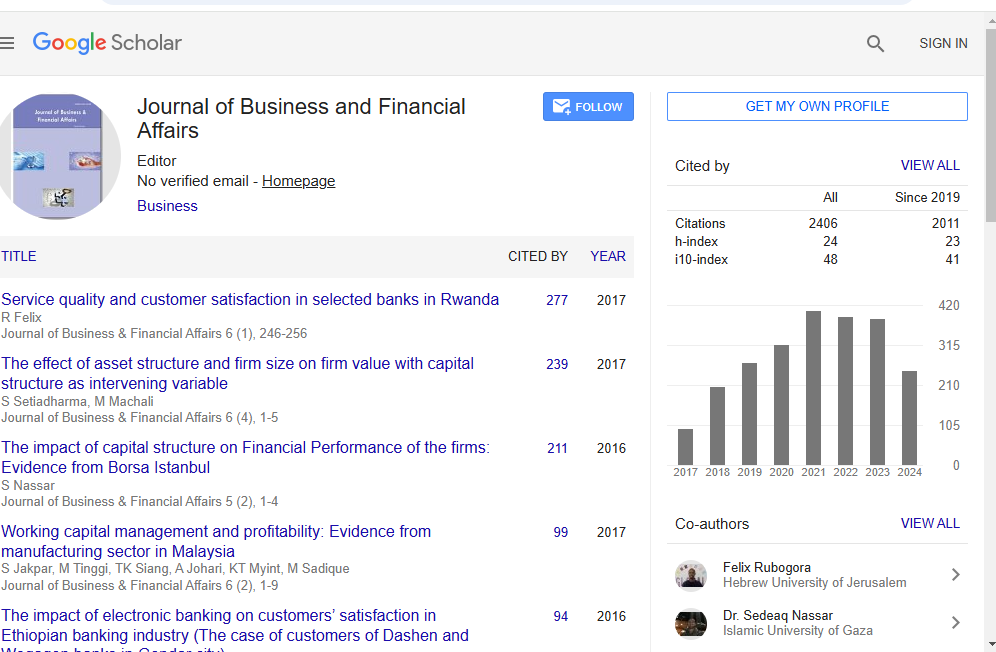
Journal of Business & Financial Affairs received 1726 citations as per Google Scholar report