Opinion - (2025) Volume 14, Issue 5
Received: 01-Oct-2025, Manuscript No. jbfa-25-176829;
Editor assigned: 03-Oct-2025, Pre QC No. P-176829;
Reviewed: 17-Oct-2025, QC No. Q-176829;
Revised: 22-Oct-2025, Manuscript No. R-176829;
Published:
29-Oct-2025
, DOI: 10.37421/2161-0673.2025.14.554
Citation: Dominguez, Rafael. ”Financial Reporting: Governance, Technology, and ESG.” J Bus Fin Aff 14 (2025):554.
Copyright: © 2025 Dominguez R. This is an open-access article distributed under the terms of the Creative Commons Attribution License, which permits unrestricted use, distribution and reproduction in any medium, provided the original author and source are credited.
Financial reporting quality is a cornerstone of effective capital markets, providing essential information for stakeholders to make informed decisions. One significant aspect of this quality relates to the characteristics of audit committees. Research explores how specific attributes of audit committees, such as their independence, expertise, and the frequency of their meetings, directly influence the overall quality of financial reporting. Empirical evidence, often drawn from emerging markets, suggests that well-structured and highly active audit committees are pivotal in boosting the reliability and transparency of financial statements. This, in turn, benefits various stakeholders by effectively reducing information asymmetry in the market [1].
Beyond traditional financial metrics, the landscape of corporate disclosure is evolving to include sustainability practices. A systematic review of existing literature delves into the intricate relationship between sustainability reporting practices and a firm's financial performance. This review synthesizes current knowledge, identifying key trends, existing gaps, and promising areas for future research. The findings frequently point towards a positive correlation, where robust sustainability reporting can lead to improved financial outcomes. This improvement is often attributed to factors like enhanced corporate reputation, more effective risk management strategies, and increased investor confidence, all contributing to a more stable and profitable business environment [2].
In the modern era, digitalization is profoundly impacting nearly every business function, including financial reporting. A dedicated study investigates the significant influence of digitalization on the quality of financial reporting, with a particular focus on companies operating within the European context. The research highlights how various digital technologies, ranging from automated processes to advanced data analytics, can substantially enhance the accuracy, timeliness, and comparability of financial information. This ultimately leads to an improved quality of reporting, which is crucial for aiding decision-making processes for a wide array of stakeholders, both internal and external to the organization [3].
The global adoption of International Financial Reporting Standards (IFRS) has been a transformative event in accounting, aimed at harmonizing financial statements across borders. This paper specifically explores the effects of IFRS adoption on the quality of financial reporting. It also pays close attention to how corporate governance structures can moderate and influence this relationship. The findings frequently suggest that while IFRS adoption generally leads to an improvement in reporting quality, strong and effective corporate governance mechanisms can further amplify these benefits. This results in even more transparent and reliable financial statements, fostering greater trust among investors and other market participants [4].
Building on the integration of various forms of reporting, research investigates how integrated reporting practices impact the quality of financial reporting. Integrated reporting is a framework designed to combine financial and non-financial information, offering a holistic view of an organization's value creation process. The study proposes that by adopting integrated reporting, companies can significantly enhance the completeness, connectivity, and clarity of their financial disclosures. This approach leads to higher quality and more insightful reports, which are invaluable for investors and other stakeholders seeking a comprehensive understanding of a company's performance and prospects [5].
The advent of Artificial Intelligence (AI) is ushering in a new era for financial reporting. A systematic review specifically explores the diverse applications of AI within this domain. It synthesizes the current academic literature to pinpoint how AI technologies, such as machine learning and natural language processing, are being utilized. These applications include automating routine tasks, detecting anomalies in data, improving analytical capabilities, and generally enhancing the overall efficiency and accuracy of financial reporting processes. The paper also thoughtfully outlines future research directions, acknowledging the rapid evolution of this exciting field [6].
As climate change concerns intensify, climate-related financial disclosures are becoming increasingly important. This study examines the crucial role of corporate governance in moderating both the adoption and the quality of climate-related financial disclosures, particularly those aligned with the recommendations from the Task Force on Climate-related Financial Disclosures (TCFD). It demonstrates that robust and effective corporate governance mechanisms can significantly influence a firm's willingness and its capability to provide comprehensive and transparent climate disclosures. Such disclosures are critically important for investors who need to accurately assess climate-related risks and identify potential opportunities [7].
The broader Environmental, Social, and Governance (ESG) framework is another pivotal area in contemporary reporting. This systematic review investigates the relationship between ESG reporting and firm performance, drawing from a wide spectrum of existing literature. It identifies significant trends, common methodologies, and key findings, often indicating a positive link between comprehensive ESG disclosures and improved financial, as well as non-financial, performance. The paper also meticulously sets out a clear agenda for future research, aiming to deepen our understanding in this increasingly vital area of financial reporting [8].
Blockchain technology, initially known for cryptocurrencies, is now being explored for its potential in financial reporting. A systematic literature review offers a comprehensive overview of how blockchain technology is being applied and discussed within this specific realm. It synthesizes existing research on blockchain's inherent capabilities to enhance transparency, security, and efficiency in recording and reporting financial transactions. This includes significant implications for auditability and for fostering the creation of more trustworthy and immutable financial statements, which can build greater confidence among users [9].
Finally, the credibility of non-financial reporting is often bolstered by independent assurance. This empirical study investigates the direct relationship between non-financial reporting assurance and firm value, utilizing evidence gathered from European companies. The findings consistently suggest that companies providing independent assurance on their non-financial reports â?? which include ESG or sustainability reports â?? tend to exhibit higher firm value. This crucial observation indicates that credible assurance acts as a powerful signal of greater transparency and reliability, which investors highly value. Consequently, this leads to positive market reactions and an improved perception of corporate responsibility, ultimately benefiting the firm [10].
The fundamental quality of financial reporting is influenced by several core elements. Research shows audit committee characteristics, such as independence and expertise, are vital for enhancing financial statement reliability and transparency, particularly in dynamic emerging markets [1]. Similarly, the adoption of International Financial Reporting Standards (IFRS) consistently improves reporting quality. This effect is significantly moderated and amplified by strong corporate governance structures, leading to more robust and credible financial statements [4]. This foundational interplay between oversight bodies, standardized practices, and governance frameworks is central to fostering stakeholder trust and reducing informational imbalances in the market.
Beyond traditional financial figures, the modern business landscape increasingly emphasizes non-financial reporting to provide a holistic view of corporate performance. Systematic reviews highlight a positive link between sustainability reporting practices and improved financial performance. This often stems from enhanced reputation, better risk management, and increased investor confidence [2]. Integrated reporting further refines this by combining financial and non-financial information, leading to more complete, connected, and clear disclosures that offer deeper insights for investors and other stakeholders [5]. The broader category of Environmental, Social, and Governance (ESG) reporting also consistently shows a positive correlation with both financial and non-financial firm performance, emphasizing the strategic value of comprehensive non-financial disclosures [8].
Technological innovation is rapidly transforming financial reporting processes. Digitalization, through its various facets like automated processes and data analytics, markedly enhances the accuracy, timeliness, and comparability of financial information, thereby boosting overall reporting quality and supporting better decision-making [3]. Artificial Intelligence (AI) applications, encompassing machine learning and natural language processing, are at the forefront of this evolution. They are used to automate tasks, detect anomalies, refine data analysis, and improve the efficiency and precision of financial reporting [6]. Furthermore, blockchain technology is identified as a game-changer, promising to significantly improve transparency, security, and efficiency in recording and reporting financial transactions. Its implications for auditability and establishing more trustworthy financial statements are profound [9].
The efficacy of these evolving reporting practices is heavily reliant on effective governance and credible assurance mechanisms. Corporate governance, for instance, is critical in moderating both the adoption and the inherent quality of climate-related financial disclosures, especially those aligned with the Task Force on Climate-related Financial Disclosures (TCFD) recommendations. Strong governance mechanisms empower firms to provide more comprehensive and transparent climate information, which is essential for investors evaluating climate risks and opportunities [7]. Furthermore, the market places significant value on the independent assurance of non-financial reports. Empirical evidence from European companies suggests that obtaining independent assurance on reports like ESG or sustainability disclosures leads to higher firm value. This is because credible assurance signals enhanced transparency and reliability, positively influencing market reactions and perceptions of corporate responsibility [10]. These insights highlight the continuous need for robust oversight and verification to maintain trust in an increasingly complex reporting environment.
Various studies consistently explore factors influencing financial reporting quality and transparency. A key area involves the impact of audit committee characteristics, such as independence and expertise, which are shown to significantly enhance reporting reliability, particularly in developing economies [1]. The adoption of International Financial Reporting Standards (IFRS) also broadly improves reporting quality, with strong corporate governance mechanisms further amplifying these benefits [4]. Relatedly, corporate governance plays a crucial role in shaping a firm's willingness to provide comprehensive climate-related financial disclosures aligned with TCFD recommendations, impacting investor assessment of climate risks and opportunities [7]. Modern technological advancements are reshaping financial reporting. Digitalization, through automated processes and data analytics, demonstrably enhances the accuracy, timeliness, and comparability of financial information [3]. Artificial Intelligence (AI) further contributes by automating tasks, detecting anomalies, and improving data analysis, thereby boosting the efficiency and accuracy of reporting processes [6]. Blockchain technology also emerges as a transformative force, promising increased transparency, security, and efficiency in financial transactions and enhancing auditability [9]. Beyond traditional financial metrics, the importance of non-financial reporting is gaining traction. Sustainability reporting practices are frequently linked to improved financial outcomes, driven by enhanced reputation and better risk management [2]. Similarly, integrated reporting, by blending financial and non-financial data, offers a more holistic view of value creation, leading to clearer and more insightful disclosures [5]. The broader umbrella of Environmental, Social, and Governance (ESG) reporting often correlates positively with both financial and non-financial firm performance, underscoring the value of comprehensive disclosures [8]. Furthermore, independent assurance for these non-financial reports is shown to increase firm value, as it signals greater transparency and reliability to the market [10].
None
None
Indexed at, Google Scholar, Crossref
Indexed at, Google Scholar, Crossref
Indexed at, Google Scholar, Crossref
Indexed at, Google Scholar, Crossref
Indexed at, Google Scholar, Crossref
Indexed at, Google Scholar, Crossref
Indexed at, Google Scholar, Crossref
Indexed at, Google Scholar, Crossref
Indexed at, Google Scholar, Crossref
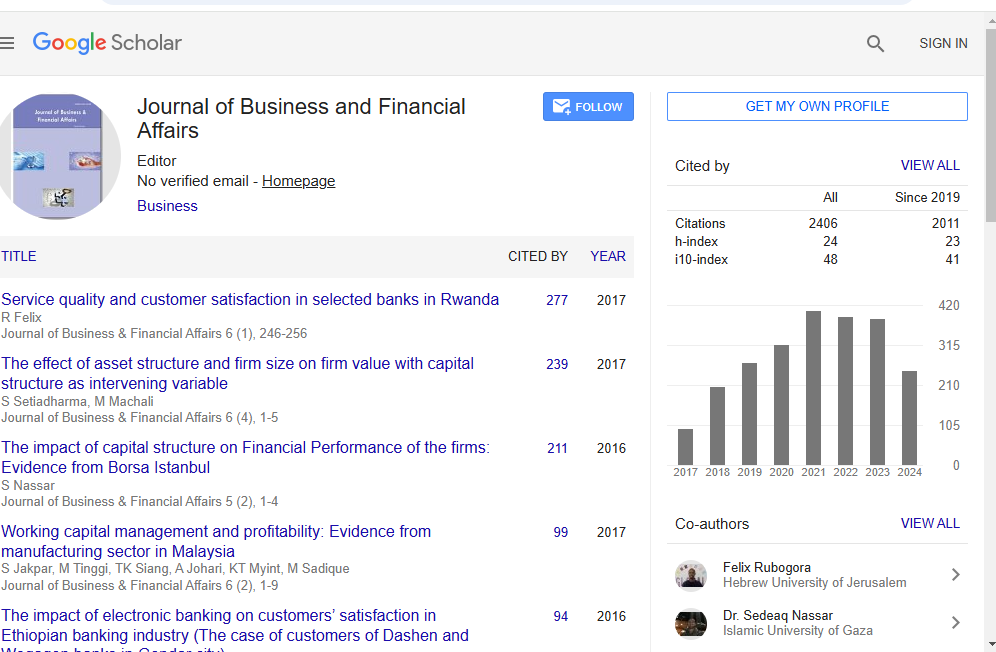
Journal of Business & Financial Affairs received 1726 citations as per Google Scholar report