Perspective - (2025) Volume 14, Issue 2
Received: 01-Apr-2025, Manuscript No. jbfa-25-174135;
Editor assigned: 03-Apr-2025, Pre QC No. P-174135;
Reviewed: 17-Apr-2025, QC No. Q-174135;
Revised: 22-Apr-2025, Manuscript No. R-174135;
Published:
29-Apr-2025
, DOI: 10.37421/2167-0234.2025.14.525
Citation: Carter, Ethan. ”Financial Literacy: Fostering Well-being and Stability.” J Bus Fin Aff 14 (2025):525.
Copyright: © 2025 Carter E. This is an open-access article distributed under the terms of the Creative Commons Attribution License, which permits unrestricted use, distribution and reproduction in any medium, provided the original author and source are credited.
Financial literacy has emerged as a cornerstone of individual well-being and economic stability in modern society. Its influence spans from personal finance decisions to national economic development, making it a critical area of study and policy focus. Understanding how financial knowledge impacts various aspects of life is essential for fostering a more secure and prosperous global community. A substantial body of research consistently demonstrates the critical role financial literacy plays in empowering individuals to plan effectively for retirement, with higher levels of financial knowledge directly correlating with greater preparedness, including increased savings and informed investment decisions [1].
This impact is not limited to general populations; studies specifically highlight how financial literacy significantly enhances entrepreneurial intentions, particularly among university students, enabling them to recognize and pursue business opportunities [2].
The ability to navigate economic challenges is also deeply rooted in financial understanding. Individuals with greater financial literacy are better equipped to withstand economic shocks and maintain stability, a truth powerfully demonstrated during crises such as the COVID-19 pandemic [3].
As financial landscapes evolve, digital financial literacy has gained prominence. Research indicates that a solid understanding of digital financial tools and services tends to correlate with higher financial well-being, with access to these services further strengthening this positive link [4].
Despite the broad benefits, disparities in financial knowledge persist. Notably, a significant gender gap in financial literacy has been observed in various regions, highlighting the need for targeted interventions to achieve greater financial equality [5].
Further reinforcing the link between knowledge and future security, investigations into salaried individuals reveal a strong positive correlation between financial literacy levels and proactive, effective retirement planning behaviors [6].
Financial education's potential to shape prudent habits early in life is also evident, with greater financial knowledge positively impacting the financial behaviors of youth, leading to more responsible saving, spending, and investment choices [7].
Household financial stability is another domain where financial literacy proves invaluable. Financially literate households are better equipped to manage their debt effectively, showing lower levels of problematic debt and making more informed borrowing decisions [8].
When it comes to investment, financial literacy is crucial for individual decision-making. While financial knowledge is key, an individual's willingness to take risks also significantly shapes their investment choices, illustrating the complex interplay of factors [9].
The ripple effects of financial literacy extend to the broader economy, particularly impacting the performance of Small and Medium-sized Enterprises (SMEs). Business owners with higher financial literacy demonstrate improved business performance, including better financial management and growth, underscoring its vital role in economic development [10].
Collectively, these studies provide compelling evidence for the multifaceted benefits of financial literacy across individual life stages, economic conditions, and business contexts. The findings consistently underscore the imperative for enhancing financial education initiatives worldwide to build more financially secure, resilient, and prosperous societies.
Financial literacy is a fundamental determinant of financial well-being and stability, influencing decisions across an individual's lifespan and impacting economic sectors broadly. The research highlights several critical areas where enhanced financial knowledge translates into tangible benefits. For example, individuals with strong financial literacy are better prepared for retirement, demonstrating higher savings rates and making more informed investment decisions, as evidenced by data from the National Financial Capability Study [1]. This benefit extends specifically to groups like salaried individuals in India, where greater financial literacy directly correlates with more proactive and effective retirement planning [6]. The implications are clear: financial education is a powerful tool for securing long-term financial futures.
The influence of financial literacy extends beyond personal retirement planning to foster economic dynamism. It significantly boosts entrepreneurial intentions among young individuals, empowering them to identify and act on business opportunities, as shown by studies on Indonesian university students [2]. This suggests that integrating financial education into curricula can cultivate a culture of entrepreneurship. Furthermore, for Small and Medium-sized Enterprises (SMEs), the financial literacy of owners directly translates to improved business performance, better financial management, and growth, which is crucial for economic development in regions like Nigeria [10]. This demonstrates that financial knowledge is not just personal but a vital asset for economic contributors.
Financial literacy also plays a critical role in mitigating financial vulnerabilities and enhancing resilience against unexpected events. During economic shocks, such as the COVID-19 pandemic, individuals with higher financial literacy proved better equipped to maintain financial stability and navigate the crisis [3]. This highlights the protective function of financial knowledge in building household resilience. Similarly, in contexts like Vietnam, financially literate households manage their debt more effectively, leading to reduced problematic debt and more sound borrowing decisions [8]. Such findings underscore financial literacy as a crucial defense mechanism against financial instability.
The digital transformation of finance introduces new dimensions to financial literacy. Digital financial literacy, encompassing an understanding of digital financial tools and services, is strongly linked to higher financial well-being. This positive association is further strengthened by digital financial inclusion, emphasizing the dual importance of both knowledge and access in the modern financial landscape [4]. This points to a need for educational efforts that keep pace with technological advancements in finance.
Moreover, financial literacy has a profound impact on specific demographic groups and complex financial behaviors. For youth, greater financial knowledge positively shapes their financial behaviors, guiding them towards more responsible saving, spending, and investment choices early in life, as seen in China [7]. This emphasizes the long-term benefits of early financial education. In investment decision-making, while financial literacy is fundamental, it interacts with an individual's risk tolerance, suggesting a nuanced relationship where both factors are crucial for predicting effective investment behaviors [9]. It is also important to address existing disparities; research from Sweden, for instance, reveals a persistent gender gap in financial literacy, with women typically scoring lower. This finding calls for targeted educational interventions to promote greater financial equality and ensure broad-based financial empowerment [5].
Research consistently demonstrates the crucial role of financial literacy in fostering individual and economic stability across various contexts. A core finding shows that higher levels of financial knowledge are directly linked to better preparedness for retirement, including increased savings and more informed investment decisions. This holds true for general populations and specific groups like Indian salaried individuals. Beyond retirement, financial literacy profoundly impacts entrepreneurial aspirations, empowering young individuals, such as university students in Indonesia, to pursue business ventures. It also builds financial resilience, with studies revealing that individuals with greater financial understanding were better equipped to manage economic shocks, like those experienced during the COVID-19 pandemic. The influence extends to everyday financial management. Financially literate households in regions like Vietnam exhibit improved debt management, leading to less problematic debt. For youth, financial knowledge fosters responsible saving, spending, and investment habits early in life. Moreover, investment decision-making is significantly shaped by financial literacy, though individual risk tolerance plays a moderating role. The importance of financial literacy is not limited to personal finance; it also extends to business. Small and Medium-sized Enterprise (SME) owners in Nigeria, for example, show improved business performance with higher financial literacy. Digital financial literacy is an emerging area, with evidence suggesting that understanding digital tools enhances financial well-being, especially when coupled with digital financial inclusion. Despite these broad benefits, a gender gap in financial literacy, as observed in Sweden, highlights areas for targeted intervention. The collective evidence strongly supports widespread financial education initiatives to improve financial security and overall economic participation.
None
None
Indexed at, Google Scholar, Crossref
Indexed at, Google Scholar, Crossref
Indexed at, Google Scholar, Crossref
Indexed at, Google Scholar, Crossref
Indexed at, Google Scholar, Crossref
Indexed at, Google Scholar, Crossref
Indexed at, Google Scholar, Crossref
Indexed at, Google Scholar, Crossref
Indexed at, Google Scholar, Crossref
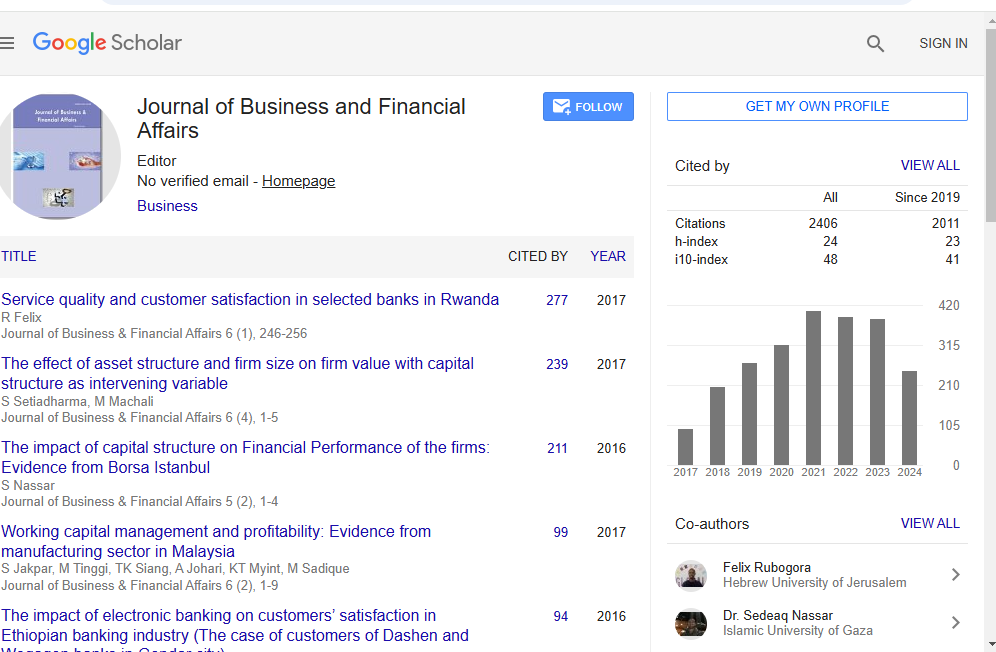
Journal of Business & Financial Affairs received 1726 citations as per Google Scholar report