Short Communication - (2025) Volume 14, Issue 2
Received: 01-Apr-2025, Manuscript No. jbfa-25-174138;
Editor assigned: 03-Apr-2025, Pre QC No. P-174138;
Reviewed: 17-Apr-2025, QC No. Q-174138;
Revised: 22-Apr-2025, Manuscript No. R-174138;
Published:
29-Apr-2025
, DOI: 10.37421/2167-0234.2025.14.528
Citation: Alvarez, Mateo. ”Financial Literacy: Empowering Decisions, Ensuring Prosperity.” J Bus Fin Aff 14 (2025):528.
Copyright: © 2025 Alvarez M. This is an open-access article distributed under the terms of the Creative Commons Attribution License, which permits unrestricted use, distribution and reproduction in any medium, provided the original author and source are credited.
Understanding the intricate relationship between digital financial literacy, individual financial behaviors, and overall financial well-being is increasingly vital. Research consistently highlights the significant moderating influence of digital skills in this dynamic. Specifically, higher digital skills empower individuals to effectively leverage their digital financial knowledge, resulting in improved financial decisions and, consequently, enhanced financial stability. This underscores the critical need for integrated educational programs that address both financial and digital competencies to foster healthier financial outcomes in our rapidly evolving digital world [1].
Another critical area of inquiry involves how financial literacy impacts the readiness of Small and Medium Enterprises (SMEs) to adopt FinTech innovations, particularly within developing economies. Studies reveal a strong correlation: SME owners and managers possessing a higher level of financial literacy demonstrate a greater willingness and capacity to integrate FinTech solutions into their business operations. This finding emphasizes the urgent need for tailored financial education initiatives. Such programs can effectively bridge existing knowledge gaps, thereby facilitating digital transformation and boosting the competitiveness of SMEs in the global marketplace [2].
The connection between financial literacy and effective retirement planning is also a significant concern, with particular attention paid to the mediating roles of psychological factors and professional financial advice. Investigations show that financial literacy forms a fundamental basis, yet psychological traits, such as self-control and future orientation, significantly amplify its effect on positive retirement savings behavior. Furthermore, seeking and utilizing guidance from financial advisors substantially enhances the efficacy of planning. This suggests that a comprehensive, multi-faceted approach, incorporating both financial education and psychological awareness, is essential for robust retirement preparedness [3].
Furthermore, financial literacy profoundly influences individual investment decisions. Research specifically focuses on the mediating role of risk perception and the moderating effect of financial knowledge in this context. It's clear that individuals who are financially literate tend to develop a more nuanced understanding of investment risks. This refined perception, in turn, leads to more informed and diversified investment choices. The implication here is that comprehending risk isn't merely a byproduct of financial literacy; rather, it actively shapes how that literacy is practically applied in real-world investment scenarios, guiding individuals towards more strategic financial engagement [4].
Examining the crucial role of financial literacy in strengthening household financial resilience, especially during periods of economic disruption, provides valuable insights. The COVID-19 pandemic serves as a stark case study, illustrating how individuals with higher levels of financial literacy were notably better equipped to manage financial strain. They could adapt spending habits effectively and access necessary support resources, which ultimately led to greater stability during the crisis. This body of research powerfully highlights financial education as a protective measure, mitigating the adverse effects of external shocks on household finances and fostering greater economic security [5].
Beyond personal finances, the contribution of financial literacy to entrepreneurial success is a vital area of study. This is particularly evident through its mediating effect on entrepreneurs' ability to access critical financing. The evidence suggests that financially literate entrepreneurs are more proficient at understanding complex financial products, meticulously preparing viable business plans, and effectively engaging with lenders. This enhanced capability significantly increases their likelihood of securing essential funding. Consequently, this improved access to finance acts as a strong predictor of sustained business growth and overall entrepreneurial achievement, underscoring financial education's strategic importance for aspiring business owners [6].
Exploring the pathways through which financial literacy affects an individual's subjective financial well-being consistently points to financial behavior as a key mediating factor. A solid grasp of financial concepts directly translates into healthier financial behaviors, encompassing prudent budgeting, consistent saving, and strategic investing. These actions, in turn, positively influence an individual's perception of their financial security and overall satisfaction. This reinforces the idea that financial education extends beyond mere knowledge acquisition; it is fundamentally about cultivating actionable behaviors that lead to improved and lasting well-being [7].
In developing economies, the effectiveness of financial literacy in reducing excessive household debt burdens has been rigorously investigated. The findings consistently demonstrate that households with higher levels of financial literacy are empowered to make more informed borrowing decisions. They manage credit responsibly and are better able to avoid predatory lending practices. This leads to a significant reduction in the probability of accumulating unsustainable debt. Such research positions financial education as an indispensable tool for promoting financial stability and ensuring consumer protection within vulnerable economic contexts, where debt can be particularly debilitating [8].
Quasi-experimental studies have also evaluated the profound impact of financial literacy education programs on the financial decision-making capabilities of university students. The outcomes are compelling, showing that students who participate in such training exhibit notably improved financial behaviors. These improvements include more effective budgeting, increased savings rates, and more prudent debt management strategies. The collective research strongly advocates for the integration of comprehensive financial education into higher education curricula. This ensures that young adults are equipped with the essential skills required to navigate today's increasingly complex financial landscapes upon entering adulthood [9].
Finally, empirical research examines the direct relationship between an individual's financial literacy and their inclination toward sustainable investment behavior. The results indicate a clear positive correlation: higher financial literacy leads to a greater understanding and active engagement in environmentally and socially responsible investment practices. This suggests that financial education serves as a powerful catalyst for promoting sustainable finance, effectively guiding investors toward choices that align harmoniously with both their personal financial objectives and broader societal welfare considerations. This highlights a dual benefit of financial knowledge [10].
Financial literacy emerges as a cornerstone of modern economic stability, influencing individuals, households, and businesses alike. A foundational understanding of financial concepts is essential for navigating the complexities of personal finance and the broader economy. Here's the thing, recent scholarship underscores how digital skills moderate the relationship between digital financial literacy and financial well-being. Individuals with enhanced digital capabilities are better positioned to leverage their financial knowledge, resulting in more informed decisions and greater stability. This clearly points to the necessity of integrated educational frameworks that foster both financial and digital competencies for healthier financial outcomes in the digital age [1].
The relevance of financial literacy extends powerfully into the business sector, particularly for Small and Medium Enterprises (SMEs) in developing economies. Studies indicate that a higher level of financial literacy among SME leadership correlates directly with a stronger willingness and ability to adopt FinTech innovations. This integration is crucial for digital transformation and bolstering competitiveness. What this really means is that targeted financial education initiatives are key to bridging knowledge gaps, enabling these businesses to thrive. On a personal level, financial literacy is equally vital for critical life planning, such as retirement. While foundational, psychological factors like self-control and future orientation significantly amplify its effect on retirement savings. Engaging with professional financial advice further enhances this planning efficacy, suggesting a multi-faceted approach for robust retirement preparedness is essential [2, 3].
Investment decisions are another domain profoundly shaped by financial literacy. Research highlights the mediating role of risk perception and the moderating effect of financial knowledge. Financially literate individuals tend to possess a more nuanced understanding of investment risks, leading to more informed and diversified choices. This is not just about knowledge; itâ??s about how that knowledge shapes real-world investment scenarios. Beyond individual choices, financial literacy proved its crucial role in bolstering household financial resilience during significant economic disruptions. The COVID-19 pandemic served as a compelling case study, demonstrating that financially literate households were better equipped to manage strain, adapt spending, and access resources, leading to greater stability during the crisis. This evidence underscores the protective power of financial education against external shocks [4, 5].
Looking at entrepreneurship, financial literacy significantly contributes to success, primarily by mediating entrepreneurs' access to finance. Literate entrepreneurs are more adept at understanding financial products, crafting business plans, and effectively engaging with lenders, increasing their chances of securing funding. This improved access directly predicts business growth and overall success. Furthermore, in developing economies, financial literacy effectively mitigates excessive household debt. It empowers households to make informed borrowing decisions, manage credit responsibly, and avoid predatory lending. This leads to a significant reduction in unsustainable debt accumulation, making financial education a crucial tool for stability and consumer protection [6, 8].
The influence of financial literacy also extends to fostering positive financial behaviors and subjective well-being. A strong understanding of financial concepts translates into behaviors like prudent budgeting, saving, and investing, which then positively impact an individual's perception of financial security. This means financial education is about actionable behaviors, not just knowledge. Moreover, educational programs, like those for university students, demonstrate improved financial decision-making, budgeting, saving, and debt management, advocating for their integration into curricula. Finally, financial literacy correlates positively with sustainable investment behavior, guiding investors toward environmentally and socially responsible choices that align with both financial goals and broader societal welfare. This demonstrates a comprehensive utility for financial knowledge [7, 9, 10].
Research consistently demonstrates the pervasive positive impact of financial literacy across various aspects of economic life. It significantly enhances individual financial well-being, especially when complemented by digital skills, leading to improved financial decisions and stability in the digital era. Financially literate Small and Medium Enterprises (SMEs) are more prepared to adopt FinTech innovations, fostering digital transformation and competitiveness in developing economies. For individuals, financial literacy is foundational for effective retirement planning, with psychological factors and professional advice further strengthening savings behaviors. It also refines risk perception, guiding more informed and diversified investment decisions. During economic shocks, such as the COVID-19 pandemic, higher financial literacy enables households to exhibit greater resilience by managing financial strain and adapting spending habits. Moreover, financial literacy is a critical determinant of entrepreneurial success, particularly by improving access to necessary financing, thereby fueling business growth. It fosters healthier financial behaviors, like budgeting and saving, which directly contribute to subjective financial well-being. In developing countries, financial literacy plays a vital role in mitigating household debt by promoting responsible borrowing practices. Educational interventions, like those for university students, prove effective in enhancing financial decision-making capabilities, including budgeting, saving, and debt management. Lastly, financial literacy correlates with a greater propensity for sustainable investment behavior, directing investors towards choices that benefit both personal finances and societal welfare.
None
None
Indexed at, Google Scholar, Crossref
Indexed at, Google Scholar, Crossref
Indexed at, Google Scholar, Crossref
Indexed at, Google Scholar, Crossref
Indexed at, Google Scholar, Crossref
Indexed at, Google Scholar, Crossref
Indexed at, Google Scholar, Crossref
Indexed at, Google Scholar, Crossref
Indexed at, Google Scholar, Crossref
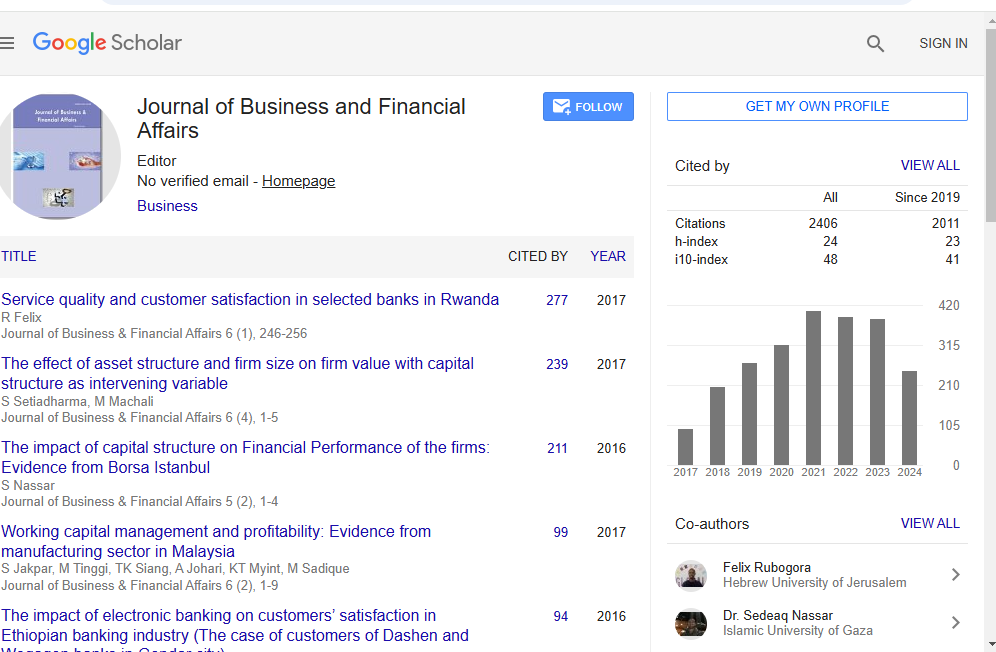
Journal of Business & Financial Affairs received 1726 citations as per Google Scholar report