Short Communication - (2025) Volume 14, Issue 2
Received: 01-Apr-2025, Manuscript No. jbfa-25-174137;
Editor assigned: 03-Apr-2025, Pre QC No. P-174137;
Reviewed: 17-Apr-2025, QC No. Q-174137;
Revised: 22-Apr-2025, Manuscript No. R-174137;
Published:
29-Apr-2025
, DOI: 10.37421/2167-0234.2025.14.527
Citation: Petrov, Ivan. ”Financial Literacy: Cornerstone for Financial Well-being.” J Bus Fin Aff 14 (2025):527.
Copyright: © 2025 Petrov I. This is an open-access article distributed under the terms of the Creative Commons Attribution License, which permits unrestricted use, distribution and reproduction in any medium, provided the original author and source are credited.
Research highlights that the financial literacy levels of new Americans are often significantly lower than native-born Americans. This lack of financial knowledge contributes to poorer financial outcomes, emphasizing a critical need for targeted financial education programs tailored to immigrant populations. It offers practical insights for policymakers and educators regarding specific knowledge gaps [1] Another study emphasizes how financial literacy, combined with perceived behavioral control, profoundly influences sound financial decision-making and overall financial well-being. This implies that just having financial knowledge isn't enough; individuals also need to feel capable of acting on that knowledge to achieve better financial outcomes. It points to the psychological aspects intertwined with financial education, suggesting a more holistic approach is beneficial [2] Exploring the relationship between financial literacy and student loan debt among undergraduates, one study found that higher financial literacy correlates with more responsible borrowing behaviors and better debt management. Understanding personal finance principles can truly help students navigate student loan complexities, potentially reducing their debt burden and improving their financial outlook post-graduation. This underlines the importance of integrating financial education into higher education curricula [3] Research investigating financial literacy's influence on older adults' financial well-being concludes that greater financial knowledge leads to better retirement planning and more secure financial futures for the elderly. Understanding compound interest, inflation, and risk diversification becomes even more crucial in later life, directly impacting an individual's ability to maintain living standards and avoid financial distress in retirement. This highlights a critical demographic for targeted financial education initiatives [4] Further research examines how financial literacy influences the composition and management of household portfolios. It concludes that financially literate households tend to hold more diversified portfolios and make more informed investment choices, ultimately leading to better financial outcomes. Here's the thing: understanding basic investment principles helps families allocate assets more effectively, reducing risk and enhancing long-term wealth growth, making financial education a key driver for sound household finance [5] An examination of financial literacy and prior experience influencing credit card behavior found that both financial knowledge and practical experience with credit are crucial for responsible credit card use. This helps individuals avoid excessive debt and manage their finances more effectively. What this really means is that a combination of formal financial education and real-world application of those principles best prepares people for navigating consumer credit complexities [6] Another study investigates how financial literacy influences entrepreneurial intentions, with risk-taking propensity and the need for achievement acting as moderating factors. It shows that aspiring entrepreneurs with a solid grasp of finance are more likely to pursue ventures, especially when they possess a higher propensity for risk and a strong drive to succeed. This highlights the crucial role financial knowledge plays in fostering entrepreneurial spirit and informed decision-making for new business owners [7] Research exploring the link between financial literacy and individual financial outcomes, using evidence from Chile, revealed that higher levels of financial literacy are consistently associated with better financial behaviors and outcomes, such as increased savings and more informed investment choices. What this really means is that investing in financial education can have a profound, positive impact on individual economic stability and long-term prosperity, particularly in developing economies [8] One study investigates the roles of digital financial literacy and financial risk tolerance in influencing financial well-being. It finds that both digital financial literacy and a healthy attitude towards financial risk contribute positively to an individual's financial well-being. This suggests that as financial services increasingly go digital, the ability to navigate online financial tools, combined with a sensible approach to risk, is vital for achieving financial stability and satisfaction [9] Finally, research explores the connection between financial literacy levels and the incidence of household over-indebtedness. It demonstrates that individuals with lower financial literacy are significantly more prone to accumulating excessive debt, leading to financial strain. What this really means is that a fundamental understanding of credit, budgeting, and debt management is a crucial protective factor against financial distress for households. It emphasizes the preventative power of financial education in fostering economic resilience [10].
Financial literacy is consistently shown to be a critical determinant of individual and household financial success across various contexts. Research indicates that a strong understanding of financial concepts is not merely beneficial but essential for sound financial decision-making and overall financial well-being. For instance, the ability to act on financial knowledge, known as perceived behavioral control, significantly enhances positive financial outcomes [2]. Similarly, higher financial literacy directly correlates with improved financial behaviors and greater economic stability, as demonstrated by studies in diverse economies like Chile [8]. The transition to digital financial services further underscores this, where digital financial literacy, alongside a sensible approach to risk, is vital for achieving financial stability and satisfaction in the modern era [9].
Specific demographic groups particularly benefit from targeted financial education. New Americans, for example, often exhibit lower financial literacy compared to native-born populations, leading to poorer financial outcomes. This highlights a clear need for programs specifically designed to address their unique knowledge gaps [1]. Among undergraduates, higher financial literacy is linked to more responsible student loan borrowing and better debt management, suggesting that integrating financial education into higher education curricula can significantly improve post-graduation financial outlooks [3]. Older adults also experience enhanced retirement planning and more secure financial futures with greater financial knowledge, particularly concerning complex concepts like compound interest, inflation, and risk diversification [4].
Financial literacy plays a crucial role in managing and mitigating various forms of debt. Students with a better grasp of finance are more adept at navigating the complexities of student loans, potentially reducing their debt burden [3]. For general consumers, both financial knowledge and practical experience are essential for responsible credit card use, helping individuals avoid excessive debt and manage their finances effectively. What this really means is that a combination of formal education and real-world application of principles is key for navigating consumer credit [6]. Furthermore, individuals with lower financial literacy are demonstrably more susceptible to household over-indebtedness, emphasizing that a fundamental understanding of credit, budgeting, and debt management serves as a crucial protective factor against financial distress [10].
Beyond debt management, financial literacy profoundly impacts investment and wealth accumulation. Financially literate households tend to hold more diversified portfolios and make more informed investment choices, which ultimately leads to better financial outcomes. Understanding basic investment principles empowers families to allocate assets more effectively, reducing risk and enhancing long-term wealth growth, making financial education a key driver for sound household finance [5].
The scope of financial literacy extends even to entrepreneurial aspirations. Aspiring entrepreneurs who possess a solid grasp of finance are more likely to pursue their ventures, especially when coupled with a higher propensity for risk and a strong drive to succeed. This underlines the critical role financial knowledge plays in fostering entrepreneurial spirit and informed decision-making for new business owners [7]. The consistent findings across these diverse studies underscore that financial education is not a luxury, but a fundamental necessity for individuals and households to achieve economic resilience, stability, and prosperity.
This collection of studies consistently demonstrates that financial literacy is a cornerstone for sound financial decision-making, well-being, and resilience across diverse demographics and life stages. It reveals that individuals with greater financial knowledge are better equipped to manage debt, make informed investment choices, plan for retirement, and even pursue entrepreneurial ventures [5, 7, 8]. The research highlights specific vulnerabilities, noting that new Americans often face lower financial literacy levels, contributing to poorer financial outcomes, and underscores the importance of tailored educational programs [1]. Similarly, undergraduates with higher financial literacy manage student loans more responsibly, while older adults achieve more secure retirements [3, 4]. Beyond knowledge, factors like perceived behavioral control and digital financial literacy are also crucial, indicating that simply having information isn't enough; individuals need to feel capable of acting on it and navigating modern financial tools [2, 9]. The findings universally point to financial education as a powerful preventative measure against over-indebtedness and a vital tool for fostering economic stability for households globally [6, 10].
None
None
Indexed at, Google Scholar, Crossref
Indexed at, Google Scholar, Crossref
Indexed at, Google Scholar, Crossref
Indexed at, Google Scholar, Crossref
Indexed at, Google Scholar, Crossref
Indexed at, Google Scholar, Crossref
Indexed at, Google Scholar, Crossref
Indexed at, Google Scholar, Crossref
Indexed at, Google Scholar, Crossref
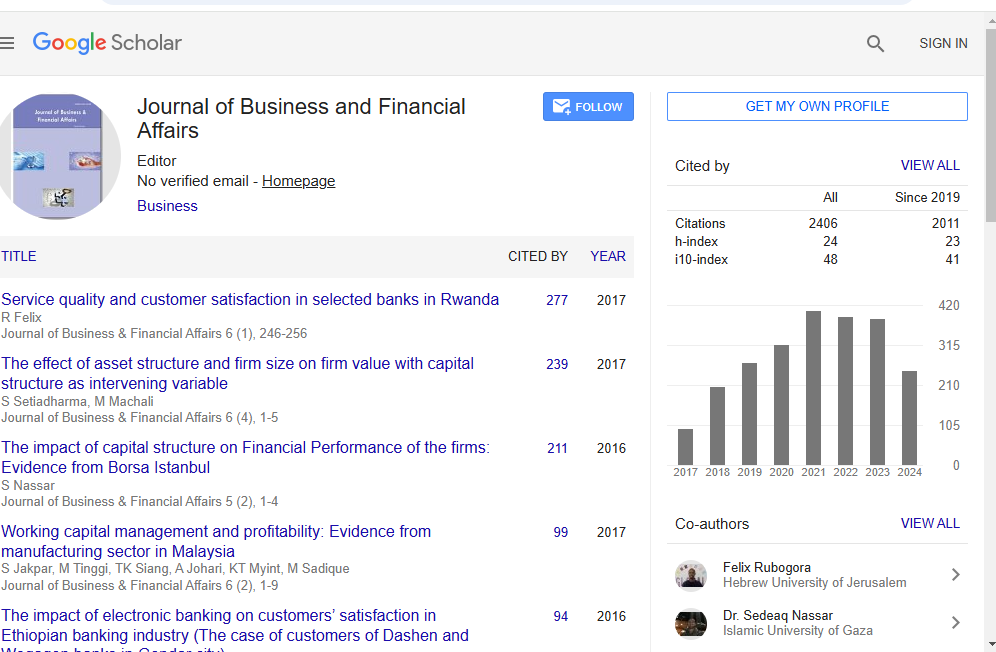
Journal of Business & Financial Affairs received 1726 citations as per Google Scholar report