Brief Report - (2025) Volume 10, Issue 5
Received: 01-Oct-2025, Manuscript No. jomp-26-185121;
Editor assigned: 03-Oct-2025, Pre QC No. P-185121;
Reviewed: 17-Oct-2025, QC No. Q-185121;
Revised: 22-Oct-2025, Manuscript No. R-185121;
Published:
29-Oct-2025
, DOI: 10.37421/2576-3857.2025.10.323
Citation: Li, Jia. ”FGFR Signaling: A Target for Cholangiocarcinoma Treatment.” J Oncol Med and Pract 10 (2025):323.
Copyright: © 2025 Li J. This is an open-access article distributed under the terms of the Creative Commons Attribution License, which permits unrestricted use, distribution and reproduction in any medium, provided the original author and source are credited.
Fibroblast Growth Factor Receptor (FGFR) signaling is deeply intertwined with the pathogenesis of cholangiocarcinoma (CCA), a group of rare and aggressive biliary tract cancers. This signaling pathway is instrumental in orchestrating key cellular processes vital for tumor progression, including cell proliferation, survival, and the formation of new blood vessels, a process known as angiogenesis [1].
The aberrant activation of FGFRs, which can manifest through various genetic alterations such as gene amplifications, point mutations, or gene fusions, presents a compelling and promising therapeutic target for CCA. The identification of these alterations has opened new avenues for targeted treatment strategies [2].
Recent scientific advancements have significantly deepened our understanding of the intricate ways in which FGFR pathway dysregulation contributes to cholangiocarcinoma. This has led to a concerted effort to unravel the molecular underpinnings of this aggressive disease [3].
Consequently, there has been a notable surge in the development and rigorous clinical evaluation of specific FGFR inhibitors. These targeted therapies aim to block the aberrant signaling driven by FGFR alterations, offering hope for improved patient outcomes [4].
The genetic landscape of FGFR alterations in cholangiocarcinoma is complex and varied, encompassing both intrahepatic and extrahepatic forms of the disease. Understanding these specific alterations is crucial for correlating them with clinical outcomes and predicting treatment responses [5].
However, the interpretation of these complex FGFR alterations poses significant challenges. This complexity necessitates the development and implementation of accurate and reliable diagnostic methods to ensure appropriate patient stratification [6].
In this context, pemigatinib, a highly selective inhibitor targeting FGFR1-3, has emerged as a significant therapeutic option. Its clinical efficacy has been demonstrated in patients with previously treated, unresectable, locally advanced or metastatic cholangiocarcinoma harboring specific FGFR2 fusions or other rearrangements [7].
Similarly, infigratinib, another potent FGFR inhibitor, has shown promising results. A phase II study evaluating its efficacy and safety in patients with previously treated, unresectable, locally advanced or metastatic cholangiocarcinoma with FGFR2 fusions supports its clinical utility in this molecularly defined subset [8].
Beyond specific fusions, FGFR amplifications and other mutations also play a role in cholangiocarcinoma. Research has identified a subset of patients with these alterations who may also benefit from FGFR-targeted therapies, emphasizing the importance of comprehensive genomic profiling [9].
Furthermore, the exploration of novel FGFR inhibitors, including those with dual-targeting capabilities, is actively underway. Preclinical data investigating these agents, along with their potential to target other oncogenic pathways, pave the way for future clinical development and expanded therapeutic options [10].
Fibroblast Growth Factor Receptor (FGFR) signaling is a critical driver in the pathogenesis of cholangiocarcinoma (CCA), influencing cellular proliferation, survival, and angiogenesis. Aberrant FGFR activation, stemming from amplifications, mutations, or fusions, marks it as a key therapeutic target in this malignancy [1].
The genetic heterogeneity of FGFR alterations in cholangiocarcinoma, affecting both intrahepatic and extrahepatic subtypes, is being systematically explored. This research aims to establish clear correlations between specific genomic alterations, patient clinical outcomes, and their response to various treatment modalities [2].
While FGFR inhibitors represent a promising avenue, understanding the mechanisms by which cancer cells develop resistance to these drugs is paramount for achieving sustained clinical benefit. Emerging resistance pathways, including bypass signaling and secondary mutations, are under intense investigation [3].
The clinical utility of pemigatinib, a targeted therapy directed against FGFR1-3, has been established in patients with advanced cholangiocarcinoma who have progressed on prior treatments and harbor specific FGFR2 fusions or rearrangements. This underscores the value of molecularly guided therapy [4].
Another FGFR inhibitor, infigratinib, has also demonstrated significant clinical activity and a favorable safety profile in a similar patient population with FGFR2 fusions, further validating the therapeutic potential of targeting this pathway in cholangiocarcinoma [5].
Beyond fusions, a substantial proportion of cholangiocarcinoma cases exhibit FGFR amplifications and mutations. Identifying these alterations through comprehensive genomic profiling is essential for expanding the eligibility of patients to FGFR-targeted therapies [6].
Investigating novel FGFR inhibitors, including those designed to inhibit multiple oncogenic pathways simultaneously, is a critical area of preclinical research. These efforts aim to discover next-generation therapies with enhanced efficacy and broader applicability [7].
The role of FGFR signaling extends to the tumor microenvironment in cholangiocarcinoma. Emerging evidence suggests that targeting FGFR may also modulate immune cell function and influence the response to immunotherapies, opening doors for combination strategies [8].
Accurate and standardized diagnostic methods are crucial for identifying FGFR alterations in cholangiocarcinoma. Challenges in interpreting complex genetic findings highlight the need for robust molecular testing protocols to ensure optimal patient selection for targeted treatments [9].
The ongoing clinical trial landscape for FGFR inhibitors in cholangiocarcinoma is dynamic and expanding. Research is focused on evaluating these agents in various treatment settings, including first-line therapy and combination regimens, to maximize their therapeutic impact [10].
Cholangiocarcinoma (CCA) pathogenesis is significantly driven by aberrant Fibroblast Growth Factor Receptor (FGFR) signaling, impacting proliferation, survival, and angiogenesis. FGFR alterations, including amplifications, mutations, and fusions, have emerged as crucial therapeutic targets. Selective FGFR inhibitors like pemigatinib and infigratinib have demonstrated clinical efficacy in patients with specific FGFR alterations, particularly FGFR2 fusions. Comprehensive genomic profiling is vital to identify patients who may benefit from these targeted therapies, even beyond fusions. Understanding and overcoming resistance mechanisms through strategies like combination therapies is essential for long-term patient benefit. Preclinical research is exploring novel FGFR inhibitors and their role in the tumor microenvironment, potentially impacting immunotherapy responses. Standardized diagnostic methods are critical for accurate identification of FGFR alterations and patient selection. Ongoing clinical trials aim to expand the use of FGFR inhibitors in various treatment settings for cholangiocarcinoma.
None
None
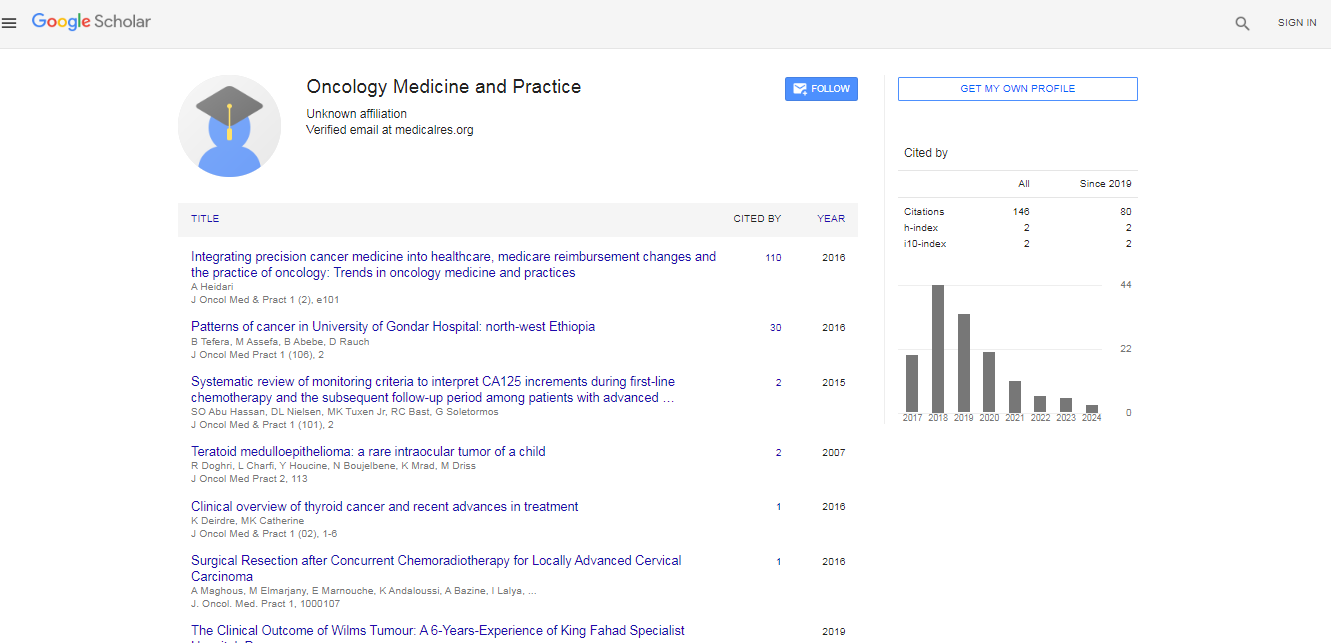
Journal of Oncology Medicine & Practice received 142 citations as per Google Scholar report