Commentary - (2025) Volume 14, Issue 6
Received: 01-Nov-2025, Manuscript No. pbt-25-178150;
Editor assigned: 03-Nov-2025, Pre QC No. P-178150;
Reviewed: 17-Nov-2025, QC No. Q-178150;
Revised: 24-Nov-2025, Manuscript No. R-178150;
Published:
29-Nov-2025
, DOI: 10.37421/2167-7689.2025.14.510
Citation: Turner, Michael J.. ”FDA Regulatory Evolution: Faster Access, Safer Drugs.” Pharmaceut Reg Affairs 14 (2025):510.
Copyright: © 2025 Turner J. Michael This is an open-access article distributed under the terms of the Creative Commons Attribution License, which permits unrestricted use, distribution and reproduction in any medium, provided the original author and source are credited.
The pharmaceutical industry is undergoing a significant transformation driven by evolving regulatory landscapes, particularly those set forth by the U.S. Food and Drug Administration (FDA). These changes are profoundly influencing how new drugs are developed, evaluated, and brought to market. A key area of focus involves expedited pathways designed to accelerate the availability of novel therapies for serious conditions, while simultaneously ensuring that rigorous scientific standards are maintained [1].
The FDA's approach to the evaluation of new treatments is also increasingly embracing real-world evidence (RWE), moving beyond traditional clinical trial data to provide a more comprehensive understanding of a drug's performance in routine clinical practice [2].
Furthermore, there is a growing emphasis on patient-centered drug development, a paradigm shift that seeks to integrate the lived experiences and perspectives of patients into the benefit-risk assessments of therapeutic interventions [3].
This patient-centric approach aims to ensure that regulatory decisions are aligned with the needs and priorities of those most impacted by diseases and their treatments. Innovations in digital health technologies are also reshaping the regulatory environment, with the FDA actively developing frameworks for software as a medical device, wearable technologies, and artificial intelligence applications in healthcare [4].
Understanding these evolving guidelines is paramount for companies seeking to navigate the complexities of digital health product development and deployment. The FDA continues to refine its strategies for post-market surveillance and pharmacovigilance, employing advanced analytics to proactively identify and manage potential safety signals after a drug has been approved [5].
This robust monitoring system is crucial for safeguarding public health throughout a product's entire lifecycle. The regulatory framework for biosimilars is also a dynamic area, with ongoing efforts to facilitate patient access to more affordable biologic therapies through clear pathways for demonstrating biosimilarity and interchangeability [6].
Navigating the regulatory maze for combination products, which integrate drugs, devices, and/or biologics, presents unique challenges, and the FDA is working to clarify review processes for these multifaceted entities [7].
The development and approval of complex generics, including those with novel delivery systems, are another area of regulatory focus, with the FDA committed to fostering competition and expanding patient access to high-quality generic alternatives [8].
Finally, the core processes for reviewing new drug applications (NDAs) and biologics license applications (BLAs) remain central to drug approval, with ongoing efforts to enhance efficiency and maintain scientific rigor in the face of increasingly complex submissions [9].
These interconnected regulatory developments collectively paint a picture of an adaptive and forward-looking FDA, striving to balance innovation with safety and efficacy in the pharmaceutical sector [10].
Recent advancements in FDA regulatory developments are fundamentally altering the pathways for pharmaceutical development and approval. Key insights highlight the agency's continued prioritization of accelerated approval mechanisms, which aim to expedite the availability of critical therapies, alongside enhanced post-market surveillance strategies to ensure ongoing product safety [1].
The increasing reliance on real-world evidence (RWE) is a significant trend, impacting how novel therapies are evaluated by incorporating data from routine clinical practice into the decision-making process [2].
This integration of RWE promises to offer a more comprehensive understanding of drug effectiveness and safety beyond the confines of controlled clinical trials. A pronounced shift towards patient-focused drug development is also evident, where the FDA actively seeks to incorporate patient experiences and preferences into the benefit-risk assessments of therapeutic interventions [3].
This patient-centric approach underscores the agency's commitment to ensuring that regulatory decisions reflect the values and needs of the individuals who will ultimately use these medicines. The regulatory landscape for digital health technologies is rapidly evolving to keep pace with technological innovation, encompassing guidance for software as a medical device (SaMD), wearable sensors, and artificial intelligence/machine learning applications in healthcare [4].
Companies operating in this space must navigate these evolving regulations to ensure compliance and patient safety. Post-market surveillance and pharmacovigilance efforts are being strengthened through the integration of advanced analytical tools and diverse data sources, enabling proactive identification of potential safety signals [5].
These enhanced monitoring systems are vital for protecting public health throughout the entire lifecycle of a pharmaceutical product. The regulatory framework for biosimilars continues to mature, driven by the FDA's objective to improve patient access to affordable biologic therapies, with clear guidelines for demonstrating biosimilarity and interchangeability [6].
The intricate regulatory pathways for combination products, which may involve drugs, devices, and biologics, are being clarified through updated guidance aimed at streamlining the review process and designating appropriate lead review centers [7].
Furthermore, the FDA is adapting its regulatory science and methodologies to address the unique challenges posed by complex generics and those with novel delivery systems, thereby promoting competition and patient access to essential medications [8].
The foundational processes for reviewing new drug applications (NDAs) and biologics license applications (BLAs) are also undergoing refinement, with a focus on managing increasingly complex submissions and ensuring data integrity while striving for efficient review timelines [9].
These multifaceted regulatory developments collectively underscore the FDA's dynamic role in fostering innovation while upholding stringent standards for drug safety and efficacy [10].
The FDA's regulatory landscape is actively evolving, with key developments in accelerated approval pathways, enhanced post-market surveillance, and the increasing use of real-world evidence to inform decision-making. Patient-focused drug development is gaining prominence, incorporating patient experience data into benefit-risk assessments. The agency is also adapting its frameworks for digital health technologies and complex generics. These changes aim to expedite the availability of novel therapies, ensure ongoing product safety, and improve patient access to both innovative and generic medications while maintaining scientific rigor.
None
None
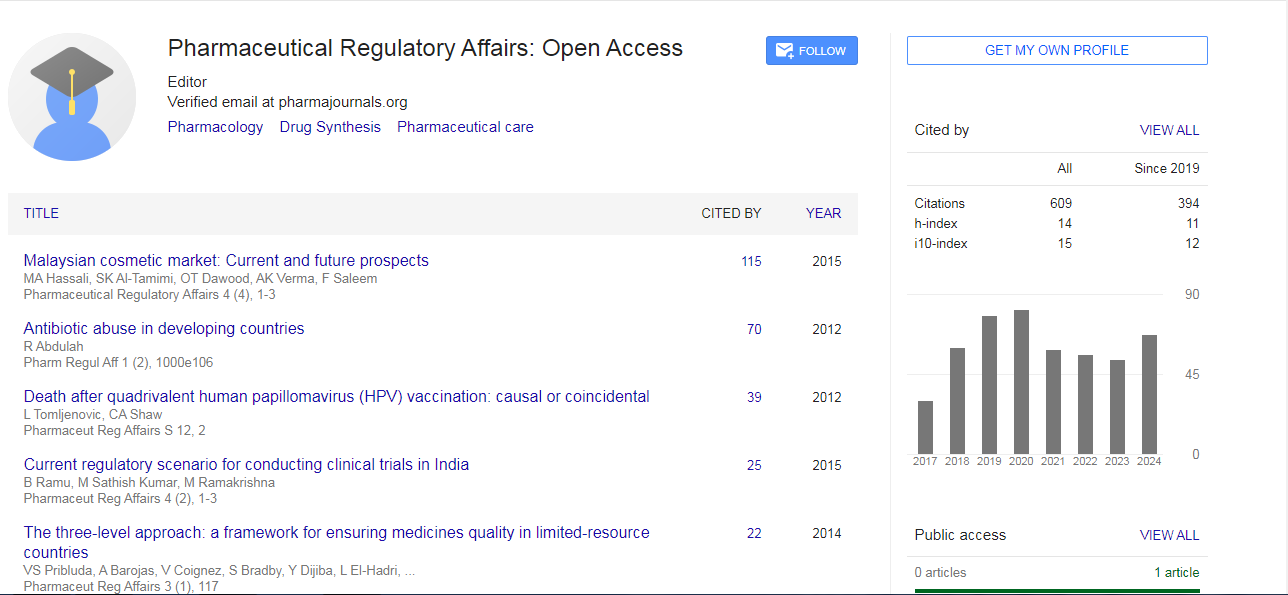
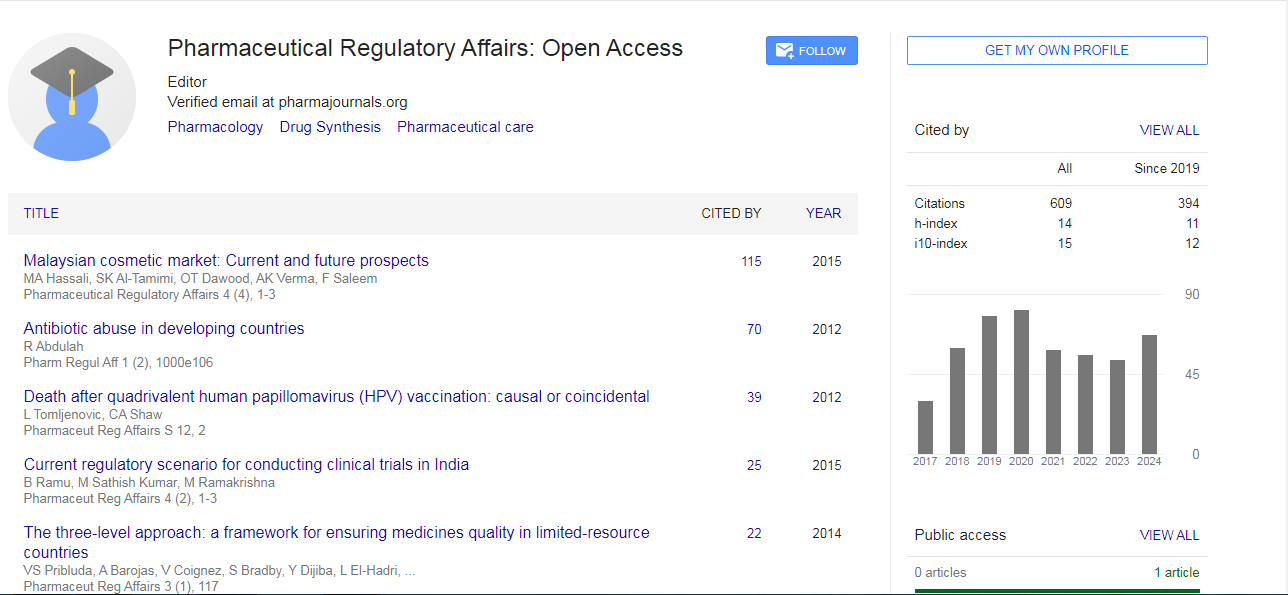
Pharmaceutical Regulatory Affairs: Open Access received 533 citations as per Google Scholar report