Commentary - (2025) Volume 14, Issue 3
Received: 01-May-2025, Manuscript No. jtsm-26-179527;
Editor assigned: 05-May-2025, Pre QC No. P-179527;
Reviewed: 19-May-2025, QC No. Q-179527;
Revised: 22-May-2025, Manuscript No. R-179527;
Published:
29-May-2025
, DOI: 10.37421/2167-0919.2025.14.502
Citation: Santos, Maria. ”Evolving Telecom Service Management: AI, Agile, Customer-Centric.” J Telecommun Syst Manage 14 (2025):502.
Copyright: © 2025 Santos M. This is an open-access article distributed under the terms of the Creative Commons Attribution License, which permits unrestricted use, distribution and reproduction in any medium, provided the original author and source are credited.
The telecommunications industry is undergoing a profound transformation, driven by evolving technological landscapes and increasing customer expectations. This evolution necessitates a continuous adaptation of service management frameworks to ensure operational efficiency and service quality. The current era emphasizes agile, data-driven, and customer-centric approaches, moving away from traditional, rigid models. Integration of advanced technologies like Artificial Intelligence (AI) and Machine Learning (ML) is becoming crucial for proactive issue detection and automated resolution, which are cornerstones of modern service assurance and performance optimization initiatives in telecommunications [1].
Enhancing network reliability and customer experience within telecom operations is a paramount concern. Research has focused on the application of AI and ML to achieve these goals, detailing methodologies for predictive maintenance, anomaly detection, and automated root cause analysis. These intelligent service management strategies are vital for maintaining the integrity and performance of complex telecom networks [2].
Managing the inherent complexities of multi-vendor telecommunication environments presents significant challenges and opportunities. The development of unified frameworks for service orchestration and assurance is key to addressing these issues. Such frameworks aim to provide cross-domain visibility and automation, thereby improving operational efficiency and the overall quality of services delivered to end-users [3].
The principles and practices of DevOps have emerged as a critical factor in modern telecom service management. By embracing agile methodologies, continuous integration/continuous deployment (CI/CD), and infrastructure as code, telecom operators can significantly accelerate service delivery and enhance the resilience of their networks, ensuring a more robust and responsive service [4].
The advent of 5G network architecture introduces new paradigms that profoundly impact service management. Concepts like network slicing, edge computing, and virtual network functions demand novel approaches to monitoring, assurance, and dynamic resource allocation to effectively meet the diverse and stringent requirements of various services operating over these advanced networks [5].
A fundamental shift towards a customer-centric approach is redefining telecom service management strategies. This involves implementing proactive service monitoring, offering personalized support, and efficiently resolving customer complaints. Leveraging data analytics is instrumental in understanding customer needs and preferences, enabling operators to tailor services and improve satisfaction [6].
The adoption of cloud-native technologies and microservices is revolutionizing the development of telecom service management platforms. These architectures facilitate the creation of flexible and scalable solutions, enabling faster development cycles, optimizing resource utilization, and significantly improving the resilience of management systems [7].
ITIL 4 provides a robust framework for managing IT services, and its Service Operation component is particularly relevant for telecommunications. Adapting best practices for incident, problem, and change management within the ITIL framework is essential for optimizing service delivery and minimizing disruptions in complex telecom environments [8].
The integration of blockchain technology into telecom service management offers a path towards enhanced security, transparency, and trust. Potential use cases span identity management, service provisioning, and revenue assurance, proposing a decentralized model that can bolster the integrity of telecom operations [9].
Advanced service management in telecommunications can be significantly enhanced through the application of big data analytics and digital twins. These technologies provide deep insights into network performance, enable the prediction of future network states, and facilitate proactive optimization of services, leading to improved efficiency and reliability [10].
Looking ahead, the telecommunications industry will continue to embrace sophisticated technologies and methodologies to manage its complex service infrastructures. The ongoing integration of AI, data analytics, cloud-native architectures, and customer-centric strategies will shape the future of service management, ensuring resilience, efficiency, and superior customer experiences in an increasingly connected world.
The evolving landscape of telecom service management frameworks is characterized by a significant shift towards agile, data-driven, and customer-centric methodologies. This paradigm necessitates the deep integration of Artificial Intelligence (AI) and Machine Learning (ML) to enable proactive issue detection and automated resolution. Furthermore, best practices for service assurance, performance optimization, and digital transformation are paramount in shaping the future of telecommunications [1].
Artificial intelligence and machine learning are pivotal in enhancing network reliability and the overall customer experience within telecom operations. Methodologies for predictive maintenance, anomaly detection, and automated root cause analysis are being explored and implemented to create more intelligent and responsive service management systems [2].
Telecommunication environments are often complex and involve multiple vendors, posing substantial management challenges. A unified framework for service orchestration and assurance is proposed to address these complexities, emphasizing the critical role of cross-domain visibility and automation in boosting operational efficiency and service quality [3].
The adoption of DevOps principles and agile methodologies is transforming telecom service management. Practices such as continuous integration/continuous deployment (CI/CD) and infrastructure as code are instrumental in accelerating service delivery and bolstering the resilience of telecommunication networks [4].
The architecture of 5G networks introduces new dimensions to service management. Innovations like network slicing, edge computing, and virtual network functions necessitate the development of advanced approaches for monitoring, assurance, and dynamic resource allocation to cater to a wide array of service requirements [5].
A customer-centric approach is fundamental to modern telecom service management. Strategies focus on proactive service monitoring, delivering personalized support, and efficient complaint resolution. The use of data analytics is crucial for understanding customer needs and enhancing their overall experience with telecom services [6].
Cloud-native technologies and microservices architectures are being adopted for the development of next-generation telecom service management platforms. These architectural choices promote flexibility and scalability, leading to faster development cycles, better resource utilization, and improved system resilience [7].
The ITIL 4 framework, particularly its Service Operation component, offers valuable guidance for telecommunications. Adapting ITIL best practices for incident, problem, and change management is essential for optimizing service delivery and minimizing disruptions within the telecom sector [8].
Blockchain technology is being investigated for its potential to enhance security, transparency, and trust in telecom service management. Applications such as identity management, service provisioning, and revenue assurance can benefit from a decentralized approach enabled by blockchain [9].
Big data analytics and digital twins are powerful tools for advanced service management in telecommunications. These technologies provide deep insights into network performance, enable predictive capabilities for future states, and support the proactive optimization of services [10].
In conclusion, the future of telecom service management is being shaped by the convergence of advanced technologies and strategic methodologies, all aimed at creating more efficient, reliable, and customer-focused services.
Telecommunications service management is rapidly evolving towards agile, data-driven, and customer-centric models. The integration of AI and ML is crucial for proactive issue detection and automated resolution, enhancing network reliability and customer experience through predictive maintenance and anomaly detection. Unified frameworks are being developed to manage multi-vendor environments, while DevOps and agile practices accelerate service delivery. 5G network architectures necessitate new approaches to monitoring and resource allocation, and a customer-centric focus guides strategies for improved support and satisfaction. Cloud-native architectures and microservices offer flexibility and scalability, and ITIL 4 principles are adapted for telecom operations. Emerging technologies like blockchain enhance security and transparency, and big data analytics coupled with digital twins enable proactive service optimization. These advancements collectively aim to improve operational efficiency, service quality, and customer satisfaction in the telecommunications sector.
None
None
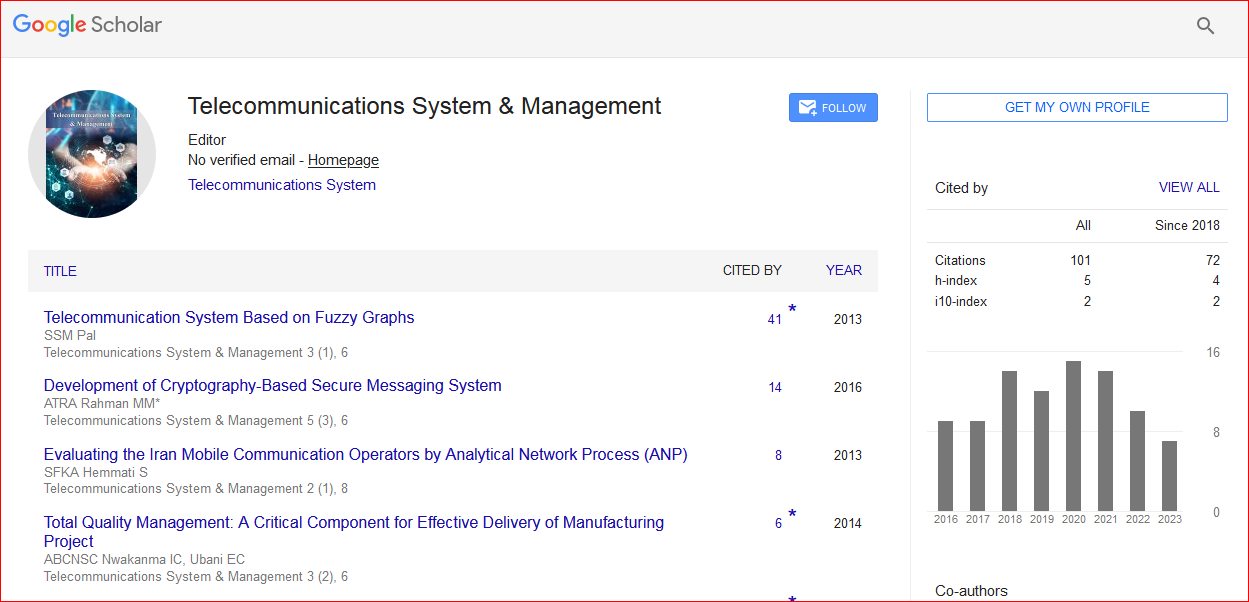
Telecommunications System & Management received 109 citations as per Google Scholar report