Opinion - (2025) Volume 11, Issue 4
Received: 01-Jul-2025, Manuscript No. ohcr-25-174295;
Editor assigned: 03-Jul-2025, Pre QC No. P-174295;
Reviewed: 17-Jul-2025, QC No. Q-174295;
Revised: 22-Jul-2025, Manuscript No. R-174295;
Published:
29-Jul-2025
, DOI: 10.37421/2471-8726.2025.11.204
Citation: Haddad, Omar. ”Evolving Salivary Gland Disease Diagnostics and Treatments.” Oral Health Case Rep 11 (2025):204.
Copyright: © 2025 Haddad O. This is an open-access article distributed under the terms of the Creative Commons Attribution License, which permits unrestricted use, distribution and reproduction in any medium, provided the original author and source are credited.
Sialendoscopy offers a comprehensive look at treating salivary gland obstructions. A systematic review and meta-analysis confirm this minimally invasive procedure is a safe and highly successful option, particularly for conditions like salivary stones. It reliably helps patients avoid more extensive surgical interventions, highlighting its crucial role in modern patient care [1].
Here's a thorough review that covers the entire spectrum of salivary gland neoplasms, from initial diagnosis to ongoing management. It highlights the critical importance of accurate diagnostic techniques. This piece also discusses the diverse treatment strategies available, emphasizing how crucial a precise understanding of these tumors truly is for optimizing patient outcomes [2].
This piece deeply explores salivary gland disease within the complex framework of Sjögren's syndrome. What this really means is understanding how advanced imaging, targeted biopsies, and specific biomarkers are essential tools for diagnosing and diligently monitoring these challenging conditions. It offers vital insights into the intricate interplay between the immune system and salivary gland function in this specific autoimmune disorder [3].
Let's break down the management of chronic non-specific sialadenitis. This comprehensive review highlights that persistent inflammation of the salivary glands can be tricky to manage. However, it details various therapeutic approaches, ranging from conservative care options to necessary surgical interventions, providing clinicians clear guidance to navigate these choices for effective patient care [4].
This update on pediatric sialendoscopy is quite important because it specifically focuses on a less invasive technique tailored for treating salivary gland issues in children. What's clearly emphasized is how recent advancements in this specialized field are substantially improving both diagnostic and therapeutic outcomes for young patients, often helping significantly to preserve vital gland function [5].
Here's the thing about sialolithiasis, also known as salivary gland stones: this comprehensive review thoroughly covers its pathophysiology, crucial diagnostic methods, and available treatments. It's a common condition, and understanding the precise mechanisms behind stone formation, along with utilizing modern diagnostic tools and effective treatment approaches, remains absolutely key to providing optimal patient care [6].
This article discusses the evolving therapeutic challenges in managing salivary gland diseases, specifically focusing on the exciting and recent developments in immunotherapy and targeted therapies. What this means for patients is a tangible move towards more personalized and notably less invasive treatment approaches, particularly for those facing complex or malignant conditions, offering new hope [7].
This particular review sheds light on the debilitating condition of radiation-induced salivary gland dysfunction. It thoroughly breaks down the underlying mechanisms of damage resulting from radiation therapy. The article also explores various innovative therapeutic strategies aimed at effectively mitigating chronic dry mouth and other debilitating side effects, which significantly impact the quality of life for cancer survivors [8].
The diagnostic utility of ultrasound elastography for salivary gland lesions is the primary focus here. What this study clearly reveals through a systematic review and meta-analysis is how this advanced imaging technique can significantly help differentiate between benign and malignant lesions, thereby potentially reducing the need for more invasive and often painful biopsies, leading to improved patient pathways [9].
This piece outlines recent and critical advancements in both diagnosing and treating salivary gland dysfunction specifically linked to Sjögren's syndrome. Understanding the latest developments in this area is absolutely key, as it points towards improved methods for identifying the condition earlier. It also offers more effective ways to manage the chronic dry mouth and other oral symptoms that significantly impact patients' daily lives [10].
Sialendoscopy stands out as a minimally invasive yet highly effective approach for addressing salivary gland obstructions. This technique, validated by systematic reviews and meta-analyses, offers a safe and successful alternative to more extensive surgical interventions, particularly for conditions like salivary stones. Its widespread adoption highlights a move towards less invasive treatments that preserve gland function and improve patient outcomes. The utility of sialendoscopy extends significantly into pediatric care as well. Recent updates in pediatric sialendoscopy emphasize how advancements in this specialized field are substantially improving diagnostic and therapeutic outcomes for young patients, helping to preserve vital gland function and ensure minimal disruption to their development. These developments underscore the procedure's versatility and its critical role across different patient demographics, from adults to children [1, 5].
Understanding and managing salivary gland neoplasms is crucial, covering the entire spectrum from initial diagnosis to long-term management. A precise understanding of these tumors, facilitated by accurate diagnostic techniques and diverse treatment strategies, is essential for optimal patient care. In this context, advanced imaging plays a significant role in improving diagnostic accuracy. Specifically, the diagnostic utility of ultrasound elastography for salivary gland lesions is gaining attention. Studies, including systematic reviews and meta-analyses, show how this advanced imaging technique can significantly help differentiate between benign and malignant lesions. This capability is vital, as it potentially reduces the need for more invasive and often painful biopsies, streamlining patient pathways and guiding appropriate treatment decisions with greater confidence [2, 9].
Salivary gland disease, particularly in the context of Sjögren's syndrome, presents unique diagnostic and therapeutic challenges. Understanding the intricate interplay between the immune system and salivary gland function in this autoimmune disorder is paramount. Key to diagnosing and monitoring these complex conditions are advanced imaging techniques, targeted biopsies, and the use of specific biomarkers. Beyond diagnosis, recent advancements are reshaping the approach to Sjögren's syndrome-related salivary gland dysfunction. These developments point towards improved methods for earlier identification of the condition and more effective strategies to manage chronic dry mouth and other debilitating oral symptoms that profoundly impact patients' daily lives, aiming for enhanced quality of life [3, 10].
Chronic non-specific sialadenitis, a persistent inflammation of the salivary glands, can be tricky to manage. This condition requires a comprehensive understanding of various therapeutic approaches, ranging from conservative care to surgical interventions, to ensure effective patient outcomes. Similarly, sialolithiasis, or salivary gland stones, represents a common obstructive condition. A thorough review of sialolithiasis covers its pathophysiology, crucial diagnostic methods, and available treatments. Gaining insight into the precise mechanisms behind stone formation, coupled with modern diagnostic tools and effective treatment strategies, remains absolutely key to providing optimal patient care for this prevalent issue. Clinicians now have better tools to navigate these conditions effectively [4, 6].
The landscape of salivary gland disease management is evolving, marked by significant therapeutic challenges and promising advancements. There is an exciting focus on innovative treatment modalities such as immunotherapy and targeted therapies. What this means for patients is a tangible move towards more personalized and notably less invasive treatment approaches, particularly for those facing complex or malignant conditions, offering new hope and improved prognosis. Separately, radiation-induced salivary gland dysfunction represents a critical area of concern. This condition, often a side effect of cancer treatment, involves underlying mechanisms of damage from radiation therapy. Various therapeutic strategies are being explored to effectively mitigate chronic dry mouth and other debilitating side effects, which significantly impact the quality of life for cancer survivors, aiming to restore comfort and function [7, 8].
This collection of articles offers a comprehensive look at the multifaceted field of salivary gland diseases, covering diagnostics, treatments, and underlying mechanisms. A significant focus is on minimally invasive interventions like sialendoscopy, which proves highly successful for conditions such as salivary gland obstructions and stones in both adult and pediatric populations [1, 5, 6]. Advances in diagnosing challenging conditions are also highlighted, with reviews on salivary gland neoplasms and the diagnostic utility of ultrasound elastography to differentiate between benign and malignant lesions, potentially reducing the need for invasive biopsies [2, 9]. The literature also delves into autoimmune aspects, particularly salivary gland disease in Sjögren's syndrome, discussing the role of imaging, biopsies, biomarkers, and recent advancements in diagnosis and management to alleviate chronic symptoms [3, 10]. Management of chronic non-specific sialadenitis is explored, outlining various therapeutic approaches from conservative to surgical [4]. Furthermore, the collection addresses therapeutic innovations like immunotherapy and targeted therapies for complex or malignant conditions, signaling a shift towards personalized care [7]. Finally, concerns regarding radiation-induced salivary gland dysfunction are examined, with discussions on damage mechanisms and strategies to mitigate debilitating side effects, improving quality of life for cancer survivors [8]. These papers collectively underscore the evolving understanding and treatment options for a range of salivary gland pathologies.
None
None
1. Syed DA, Edward CK, Jeffrey K. "Sialendoscopy for Salivary Gland Obstruction: A Systematic Review and Meta-Analysis.".Laryngoscope 133 (2023):1043-1052.
Indexed at, Google Scholar, Crossref
2. Reza G, Mona A, Robert S. "A Review of Salivary Gland Neoplasms: From Diagnosis to Management.".Diagnostics 13 (2023):2478.
Indexed at, Google Scholar, Crossref
3. Raphaèle S, Simon JB, Friederike M. "Salivary gland disease in Sjögren's syndrome: The role of imaging, biopsy, and biomarkers.".Best Pract Res Clin Rheumatol 36 (2022):101783.
Indexed at, Google Scholar, Crossref
4. Fadi N, Haya N, Jihane D. "Management of chronic non-specific sialadenitis: A comprehensive review.".Clin Otolaryngol 48 (2023):618-624.
Indexed at, Google Scholar, Crossref
5. Steven P, Audrey P, Evan P. "Update on Pediatric Sialendoscopy.".Children 10 (2023):1676.
Indexed at, Google Scholar, Crossref
6. Ciara O, Andrea C, David K. "Sialolithiasis: A Review of Pathophysiology, Diagnosis, and Treatment.".J Clin Med 12 (2023):7270.
Indexed at, Google Scholar, Crossref
7. Monika T, Anurag S, Kapil S. "Therapeutic challenges in salivary gland diseases: A focus on immunotherapy and targeted therapies.".J Oral Maxillofac Pathol 26 (2022):15-22.
Indexed at, Google Scholar, Crossref
8. Arjan V, Jantina J, Irene S. "Radiation-induced salivary gland dysfunction: Mechanisms and therapeutic strategies.".Oral Dis 28 (2022):2059-2068.
Indexed at, Google Scholar, Crossref
9. Siyu L, Yu L, Xiao J. "Diagnostic utility of ultrasound elastography for salivary gland lesions: A systematic review and meta-analysis.".Oral Surg Oral Med Oral Pathol Oral Radiol 136 (2023):708-718.
Indexed at, Google Scholar, Crossref
10. Takuya S, Hisako T, Norihiro T. "Recent advances in the diagnosis and treatment of Sjögren's syndrome-related salivary gland dysfunction.".Curr Rheumatol Rep 23 (2021):57.
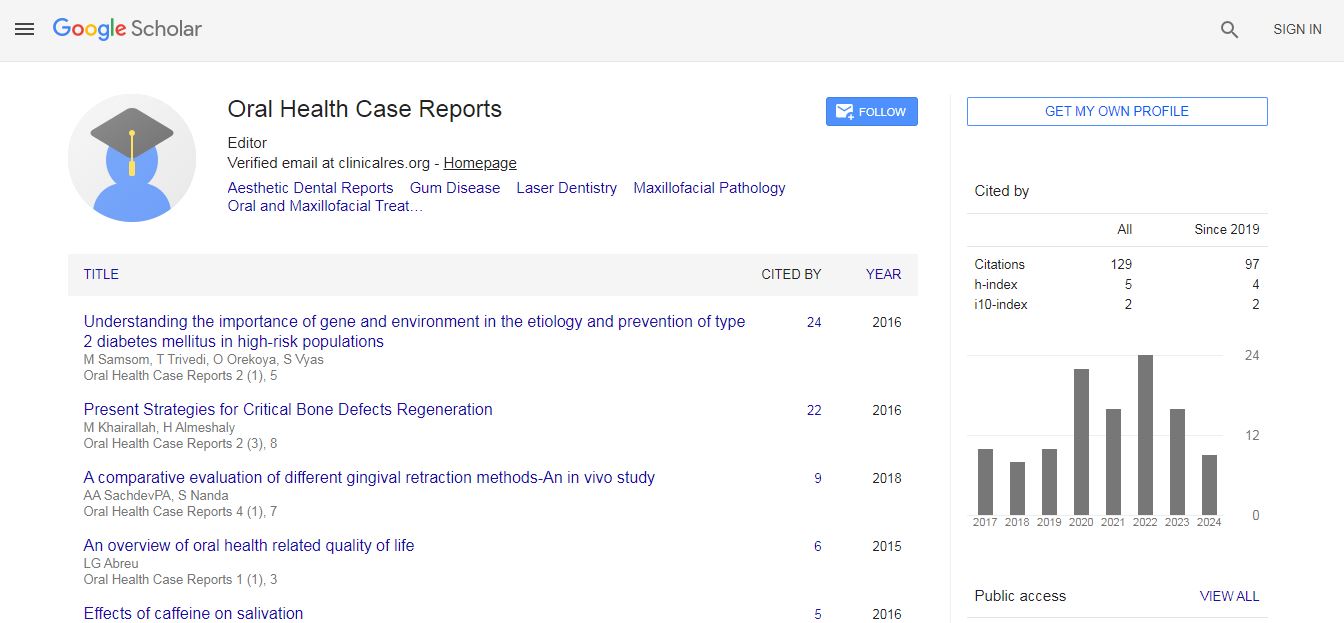
Oral Health Case Reports received 120 citations as per Google Scholar report