Short Communication - (2025) Volume 15, Issue 5
Received: 01-Oct-2025, Manuscript No. jprm-25-174473;
Editor assigned: 03-Oct-2025, Pre QC No. P-174473;
Reviewed: 17-Oct-2025, QC No. Q-174473;
Revised: 22-Oct-2025, Manuscript No. R-174473;
Published:
29-Oct-2025
, DOI: 10.37421/2161-105X.2025.15.767
Citation: Evans, Robert. ”Evolving PH Management: Advances and Personalized Care.” J Pulm Respir Med 15 (2025):767.
Copyright: © 2025 Evans R. This is an open-access article distributed under the terms of the Creative Commons Attribution License, which permits unrestricted use, distribution and reproduction in any medium, provided the original author and source are credited.
This article outlines the comprehensive 2022 ESC/ERS Guidelines for the diagnosis and treatment of pulmonary hypertension, emphasizing updated classifications, diagnostic algorithms, and therapeutic strategies. It integrates new evidence on risk stratification and personalized treatment approaches, aiming to improve patient outcomes. The guidelines highlight the importance of multidisciplinary team management and patient-centered care[1].
This review provides an update on recent advances in the field of pulmonary hypertension, covering new diagnostic tools, refined risk assessment strategies, and emerging therapeutic targets. It discusses the evolving landscape of management for different forms of PH, including pulmonary arterial hypertension, and the implications for clinical practice[2].
This article delves into the complex pathophysiology of pulmonary hypertension, exploring cellular and molecular mechanisms driving vascular remodeling and increased pulmonary vascular resistance. It highlights current targeted therapies and discusses potential future drug development strategies based on a deeper understanding of the disease's underlying biology[3].
This paper examines the crucial role of genetic and epigenetic factors in the development and progression of pulmonary arterial hypertension. It discusses how mutations in specific genes, along with epigenetic modifications, contribute to vascular remodeling and disease severity, offering insights into personalized medicine approaches and potential new therapeutic targets[4].
This study focuses on current strategies for risk stratification in pulmonary arterial hypertension, emphasizing the use of multi-parameter assessment to predict patient prognosis and guide treatment intensity. It highlights the utility of various clinical, hemodynamic, and imaging parameters in classifying disease severity and tailoring individual management plans[5].
This review provides an insightful overview of new pharmacological treatments for pulmonary hypertension, particularly focusing on the most recent advancements in drug development. It discusses novel molecular targets and agents that are currently in clinical trials or have recently been approved, offering hope for improved therapeutic outcomes for patients[6].
This article explores the significant impact of comorbidities on the clinical presentation, prognosis, and management of pulmonary hypertension. It highlights how conditions such as chronic lung disease, left heart disease, and systemic diseases complicate the diagnosis and treatment, underscoring the need for a holistic approach to patient care[7].
This review provides an in-depth analysis of right ventricular adaptation and subsequent failure in the context of pulmonary hypertension. It discusses the mechanisms by which the right ventricle responds to increased afterload and the factors that contribute to its decompensation, which is a major determinant of prognosis in PH patients[8].
This state-of-the-art review comprehensively covers the role of various imaging modalities in the diagnosis, assessment, and follow-up of pulmonary hypertension. It details the utility of echocardiography, CT, MRI, and nuclear imaging in evaluating right ventricular function, pulmonary vascular changes, and identifying the underlying causes of PH[9].
This article discusses the global epidemiology of pulmonary hypertension, examining its prevalence, incidence, and risk factors across different populations and geographical regions. It sheds light on the varying burden of the disease worldwide and highlights the challenges in diagnosis and management in resource-limited settings[10].
Comprehensive guidelines from organizations like ESC/ERS provide the bedrock for diagnosing and treating pulmonary hypertension (PH), emphasizing updated classifications, diagnostic algorithms, and therapeutic strategies [1]. These guidelines are built on new evidence for risk stratification and personalized treatment, aiming to significantly improve patient outcomes through multidisciplinary team management and patient-centered care [1]. Regular updates in the field refine diagnostic tools, risk assessment strategies, and identify emerging therapeutic targets, continuously shaping the evolving landscape of PH management, including pulmonary arterial hypertension (PAH) [2].
The complex pathophysiology of PH involves intricate cellular and molecular mechanisms that drive vascular remodeling and increase pulmonary vascular resistance [3]. This deep understanding of the disease's underlying biology is essential for developing current targeted therapies and future drug development strategies [3]. Complementing this, research highlights the crucial role of genetic and epigenetic factors in PAH development and progression, where specific gene mutations and epigenetic modifications contribute to vascular remodeling and disease severity, opening avenues for personalized medicine and new therapeutic targets [4].
Effective risk stratification is fundamental in PAH, relying on multi-parameter assessments to predict patient prognosis and guide treatment intensity [5]. This involves the utility of various clinical, hemodynamic, and imaging parameters to classify disease severity and tailor individual management plans [5]. Imaging modalities are pivotal in diagnosis, assessment, and follow-up, with echocardiography, CT, MRI, and nuclear imaging providing vital information on right ventricular function, pulmonary vascular changes, and identifying underlying causes of PH [9].
Recent pharmacological treatments for PH focus on the latest advancements in drug development, discussing novel molecular targets and agents either in clinical trials or newly approved, which offer significant hope for improved therapeutic outcomes [6]. However, the presence of comorbidities profoundly impacts the clinical presentation, prognosis, and management of PH [7]. Conditions like chronic lung disease, left heart disease, and systemic diseases complicate diagnosis and treatment, underscoring the necessity for a holistic approach to patient care [7].
An in-depth analysis of right ventricular adaptation and its subsequent failure is crucial, as this response to increased afterload is a major determinant of prognosis in PH patients [8]. Globally, the epidemiology of PH varies, with studies examining its prevalence, incidence, and risk factors across diverse populations and geographical regions [10]. This global perspective also brings to light the challenges in diagnosis and management, particularly in resource-limited settings, where the burden of the disease can differ significantly [10].
Pulmonary hypertension (PH) management is continually evolving, driven by comprehensive guidelines that refine classifications, diagnostic algorithms, and therapeutic strategies, emphasizing personalized approaches and multidisciplinary care. Significant advances include new diagnostic tools, improved risk assessment techniques, and the identification of emerging therapeutic targets, impacting clinical practice across various forms of PH, including pulmonary arterial hypertension (PAH). A deeper understanding of PH pathophysiology, particularly cellular and molecular mechanisms behind vascular remodeling and increased pulmonary vascular resistance, underpins the development of both current targeted therapies and future drug strategies. The influence of genetic and epigenetic factors on PAH development and progression is increasingly recognized, providing pathways for personalized medicine and novel therapeutic targets. Effective risk stratification in PAH relies on multi-parameter assessments that integrate clinical, hemodynamic, and imaging data to predict patient prognosis and guide treatment intensity. New pharmacological treatments are emerging, focusing on advanced drug development and novel molecular targets to improve patient outcomes. Comorbidities pose considerable challenges to PH diagnosis and management, necessitating a holistic view of patient care. Critical to prognosis is the right ventricle's adaptation and its eventual failure in response to increased afterload. Advanced imaging modalities are indispensable for diagnosis, assessment, and follow-up, offering detailed insights into right ventricular function and pulmonary vascular changes. Understanding the global epidemiology of PH is vital, as it highlights variations in prevalence, incidence, and risk factors, alongside the substantial challenges in diagnosis and management in diverse settings.
None
None
1. Jean-Luc V, Stephan R, Marius MH. "2022 ESC/ERS Guidelines for the diagnosis and treatment of pulmonary hypertension".Eur Respir J 60 (2022):2101037.
Indexed at, Google Scholar, Crossref
2. Patrizio L, Marco G, Massimo FP. "Updates in pulmonary hypertension".Eur Heart J Suppl 25 (2023):A46-A50.
Indexed at, Google Scholar, Crossref
3. Yu C, Jie C, Ying-Mei F. "Pathophysiology and targeted therapy for pulmonary hypertension".Signal Transduct Target Ther 6 (2021):387.
Indexed at, Google Scholar, Crossref
4. Hong M, Yan Z, Yong-Min L. "Genetic and epigenetic mechanisms in pulmonary arterial hypertension".J Mol Cell Cardiol 147 (2020):43-52.
Indexed at, Google Scholar, Crossref
5. Ronald LB, Vallerie VM, Raymond LB. "Risk stratification in pulmonary arterial hypertension".JACC Cardiovasc Imaging 14 (2021):2038-2051.
Indexed at, Google Scholar, Crossref
6. Marc H, Marius MH, Nazzareno G. "New pharmacological treatments for pulmonary hypertension: focus on the latest advances".Eur Respir Rev 32 (2023):220202.
Indexed at, Google Scholar, Crossref
7. Nazzareno G, Marius MH, Irene ML. "Comorbidities and pulmonary hypertension".Eur Respir Rev 29 (2020):200028.
Indexed at, Google Scholar, Crossref
8. Katharina T, Ekkehard G, Stephan R. "Right ventricular adaptation and failure in pulmonary hypertension".J Am Coll Cardiol 78 (2021):1474-1487.
Indexed at, Google Scholar, Crossref
9. Anton VN, Andrew JP, Stephan R. "Imaging in pulmonary hypertension: a state-of-the-art review".Eur Respir J 55 (2020):1901089.
Indexed at, Google Scholar, Crossref
10. Michael R, Silvia MU, Thomas F. "Global epidemiology of pulmonary hypertension".Pulm Circ 12 (2022):e12044.
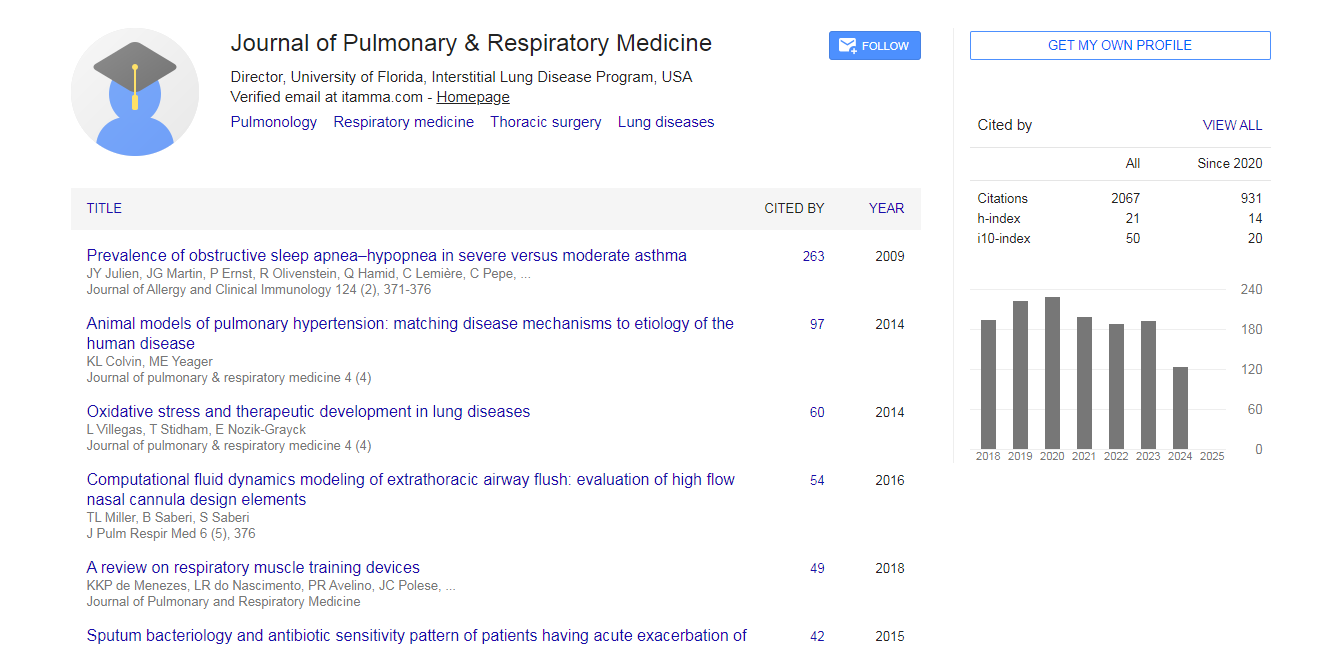
Pulmonary & Respiratory Medicine received 1690 citations as per Google Scholar report