Perspective - (2025) Volume 14, Issue 6
Received: 01-Dec-2025, Manuscript No. jsp-26-182290;
Editor assigned: 03-Dec-2025, Pre QC No. P-182290;
Reviewed: 17-Dec-2025, QC No. Q-182290;
Revised: 22-Dec-2025, Manuscript No. R-182290;
Published:
29-Dec-2025
, DOI: 10.37421/2165-7939.2025.14.756
Citation: Lee, Sung-Hoon. ”Evolving Outcome Measurement in Spine Research.” J Spine 14 (2025):756.
Copyright: © 2025 Lee S. This is an open-access article distributed under the terms of the Creative Commons Attribution License, which permits unrestricted use, distribution and reproduction in any medium, provided the original author and source are credited.
The field of spine research has seen a significant evolution in how treatment outcomes are evaluated, moving towards a more comprehensive understanding of patient well-being. Initially, the focus was predominantly on radiographic measures, such as alignment and disc height, to gauge the structural success of surgical interventions [1].
However, a paradigm shift has occurred, emphasizing the incorporation of patient-reported outcome measures (PROMs) to capture the subjective experiences of pain, function, and quality of life [1].
This transition is crucial for a holistic assessment of treatment efficacy, particularly in minimally invasive spine surgery (MISS), where the benefits of reduced invasiveness need to be weighed against potentially complex outcome assessment [2].
For degenerative spine conditions, the application of functional outcome measures is paramount. Tools like the Oswestry Disability Index (ODI) and the Visual Analog Scale (VAS) for pain have become standard in tracking patient progress and informing treatment decisions [3].
These measures are vital for providing a benchmark for surgical outcomes, but their sensitivity to change and relevance to specific patient populations must be carefully considered [3].
In the context of spinal fusion surgery, PROMs offer a patient-centric perspective that complements traditional radiographic assessments, providing a more complete picture of surgical success by evaluating improvements in pain, function, and quality of life [4].
Beyond the direct surgical impact, psychological factors significantly influence outcome measures in spine surgery. Preoperative anxiety, depression, and fear of movement can profoundly affect postoperative pain, functional recovery, and overall patient satisfaction, underscoring the need for integrated care pathways [5].
The development and validation of new outcome measures for specific spinal pathologies present unique challenges. This process necessitates patient involvement to ensure that new instruments are meaningful and relevant to their lived experiences [6].
Furthermore, establishing consensus on core outcome sets is essential for enhancing comparability and interpretability across diverse research studies [6].
While PROMs have gained prominence, radiographic outcome measures retain their importance in assessing structural integrity, particularly in deformity correction and spinal stabilization [7].
The interplay between radiographic findings and functional outcomes is increasingly recognized, advocating for a multimodal assessment approach that integrates both objective and subjective data [7].
In pediatric spine surgery, the application of PROMs requires special consideration due to factors like growth and development, necessitating age-appropriate and condition-specific instruments [8].
Engaging parents and caregivers is also critical for a comprehensive understanding of the child's experience [8].
Interpreting the clinical significance of changes in outcome measures is facilitated by the concept of the 'minimum clinically important difference' (MCID). MCIDs are essential for determining whether a treatment has yielded a meaningful improvement in a patient's life and for guiding evidence-based practice [9].
The utilization of real-world data (RWD) and real-world evidence (RWE) presents both opportunities and challenges in spine research. RWD from various sources can complement traditional clinical trial data, offering insights into long-term outcomes and treatment variations, though biases must be acknowledged [10].
The evolution of outcome measurement in spine research reflects a growing commitment to patient-centered care and a more nuanced understanding of treatment success. This evolving landscape necessitates a continuous refinement of measurement tools and methodologies. The integration of diverse data sources, including patient-reported information and real-world evidence, is key to advancing our understanding of spinal conditions and their management. The ongoing dialogue surrounding the development, validation, and application of these measures underscores their pivotal role in shaping future clinical practice and research endeavors in spine care. The imperative for rigorous validation and longitudinal assessment of outcome measures is paramount to ensure their reliability and relevance across the spectrum of spinal conditions. This meticulous approach guarantees that the data collected accurately reflects patient outcomes and informs evidence-based decision-making. The challenges associated with selecting appropriate measures, particularly for complex surgical procedures like minimally invasive spine surgery, highlight the need for ongoing research and consensus-building. Standardization in outcome measurement is another critical aspect. Without standardized protocols and instruments, comparing results across different studies and institutions becomes exceedingly difficult. This lack of standardization can hinder the synthesis of evidence and the development of best practices. The integration of PROMs into routine clinical workflows, while beneficial, requires careful planning and implementation to ensure efficient and effective data collection. The future of outcome assessment in spine research lies in its ability to provide a truly patient-centric view of treatment success. This involves not only capturing improvements in pain and function but also understanding the broader impact on a patient's quality of life and their ability to engage in meaningful activities. The continuous development of innovative assessment tools and methodologies will be crucial in achieving this goal. Ultimately, the ultimate aim of outcome measurement in spine research is to improve patient care. By rigorously evaluating treatments and understanding what truly matters to patients, researchers and clinicians can make more informed decisions, leading to better outcomes and enhanced patient satisfaction. This dedication to comprehensive and patient-focused evaluation is shaping the future of spine surgery.
The evolution of outcome measures in spine research signifies a critical shift from purely objective, often radiographic, assessments to a more comprehensive, patient-centered approach. Early research heavily relied on quantifiable metrics such as spinal alignment, disc height, and fusion rates [1].
These radiographic indicators provided a standardized way to evaluate the structural integrity and technical success of surgical procedures. However, it became increasingly apparent that these measures alone did not fully capture the patient's experience of recovery and improvement in their daily lives. Consequently, there has been a pronounced emphasis on incorporating patient-reported outcome measures (PROMs) to provide a more holistic evaluation of treatment efficacy [1].
This transition is particularly relevant in the domain of minimally invasive spine surgery (MISS). While MISS offers potential advantages like reduced invasiveness and faster recovery times, assessing its long-term effectiveness and comparing it to traditional open techniques presents unique challenges [2].
The choice of appropriate PROMs is crucial to reflect the specific benefits of MISS, and standardization of surgical techniques is also important for reproducible results [2].
The influence of surgeon experience and learning curves on outcome reporting also adds another layer of complexity to this assessment [2].
For degenerative spine conditions, the use of functional outcome measures is indispensable for managing patient care. Widely adopted tools like the Oswestry Disability Index (ODI) and the Visual Analog Scale (VAS) for pain are essential for tracking patient progress and guiding treatment decisions [3].
These instruments serve as vital benchmarks for surgical outcomes, but it is imperative that the selected measures are sensitive to change and highly relevant to the specific patient population and condition being addressed [3].
In the realm of spinal fusion surgery, PROMs are instrumental in capturing the patient's perspective on improvements in pain, function, and overall quality of life, thereby complementing traditional radiographic assessments and offering a more complete view of surgical success [4].
Furthermore, the impact of psychological factors on outcome measures in patients undergoing spine surgery cannot be overstated. Preoperative anxiety, depression, and fear of movement can significantly influence postoperative pain, functional recovery, and patient satisfaction. This underscores the importance of incorporating psychological assessments into routine preoperative evaluations and implementing integrated care pathways to address these crucial factors and ultimately improve surgical outcomes [5].
The development and validation of novel outcome measures for specific spinal pathologies, such as spinal stenosis or disc herniation, present ongoing challenges. The involvement of patients in this development process is crucial to ensure that new measures are indeed relevant and meaningful from their perspective [6].
Additionally, the establishment of consensus on core outcome sets is vital for facilitating comparability across studies and enhancing the interpretability of research findings, allowing for more robust evidence synthesis [6].
Radiographic outcome measures, while not the sole determinant of success, continue to play a significant role in spine research. Parameters such as alignment, disc height, and fusion rates are important for assessing structural integrity, especially in deformity correction and spinal stabilization procedures [7].
The interplay between radiographic findings and patient-reported functional outcomes is increasingly acknowledged, promoting a multimodal assessment approach that leverages the strengths of both types of data [7].
In pediatric spine surgery, the application of PROMs introduces distinct considerations related to growth and development. Evaluating the suitability of existing PROMs for children and adolescents is an ongoing effort, highlighting the need for age-appropriate and condition-specific instruments [8].
The comprehensive understanding of a child's experience also necessitates the active engagement of parents and caregivers in the outcome assessment process [8].
The concept of the 'minimum clinically important difference' (MCID) is fundamental to the interpretation of outcome measures in spine research. MCIDs are critical for understanding the clinical significance of observed changes in patient-reported outcomes and for determining whether a treatment has resulted in a meaningful improvement in a patient's life [9].
Methodologies for establishing MCIDs and their application in evidence-based practice are key components of this field. Finally, the utilization of real-world data (RWD) and real-world evidence (RWE) offers new avenues for outcome assessment in spine research. Data derived from electronic health records, patient registries, and claims databases can complement traditional clinical trial data, providing insights into long-term outcomes, treatment variations, and patient subgroups [10].
However, it is crucial to acknowledge and address the inherent biases and limitations associated with RWD to ensure the validity of RWE [10].
This multifaceted approach to outcome measurement, encompassing both objective and subjective data, psychological factors, and real-world evidence, is essential for advancing the field of spine research and ultimately improving patient care and outcomes.
This collection of research highlights the evolving landscape of outcome measurement in spine research. There is a clear shift from solely relying on radiographic data to incorporating patient-reported outcome measures (PROMs) that capture functional status and quality of life. This is crucial for assessing treatment efficacy, especially in areas like minimally invasive spine surgery and degenerative spine conditions. Tools such as the Oswestry Disability Index and Visual Analog Scale are vital for tracking progress, while psychological factors and the concept of minimum clinically important difference (MCID) are increasingly recognized as significant influences on outcomes. The development of new measures, the use of real-world data, and considerations for specific populations like children are also discussed, emphasizing the need for standardized, patient-centered, and multimodal assessment approaches.
None
None
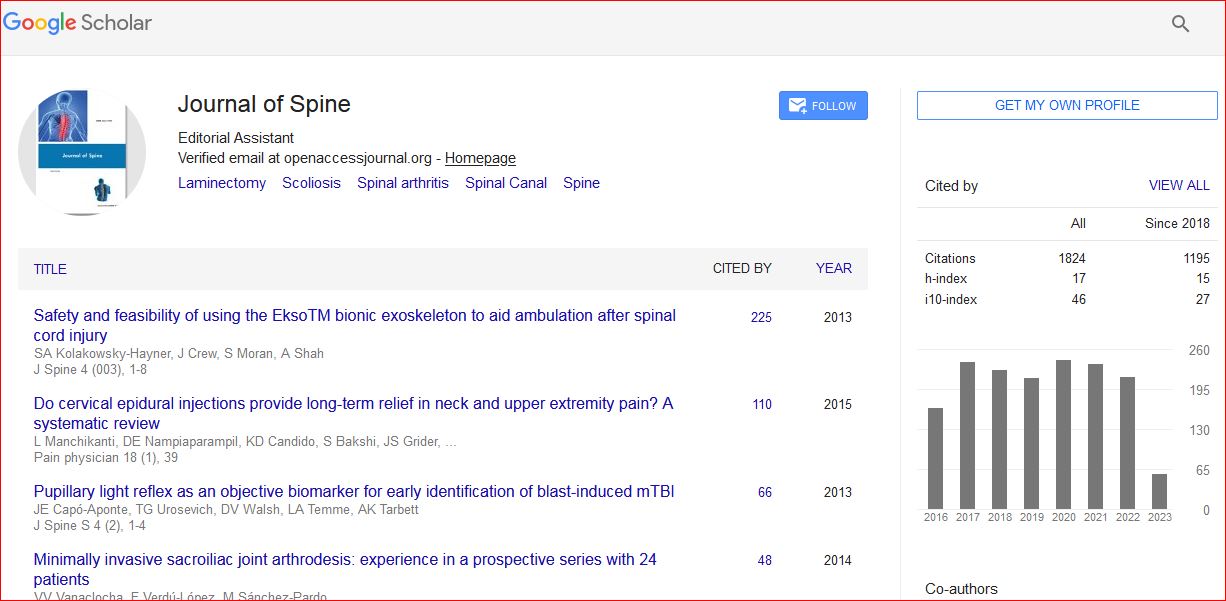
Journal of Spine received 2022 citations as per Google Scholar report