Commentary - (2025) Volume 9, Issue 3
Received: 01-Sep-2025, Manuscript No. rrms-25-175069;
Editor assigned: 03-Sep-2025, Pre QC No. P-175069;
Reviewed: 17-Sep-2025, QC No. Q-175069;
Revised: 22-Sep-2025, Manuscript No. R-175069;
Published:
29-Sep-2025
, DOI: 10.37421/2952-8127.2025.9.231
Citation: Patel, David. ”Evolving Labs: Tech, Precision, and Quality.” Res Rep Med Sci 09 (2025):231.
Copyright: © 2025 Patel D. This is an open-access article distributed under the terms of the Creative Commons Attribution License, which permits unrestricted use, distribution and reproduction in any medium, provided the original author and source are credited.
This article explores the transformative effects of total laboratory automation (TLA) on operational efficiency and staff involvement within clinical laboratories. It highlights how TLA streamlines various pre-analytical, analytical, and post-analytical phases, leading to reduced manual errors, faster turnaround times, and improved safety. The discussion also covers the critical role of managing staff adaptation and ensuring engagement during the transition to automated systems for successful implementation [1].
This paper delves into the evolving landscape of point-of-care testing (POCT) and its significant role in contemporary healthcare delivery. It addresses the practical challenges associated with POCT implementation, such as quality assurance, regulatory compliance, and data management. Simultaneously, it highlights the immense opportunities POCT offers, including rapid diagnosis, improved patient management, and enhanced accessibility to testing, especially in remote or resource-limited settings [2].
This article examines the burgeoning role of artificial intelligence (AI) in revolutionizing laboratory medicine. It discusses the potential of AI algorithms to enhance diagnostic accuracy, optimize workflow, and facilitate predictive analytics in various laboratory disciplines. However, the authors also critically evaluate the associated challenges, including data privacy concerns, the need for robust validation studies, and the ethical implications of integrating AI into clinical decision-making processes [3].
This article provides an overview of liquid biopsy's evolving role in clinical oncology, highlighting its potential for non-invasive cancer detection, monitoring treatment response, and identifying minimal residual disease. It discusses the various analytes, such as circulating tumor DNA (ctDNA) and circulating tumor cells (CTCs), and the analytical challenges in their robust detection and quantification. The authors also explore future directions, emphasizing the need for standardized methodologies and integration into routine clinical practice [4].
This review focuses on the successful integration of genomic sequencing technologies into standard clinical laboratory workflows. It discusses the methodological advancements that have made next-generation sequencing (NGS) more accessible and cost-effective for diagnostic purposes. The article covers various applications, from inherited disorders to pharmacogenomics and oncology, while also addressing critical challenges such as data interpretation, bioinformatics infrastructure, and the need for skilled personnel to handle complex genomic data [5].
This review details the significant advancements and growing utility of mass spectrometry (MS) in clinical diagnostics. It covers various MS platforms and their applications in detecting biomarkers for infectious diseases, endocrinology, toxicology, and oncology. The article emphasizes how MS provides high sensitivity, specificity, and multiplexing capabilities, making it an indispensable tool for complex analytical challenges in laboratory medicine. It also touches upon the ongoing standardization efforts and future potential of MS [6].
This article explores the transformative impact of digital pathology on anatomic pathology practice. It discusses how whole slide imaging (WSI) systems enable pathologists to digitize glass slides, facilitating remote review, easier consultation, and integration with image analysis algorithms. The paper highlights the benefits for improved diagnostic efficiency, standardization, and the potential for leveraging artificial intelligence for enhanced diagnostic accuracy and quantitative analysis in routine laboratory operations [7].
This article emphasizes the paramount importance of robust quality management systems (QMS) in clinical laboratories to ensure patient safety and reliable diagnostic outcomes. It outlines the core components of a comprehensive QMS, including quality control, quality assurance, risk management, and continuous improvement processes. The authors discuss how adherence to international standards and accreditation bodies strengthens laboratory performance, reduces errors, and fosters public trust in diagnostic testing [8].
This article explores the burgeoning field of microbiome diagnostics and its implications for laboratory medicine. It discusses how advanced sequencing technologies are enabling comprehensive analysis of microbial communities in various body sites, revealing associations with numerous diseases, including gastrointestinal disorders, metabolic conditions, and even cancer. The authors highlight current diagnostic applications and the promising future of microbiome-based biomarkers for personalized medicine, while also addressing challenges in standardization and clinical interpretation [9].
This article discusses the critical and expanding role of the clinical laboratory in advancing precision medicine. It highlights how laboratories are moving beyond traditional diagnostics to incorporate complex molecular testing, including genomics, transcriptomics, and proteomics, to tailor treatments to individual patients. The paper addresses the need for robust analytical validation, stringent quality control, and effective interpretation of highly complex data, emphasizing the laboratory's position at the forefront of personalized healthcare [10].
Modern laboratory medicine is undergoing a significant transformation, driven by innovative technologies and a focus on enhanced diagnostic capabilities and patient safety. Here's the thing, across various disciplines, labs are adopting new approaches to improve efficiency and accuracy. This evolution encompasses everything from large-scale automation to highly specialized molecular diagnostics and advanced data analysis techniques.
Operational efficiency is a core area of improvement. Total Laboratory Automation (TLA) is proving transformative, streamlining pre-analytical, analytical, and post-analytical processes. This results in fewer manual errors, quicker turnaround times, and overall enhanced safety within clinical laboratories [1]. The shift to automated systems also requires careful management of staff adaptation and engagement for successful implementation. Additionally, the evolving landscape of Point-of-Care Testing (POCT) offers immense opportunities for rapid diagnosis and improved patient management, particularly in remote or resource-limited settings. While POCT presents challenges in quality assurance, regulatory compliance, and data management, its benefits in accessibility are clear [2].
Advanced diagnostic technologies are expanding the scope of what laboratories can achieve. Artificial Intelligence (AI) is revolutionizing diagnostic accuracy, optimizing workflows, and facilitating predictive analytics across laboratory disciplines. However, integrating AI necessitates addressing data privacy, robust validation studies, and ethical considerations [3]. Liquid biopsy represents a crucial advancement in clinical oncology, enabling non-invasive cancer detection, treatment monitoring, and minimal residual disease identification. Its successful integration into clinical practice depends on standardized methodologies for analytes like circulating tumor DNA (ctDNA) and circulating tumor cells (CTCs) [4]. Genomic sequencing technologies, especially Next-Generation Sequencing (NGS), have become more accessible and cost-effective for diagnosing inherited disorders, pharmacogenomics, and oncology, although data interpretation and bioinformatics infrastructure remain critical challenges [5]. Furthermore, Mass Spectrometry (MS) provides high sensitivity, specificity, and multiplexing capabilities for detecting biomarkers in infectious diseases, endocrinology, toxicology, and oncology, making it an indispensable tool for complex analytical problems [6].
Digitalization is also reshaping traditional practices. Digital pathology, through whole slide imaging (WSI) systems, allows pathologists to digitize glass slides, which facilitates remote review, easier consultation, and integration with image analysis algorithms. This enhances diagnostic efficiency, standardization, and quantitative analysis [7]. Underlying all these advancements is the paramount importance of robust Quality Management Systems (QMS). A comprehensive QMS, including quality control, quality assurance, risk management, and continuous improvement, is essential for patient safety and reliable diagnostic outcomes. Adhering to international standards and accreditation significantly strengthens laboratory performance and public trust [8]. Looking to new frontiers, microbiome diagnostics, leveraging advanced sequencing technologies, is revealing associations between microbial communities and various diseases, from gastrointestinal disorders to cancer. This field holds promise for personalized medicine, but standardization and clinical interpretation require further development [9].
What this really means is that the clinical laboratory's role in advancing precision medicine is rapidly expanding. Laboratories are moving beyond traditional diagnostics to incorporate complex molecular testing, including genomics, transcriptomics, and proteomics, to tailor treatments to individual patients. This forward-looking approach demands rigorous analytical validation, stringent quality control, and expert interpretation of highly complex data, positioning the laboratory at the forefront of personalized healthcare [10].
Modern clinical laboratories are rapidly evolving, integrating advanced technologies to enhance diagnostics, improve efficiency, and support personalized medicine. Total Laboratory Automation (TLA) streamlines workflows, reducing errors and turnaround times, while Point-of-Care Testing (POCT) offers rapid diagnostics, though it brings challenges in quality and data management. Artificial Intelligence (AI) is poised to boost diagnostic accuracy and optimize lab processes, yet it raises important data privacy and ethical considerations. In oncology, liquid biopsy provides non-invasive cancer detection, requiring standardized methodologies for broader clinical adoption. Genomic sequencing, especially Next-Generation Sequencing (NGS), is now more accessible for diagnosing various conditions, though data interpretation remains complex. Mass spectrometry (MS) has become indispensable for biomarker detection due to its high sensitivity and specificity. Digital pathology is transforming anatomic pathology by digitizing slides, improving diagnostic efficiency and enabling AI integration. Central to all these advancements are robust Quality Management Systems (QMS) which ensure patient safety and diagnostic reliability, fostering public trust. Emerging fields like microbiome diagnostics promise new insights into disease associations for personalized medicine. Ultimately, clinical laboratories are expanding their critical role in precision medicine, leveraging complex molecular testing to tailor individual patient treatments, which demands stringent quality control and expert data interpretation.
None
None
Kuan H, Chen S, Chien T. "Total Laboratory Automation and its Impact on Laboratory Workflow and Staff Engagement".Clin Chem Lab Med 59 (2021):e339-e341.
Indexed at, Google Scholar, Crossref
V. BVR, B. DVdW, M. VD. "Point-of-Care Testing: Challenges and Opportunities in Modern Healthcare".Clin Biochem 106 (2022):10-18.
Indexed at, Google Scholar, Crossref
B. PVdZ, E. PVdV, S. JMVdP. "Artificial intelligence in laboratory medicine: Promises and pitfalls".Clin Chem Lab Med 58 (2020):1619-1630.
Indexed at, Google Scholar, Crossref
K. CML, S. BLL, T. YNO. "Liquid Biopsy in Clinical Oncology: Current Status and Future Perspectives".J Clin Pathol 76 (2023):643-651.
Indexed at, Google Scholar, Crossref
J. SAL, H. PC, M. AVS. "Integrating Genomic Sequencing into Routine Clinical Laboratory Practice: A Comprehensive Review".Clin Chem 67 (2021):770-778.
Indexed at, Google Scholar, Crossref
P. LTW, R. SKC, M. ELT. "Advances in Mass Spectrometry for Clinical Diagnostics: A Review".Clin Chem 68 (2022):533-545.
Indexed at, Google Scholar, Crossref
A. DS, B. MK, C. NR. "Digital Pathology: A Paradigm Shift in Anatomic Pathology Practice".J Clin Pathol 73 (2020):631-638.
Indexed at, Google Scholar, Crossref
M. JLDB, S. AKB, G. HMVdB. "Quality Management Systems in Clinical Laboratories: Essential for Patient Safety".J Med Lab Sci 32 (2019):97-104.
Indexed at, Google Scholar, Crossref
E. KLC, H. YLW, S. FTL. "The Microbiome in Laboratory Medicine: Current Applications and Future Directions".Clin Chem Lab Med 61 (2023):649-659.
Indexed at, Google Scholar, Crossref
D. JL, F. SKT, G. SLL. "The Evolving Role of the Clinical Laboratory in Precision Medicine".J Mol Diagn 24 (2022):425-438.
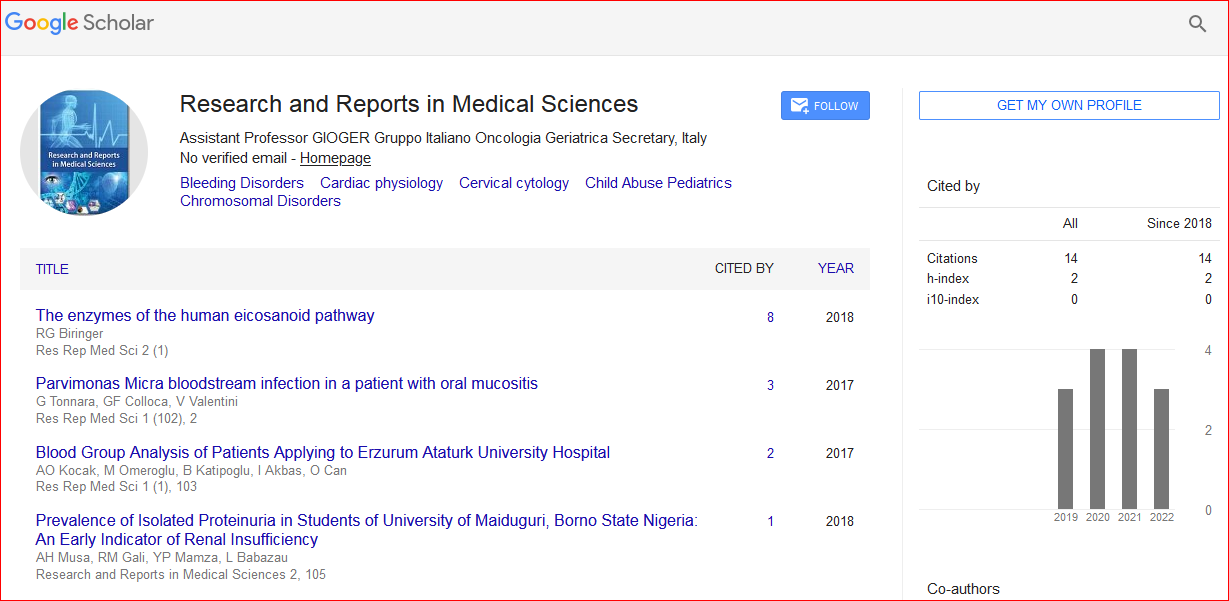
Research and Reports in Medical Sciences received 13 citations as per Google Scholar report