Commentary - (2025) Volume 14, Issue 4
Received: 01-Jul-2025, Manuscript No. pbt-25-173760;
Editor assigned: 03-Jul-2025, Pre QC No. P-173760;
Reviewed: 17-Jul-2025, QC No. Q-173760;
Revised: 22-Jul-2025, Manuscript No. R-173760;
Published:
29-Jul-2025
, DOI: 10.37421/2167-7689.2025.14.489
Citation: Chen, Amelia R.. ”Evolving Drug Regulations: Tech, Safety, Access.” Pharmaceut Reg Affairs 14 (2025): 489.
Copyright: © 2025 Chen R. Amelia This is an open-access article distributed under the terms of the Creative Commons Attribution License, which permits unrestricted use,
distribution and reproduction in any medium, provided the original author and source are credited.
Digital health technologies are rapidly transforming medicine, yet regulatory frameworks frequently struggle to keep pace. This area highlights a pressing need for adaptive regulatory science, emphasizing collaborative approaches and innovative methodologies. The goal is to ensure these technologies prove both safe and effective, streamlining evaluation processes without compromising patient safety or data integrity. This focus becomes even more vital as digital tools become deeply integrated into drug development and patient care [1].
Artificial Intelligence (AI) is fundamentally reshaping drug discovery and development. While offering immense potential, AI also poses complex regulatory questions. This perspective explores how agencies must adapt to effectively validate AI algorithms, ensure robust data quality, and skillfully manage the ethical implications arising from AI-driven drug development. The crucial point here is balancing innovation with rigorous oversight to guarantee safe and effective medicines reach patients [2].
Real-World Evidence (RWE) holds considerable promise for supplementing traditional clinical trial data. However, its integration into regulatory decisions varies significantly across the globe. This review outlines diverse regulatory pathways for RWE in different regions, bringing to light inconsistencies and identifying best practices. The core objective is to understand precisely how regulators are approaching the use of existing data sources to support drug approvals and ongoing post-market safety monitoring [3].
Decentralized Clinical Trials (DCTs) have gained substantial traction, especially in recent times, providing increased flexibility and broader patient access. This discussion delves into the key regulatory and operational considerations required for implementing DCTs effectively. It points out the critical need for clear guidance on remote data collection, securing patient consent in virtual settings, and thorough technology validation to maintain trial integrity and ensure regulatory compliance [4].
Innovation in drug development often moves at a quicker pace than regulatory evolution, inevitably creating challenges for delivering new therapies to patients. This piece examines regulatory innovation specifically within the European Union. It focuses on how agencies are actively adapting their processes to facilitate faster access to groundbreaking medicines while, crucially, ensuring rigorous safety and efficacy standards. Its truly about finding smart, efficient ways to regulate without stifling vital progress [5].
Biosimilars present a cost-effective alternative to expensive biologic drugs. However, their development and subsequent approval involve intricate regulatory pathways. This article offers a global overview of these pathways, highlighting unique challenges such as demonstrating biosimilarity and skillfully navigating different national requirements. The ultimate goal is to standardize and streamline the entire process, thereby ensuring broader patient access to these increasingly important therapies [6].
Developing drugs for rare diseases, commonly known as orphan drugs, consistently encounters its own distinct set of regulatory hurdles. This paper scrutinizes the specific challenges faced by manufacturers, including small patient populations and limited available data. It also explores the various incentives and expedited pathways regulators have established. The aim is clear: to encourage innovation in areas where medical needs remain significantly unmet [7].
Post-market surveillance plays an absolutely crucial role in monitoring the safety and effectiveness of drugs once they are commercially available. This review explores the global regulatory landscape for such surveillance, noting considerable differences in reporting requirements, data collection methodologies, and enforcement mechanisms across various countries. Understanding these variations becomes essential for ensuring robust pharmacovigilance and comprehensive public health protection worldwide [8].
Personalized medicine offers the profound promise of tailored treatments, meticulously based on an individuals unique genetic makeup and other biomarkers. Yet, it introduces distinct regulatory challenges. This article investigates how regulatory bodies are grappling with the complex task of approving diagnostics concurrently with therapeutics, ensuring equitable patient access, and thoughtfully managing the ethical considerations inherent in highly individualized treatments. The key here is to develop adaptable frameworks that can accommodate these rapidly evolving therapies [9].
Advanced Therapy Medicinal Products (ATMPs), particularly gene therapies, represent a significant frontier in modern medicine, holding the potential for cures for previously untreatable diseases. However, their inherently complex nature presents substantial regulatory hurdles, ranging from ensuring manufacturing consistency to implementing rigorous long-term safety monitoring. This paper highlights these specific challenges and proposes practical strategies for effective regulation, ultimately ensuring these innovative therapies can reach patients both safely and efficiently [10].
The modern pharmaceutical landscape faces constant evolution, driven by technological advancements. Regulatory frameworks frequently find themselves challenged to keep pace with these rapid changes. Digital health technologies are quickly transforming medicine, demanding adaptive regulatory science and collaborative approaches to ensure safety and effectiveness. The focus is on streamlining evaluation processes for digital tools without compromising patient safety or data integrity [C001]. Similarly, Artificial Intelligence (AI) is fundamentally reshaping drug discovery and development. AI offers immense potential but also introduces complex regulatory questions. Agencies need to adapt to validate AI algorithms, ensure data quality, and manage the ethical implications of AI-driven development, striking a balance between innovation and rigorous oversight to deliver safe and effective medicines [C002].
Beyond digital tools, new methodologies are altering how clinical evidence is gathered. Real-World Evidence (RWE) holds promise for supplementing traditional clinical trial data. However, its integration into regulatory decisions varies globally, with diverse pathways and inconsistencies needing to be addressed. Understanding how regulators worldwide use existing data sources is key to supporting drug approvals and post-market safety [C003]. Parallel to this, Decentralized Clinical Trials (DCTs) have gained significant traction, offering flexibility and broader patient access. Effective implementation requires clear regulatory and operational considerations, particularly concerning remote data collection, patient consent in virtual settings, and technology validation to maintain trial integrity and compliance [C004].
Regulatory innovation itself is critical, especially when drug development outpaces current frameworks. For instance, within the European Union, agencies are adapting processes to facilitate faster access to groundbreaking medicines while upholding rigorous safety and efficacy standards, aiming to regulate without stifling progress [C005]. Moreover, specific product categories present unique challenges. Biosimilars, while cost-effective, involve intricate global regulatory pathways that require demonstrating biosimilarity and navigating varying national requirements. The goal is to standardize these processes for improved patient access [C006]. Developing drugs for rare diseases, or orphan drugs, also comes with its own set of hurdles, like small patient populations and limited data. Regulators have implemented incentives and expedited pathways to encourage innovation in these high-unmet-medical-need areas [C007].
Effective post-market surveillance is crucial for monitoring drug safety and effectiveness once products are commercially available. The global regulatory landscape for this surveillance reveals significant differences in reporting requirements, data collection, and enforcement across countries. Understanding these variations is essential for robust pharmacovigilance and public health protection [C008]. Looking to the future, personalized medicine promises tailored treatments based on an individuals unique genetic makeup and other biomarkers, but it introduces unique regulatory challenges. Bodies grapple with approving diagnostics alongside therapeutics, ensuring equitable access, and managing ethical considerations for highly individualized treatments, necessitating adaptable frameworks [C009]. Advanced Therapy Medicinal Products (ATMPs), particularly gene therapies, represent a frontier with potential cures, yet their complex nature presents substantial regulatory hurdles from manufacturing consistency to long-term safety monitoring. Proposing strategies for effective regulation is vital to ensure these innovative therapies safely reach patients [C010].
The regulatory landscape for drug development is in constant flux, driven by technological innovations like Digital Health and Artificial Intelligence (AI). Regulators face the challenge of adapting frameworks to ensure safety and efficacy while fostering innovation. This involves streamlining evaluation processes for digital tools and validating AI algorithms, all while managing ethical implications [C001, C002]. New approaches to data collection, such as Real-World Evidence (RWE) and Decentralized Clinical Trials (DCTs), are gaining traction. Their integration into regulatory decisions requires consistent guidelines for data quality, remote consent, and technology validation across various global pathways [C003, C004]. Regulatory innovation extends to specific product types and global harmonisation. Agencies, like those in the European Union, are evolving processes to facilitate quicker access to groundbreaking medicines without compromising safety standards [C005]. Biosimilars, orphan drugs, and personalized medicine each present distinct regulatory hurdles, from demonstrating biosimilarity and navigating small patient populations to managing complex approvals for individualized treatments [C006, C007, C009]. Furthermore, Advanced Therapy Medicinal Products (ATMPs), especially gene therapies, introduce significant manufacturing and long-term safety monitoring challenges [C010]. Crucially, global post-market surveillance remains vital, though reporting requirements and enforcement vary widely, underscoring the need for consistent pharmacovigilance to protect public health [C008]. Ultimately, the overarching goal is to balance innovation with oversight to ensure safe, effective, and accessible therapies reach patients worldwide.
None
None
1. Janet MW, Michelle AM, Amy PA. "Regulatory Science and Digital Health Technologies: Navigating the Evolving Landscape".Clin Pharmacol Ther 110 (2021):1475-1478.
Indexed at, Google Scholar, Crossref
2. Jun Z, Yuxuan C, Xiaomei W. "Artificial intelligence in drug discovery and development: regulatory perspectives".J Pharm Anal 12 (2022):569-583.
Indexed at, Google Scholar, Crossref
3. Elena PRDP, Giulia B, Giovanni F. "Regulatory pathways for real-world evidence in drug development: a global perspective".J Clin Pharmacol 61 (2021):S66-S79.
Indexed at, Google Scholar, Crossref
4. Craig L, Rosanne VB, Michelle MC. "Decentralized Clinical Trials: The New Normal? Regulatory and Operational Considerations".Clin Pharmacol Ther 108 (2020):663-672.
Indexed at, Google Scholar, Crossref
5. Guido R, Andreas P, Sabine A. "Regulatory innovation and drug development in the European Union".Clin Pharmacol Ther 109 (2021):310-313.
Indexed at, Google Scholar, Crossref
6. Chetan K, Ashish K, Ashutosh K. "Global Regulatory Pathways for Biosimilars: Challenges and Opportunities".Curr Pharm Biotechnol 21 (2020):11-20.
Indexed at, Google Scholar, Crossref
7. Anamul K, Md. SI, Riasat C. "Orphan Drug Development: Regulatory Challenges and Opportunities".J Pharm Res Int 26 (2019):1-13.
Indexed at, Google Scholar, Crossref
8. Neha J, Vimarsh R, Ashish KS. "Global regulatory landscape of post-market surveillance of medical products: A narrative review".J Postgrad Med 67 (2021):167-175.
Indexed at, Google Scholar, Crossref
9. Elena MC, Alessandra F, Giorgio F. "Regulatory challenges in personalized medicine: A global perspective".Pers Med 17 (2020):389-398.
Indexed at, Google Scholar, Crossref
10. Francesca L, Alessia C, Francesca M. "Regulatory Challenges for Advanced Therapy Medicinal Products (ATMPs): A Focus on Gene Therapy Products".Pharmaceutics 15 (2023):228.
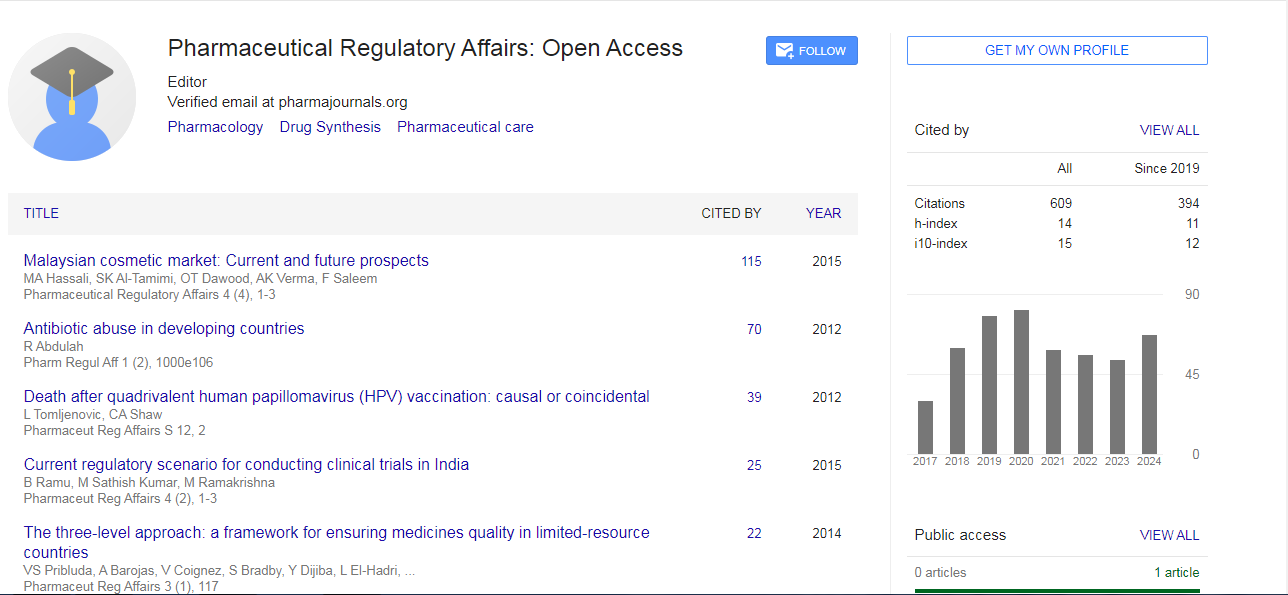
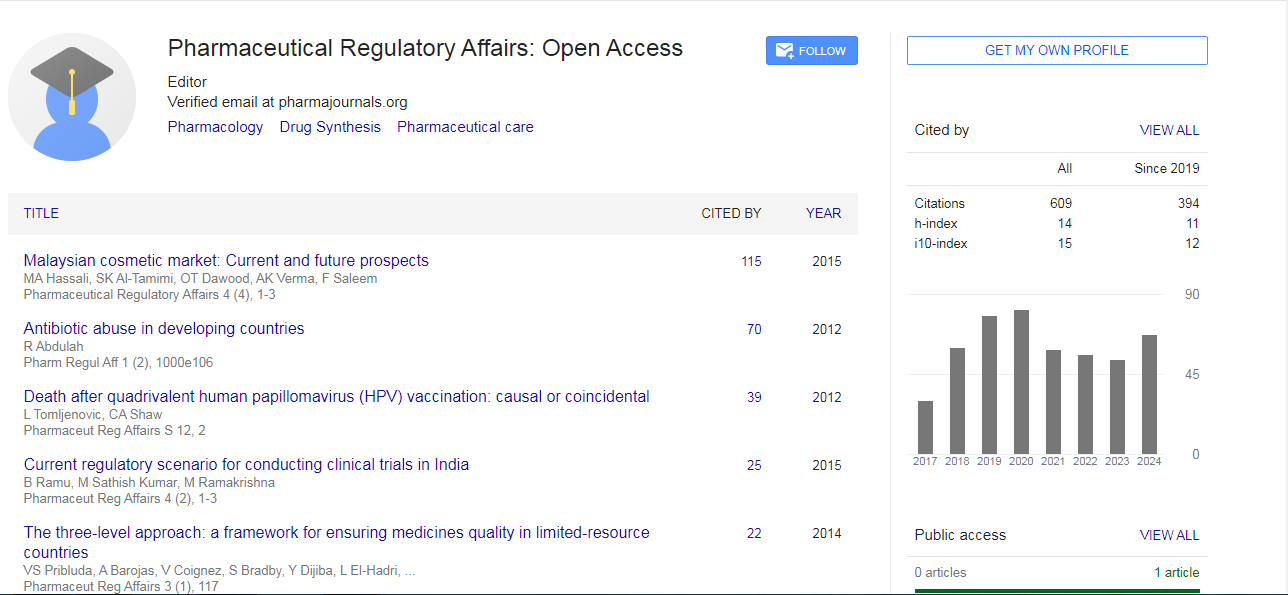
Pharmaceutical Regulatory Affairs: Open Access received 533 citations as per Google Scholar report