Opinion - (2025) Volume 14, Issue 4
Received: 01-Jul-2025, Manuscript No. iem-26-179821;
Editor assigned: 03-Jul-2025, Pre QC No. P-179821;
Reviewed: 14-Jul-2025, QC No. Q-179821;
Revised: 22-Jul-2025, Manuscript No. R-179821;
Published:
29-Jul-2025
, DOI: 10.37421/2169- 0316.2025.14.314
Citation: Thompson, Emma. âEvolving Continuous Improvement: Lean, Agile, and Human-Centered.â J Ind Eng Manag 14 (2025):314.
Copyright: © 2025 Thompson E. This is an open-access article distributed under the terms of the Creative Commons Attribution License, which permits unrestricted use, distribution and reproduction in any medium, provided the original author and source are credited.
The pursuit of operational excellence and enhanced organizational performance has led to the development and refinement of numerous continuous improvement methodologies over the years. These frameworks aim to systematically identify and eliminate inefficiencies, reduce defects, and foster a culture of ongoing advancement. Early approaches often focused on specific aspects of improvement, laying the groundwork for more integrated strategies. This article provides a comprehensive overview of established continuous improvement methodologies, specifically Lean and Six Sigma, and explores emerging trends and hybrid approaches. It highlights how Lean focuses on waste reduction and value stream optimization, while Six Sigma emphasizes defect reduction through statistical analysis. The discussion then extends to integrated models like Lean Six Sigma, and more recent developments such as Agile and Design Thinking as complementary or alternative frameworks for driving organizational improvement in dynamic environments [1].
The healthcare sector, with its inherent complexities and critical importance, has increasingly adopted systematic approaches to enhance its operations. Ensuring patient safety, optimizing resource allocation, and reducing errors are paramount concerns that can be addressed through structured improvement frameworks. The application of these methodologies in healthcare is being explored for its potential to revolutionize patient care and administrative processes. This paper delves into the application of Lean Six Sigma principles within the healthcare sector, demonstrating its potential for enhancing patient safety, operational efficiency, and cost reduction. It examines how the DMAIC (Define, Measure, Analyze, Improve, Control) framework, central to Six Sigma, can be effectively adapted to address complex healthcare challenges. The authors present case studies illustrating successful implementations and discuss the critical success factors for adopting these methodologies in healthcare settings [2].
In parallel with the evolution of improvement methodologies, technological advancements have opened new avenues for enhancing their effectiveness. The digital transformation of industries, often referred to as Industry 4.0, offers powerful tools that can augment traditional improvement practices. The integration of smart technologies allows for real-time data collection and analysis, providing unprecedented insights into operational performance. This research explores the integration of Industry 4.0 technologies with Lean and Six Sigma methodologies. It argues that smart manufacturing capabilities, such as the Internet of Things (IoT) and big data analytics, can significantly amplify the effectiveness of traditional continuous improvement models. The paper discusses how real-time data from connected systems can enable more precise problem identification and faster implementation of improvements, leading to enhanced agility and productivity [3].
Beyond quantitative and technological approaches, a human-centered perspective is crucial for successful innovation and problem-solving. Understanding the needs and experiences of users is fundamental to developing solutions that are not only effective but also sustainable and widely adopted. Design Thinking, with its emphasis on empathy and iterative development, offers a complementary approach to traditional improvement models. This study examines the application of Design Thinking as a framework for innovation and problem-solving in organizational contexts, presenting it as a valuable complement to traditional improvement models. It emphasizes the human-centered approach of Design Thinking, focusing on empathy, ideation, prototyping, and testing. The authors suggest that by understanding user needs deeply, organizations can develop more effective and sustainable solutions that go beyond incremental improvements [4].
Agile methodologies, initially prominent in software development, have demonstrated their value in fostering continuous improvement across various project management contexts. Their iterative nature, focus on collaboration, and responsiveness to feedback align well with the core principles of improvement. The integration of Agile practices can lead to more adaptive and efficient processes. This paper investigates the role of Agile methodologies in fostering continuous improvement, particularly in software development and project management. It highlights how Agile's iterative and incremental approach, along with its emphasis on collaboration and customer feedback, aligns with the goals of continuous improvement. The authors discuss how Agile principles can be integrated with Lean and Six Sigma to create more adaptive and responsive improvement systems [5].
While large corporations have often been at the forefront of adopting sophisticated improvement methodologies, small and medium-sized enterprises (SMEs) also stand to benefit significantly. SMEs, however, face unique challenges related to resource constraints and operational scale. Tailoring these methodologies to fit the specific context of smaller businesses is essential for their successful implementation. This article explores the application of Lean Six Sigma in small and medium-sized enterprises (SMEs), addressing the unique challenges they face in implementing continuous improvement. It examines how SMEs can adapt these methodologies to their resource constraints and operational realities, focusing on practical tools and strategies for waste reduction and process enhancement. The paper provides insights into fostering a culture of continuous improvement within smaller organizations [6].
The synergy between Lean and Six Sigma has been a subject of extensive research and practice, leading to the development of integrated approaches that leverage the strengths of both. Lean's focus on process flow and waste elimination complements Six Sigma's data-driven approach to variation reduction. Empirical studies have provided evidence of the significant benefits derived from combining these methodologies. This research evaluates the effectiveness of integrating Lean and Six Sigma methodologies. It provides a detailed analysis of the synergy between Lean's focus on flow and waste elimination and Six Sigma's data-driven approach to variation reduction. The authors present empirical evidence from various industries demonstrating how Lean Six Sigma can lead to significant improvements in quality, efficiency, and customer satisfaction [7].
The applicability of Lean principles extends beyond the manufacturing and service sectors to the public sector, where efficiency and service delivery are critical. Adapting Lean thinking to the unique context of government operations can lead to more effective and citizen-focused public services. Addressing non-value-added activities and improving process flows are key areas of focus. This paper examines the application of Lean principles in the public sector, highlighting its utility in improving service delivery and operational efficiency. It discusses how Lean's emphasis on identifying and eliminating non-value-added activities can lead to more effective and citizen-centric public services. The authors provide examples of successful Lean implementations in government agencies and explore the cultural shifts required for sustained improvement [8].
The continuous improvement landscape is not static; it is constantly evolving to address new challenges and opportunities. As markets become more volatile and complex, traditional approaches may need to be augmented or replaced by more adaptive strategies. Methodologies that foster agility and resilience are becoming increasingly important for organizational success. This article explores the evolving landscape of continuous improvement, moving beyond traditional models to embrace more agile and adaptive approaches. It discusses the challenges posed by increasing market volatility and complexity, and how methodologies like Lean Startup and systems thinking offer new ways to drive innovation and organizational resilience. The authors emphasize the need for a flexible and integrated approach to improvement in today's dynamic business environment [9].
Finally, the successful implementation and sustainability of any continuous improvement initiative are heavily influenced by human factors. Psychological and behavioral aspects, such as employee engagement, leadership support, and organizational culture, play a pivotal role. Understanding these dynamics is crucial for fostering an environment conducive to lasting improvements. This research investigates the psychological and behavioral factors that influence the successful adoption and sustainability of continuous improvement initiatives, using Six Sigma as a case study. It examines the importance of employee engagement, leadership commitment, and organizational culture in driving sustained improvements. The study offers practical recommendations for managers on how to foster a supportive environment for continuous improvement efforts [10].
The foundational principles of continuous improvement are explored through the lens of established methodologies like Lean and Six Sigma, which form the bedrock of many organizational advancement strategies. Lean focuses on the meticulous reduction of waste across the entire value stream, ensuring that every process step contributes directly to customer value. Conversely, Six Sigma employs a rigorous statistical approach to identify, analyze, and eliminate defects, aiming for near-perfect process outcomes. The interplay between these two powerful frameworks has led to the development of integrated models, such as Lean Six Sigma, which seeks to harness the strengths of both. Furthermore, emerging trends indicate a shift towards more adaptive and dynamic approaches, including Agile and Design Thinking, which are proving to be valuable complements or alternatives in fast-paced business environments. This article provides a comprehensive overview of established continuous improvement methodologies, specifically Lean and Six Sigma, and explores emerging trends and hybrid approaches. It highlights how Lean focuses on waste reduction and value stream optimization, while Six Sigma emphasizes defect reduction through statistical analysis. The discussion then extends to integrated models like Lean Six Sigma, and more recent developments such as Agile and Design Thinking as complementary or alternative frameworks for driving organizational improvement in dynamic environments [1].
Within the demanding and critical domain of healthcare, the adoption of Lean Six Sigma principles offers a structured pathway to enhance patient safety, streamline operations, and achieve significant cost reductions. The DMAIC (Define, Measure, Analyze, Improve, Control) framework, a cornerstone of Six Sigma, provides a systematic methodology for tackling complex healthcare challenges, from reducing medical errors to optimizing patient flow. Case studies illustrate the tangible benefits of successful implementations, underscoring the importance of adapting these robust methodologies to the unique intricacies of healthcare settings. This paper delves into the application of Lean Six Sigma principles within the healthcare sector, demonstrating its potential for enhancing patient safety, operational efficiency, and cost reduction. It examines how the DMAIC (Define, Measure, Analyze, Improve, Control) framework, central to Six Sigma, can be effectively adapted to address complex healthcare challenges. The authors present case studies illustrating successful implementations and discuss the critical success factors for adopting these methodologies in healthcare settings [2].
The advent of Industry 4.0 technologies has ushered in a new era of opportunities for augmenting traditional continuous improvement frameworks. The integration of smart manufacturing capabilities, including the Internet of Things (IoT) and advanced big data analytics, amplifies the effectiveness of Lean and Six Sigma. Real-time data streams from interconnected systems enable more precise problem identification, facilitate faster implementation of corrective actions, and ultimately lead to enhanced organizational agility and productivity. This research explores the integration of Industry 4.0 technologies with Lean and Six Sigma methodologies. It argues that smart manufacturing capabilities, such as the Internet of Things (IoT) and big data analytics, can significantly amplify the effectiveness of traditional continuous improvement models. The paper discusses how real-time data from connected systems can enable more precise problem identification and faster implementation of improvements, leading to enhanced agility and productivity [3].
Complementing the data-driven and process-oriented approaches, Design Thinking offers a fundamentally human-centered framework for innovation and problem-solving. By prioritizing empathy, ideation, prototyping, and testing, organizations can move beyond incremental improvements to develop solutions that deeply resonate with user needs. This user-centric perspective is invaluable in creating more effective, sustainable, and impactful outcomes that address the root causes of challenges. This study examines the application of Design Thinking as a framework for innovation and problem-solving in organizational contexts, presenting it as a valuable complement to traditional improvement models. It emphasizes the human-centered approach of Design Thinking, focusing on empathy, ideation, prototyping, and testing. The authors suggest that by understanding user needs deeply, organizations can develop more effective and sustainable solutions that go beyond incremental improvements [4].
Agile methodologies, widely adopted in software development, are increasingly recognized for their efficacy in driving continuous improvement across diverse project management environments. The iterative and incremental nature of Agile, coupled with its emphasis on collaborative teamwork and continuous customer feedback, aligns seamlessly with the objectives of ongoing refinement and adaptation. By integrating Agile principles with existing improvement systems, organizations can cultivate more responsive and agile improvement cycles. This paper investigates the role of Agile methodologies in fostering continuous improvement, particularly in software development and project management. It highlights how Agile's iterative and incremental approach, along with its emphasis on collaboration and customer feedback, aligns with the goals of continuous improvement. The authors discuss how Agile principles can be integrated with Lean and Six Sigma to create more adaptive and responsive improvement systems [5].
Small and medium-sized enterprises (SMEs) face distinct challenges when implementing continuous improvement initiatives, particularly concerning resource limitations and operational scale. Adapting established methodologies like Lean Six Sigma to the specific realities of SMEs requires a pragmatic approach, focusing on practical tools and strategies for waste reduction and process enhancement. Cultivating a culture that embraces continuous improvement is crucial for SMEs to achieve sustainable growth and competitiveness. This article explores the application of Lean Six Sigma in small and medium-sized enterprises (SMEs), addressing the unique challenges they face in implementing continuous improvement. It examines how SMEs can adapt these methodologies to their resource constraints and operational realities, focusing on practical tools and strategies for waste reduction and process enhancement. The paper provides insights into fostering a culture of continuous improvement within smaller organizations [6].
The integration of Lean and Six Sigma methodologies has been shown to create a powerful synergy, enhancing both process flow and variation reduction. Lean's emphasis on eliminating non-value-added activities streamlines operations, while Six Sigma's data-driven approach ensures that improvements are statistically robust and lead to a significant reduction in defects. Empirical evidence across various industries supports the notion that Lean Six Sigma, when effectively implemented, leads to substantial gains in quality, efficiency, and customer satisfaction. This research evaluates the effectiveness of integrating Lean and Six Sigma methodologies. It provides a detailed analysis of the synergy between Lean's focus on flow and waste elimination and Six Sigma's data-driven approach to variation reduction. The authors present empirical evidence from various industries demonstrating how Lean Six Sigma can lead to significant improvements in quality, efficiency, and customer satisfaction [7].
The application of Lean principles within the public sector offers a compelling avenue for enhancing service delivery and operational efficiency. By systematically identifying and eliminating non-value-added activities, government agencies can become more responsive, effective, and citizen-centric. Successful implementations in various public sector organizations demonstrate the adaptability of Lean thinking to governmental contexts, often requiring significant cultural shifts to embed continuous improvement practices. This paper examines the application of Lean principles in the public sector, highlighting its utility in improving service delivery and operational efficiency. It discusses how Lean's emphasis on identifying and eliminating non-value-added activities can lead to more effective and citizen-centric public services. The authors provide examples of successful Lean implementations in government agencies and explore the cultural shifts required for sustained improvement [8].
The field of continuous improvement is in constant flux, driven by increasing market volatility and complexity. This necessitates a move beyond traditional, rigid methodologies towards more agile and adaptive approaches. Frameworks such as Lean Startup and systems thinking offer innovative ways to foster organizational resilience and drive continuous innovation, enabling businesses to navigate dynamic environments effectively. The authors emphasize the need for a flexible and integrated approach to improvement in today's dynamic business environment. This article explores the evolving landscape of continuous improvement, moving beyond traditional models to embrace more agile and adaptive approaches. It discusses the challenges posed by increasing market volatility and complexity, and how methodologies like Lean Startup and systems thinking offer new ways to drive innovation and organizational resilience [9].
The sustainability of continuous improvement initiatives is profoundly influenced by psychological and behavioral determinants, as evidenced by studies on Six Sigma implementation. Critical factors include robust leadership commitment, active employee engagement, and a supportive organizational culture. Fostering an environment that encourages participation, provides necessary training, and recognizes contributions is paramount for embedding continuous improvement as an organizational norm. This research investigates the psychological and behavioral factors that influence the successful adoption and sustainability of continuous improvement initiatives, using Six Sigma as a case study. It examines the importance of employee engagement, leadership commitment, and organizational culture in driving sustained improvements. The study offers practical recommendations for managers on how to foster a supportive environment for continuous improvement efforts [10].
This collection of research explores various facets of continuous improvement, with a strong focus on Lean and Six Sigma methodologies. It details their core principles, including waste reduction and defect elimination, and examines integrated approaches like Lean Six Sigma. The research also highlights the application of these methodologies in diverse sectors such as healthcare and the public sector, as well as in small and medium-sized enterprises (SMEs). Emerging trends and complementary frameworks like Design Thinking and Agile are discussed for their role in modern organizational improvement. Furthermore, the influence of technological advancements like Industry 4.0 on enhancing improvement processes is explored, alongside the crucial psychological and behavioral factors that underpin the successful adoption and sustainability of these initiatives. The overarching theme is the evolution of continuous improvement towards more agile, adaptive, and human-centered approaches in dynamic environments.
None
None
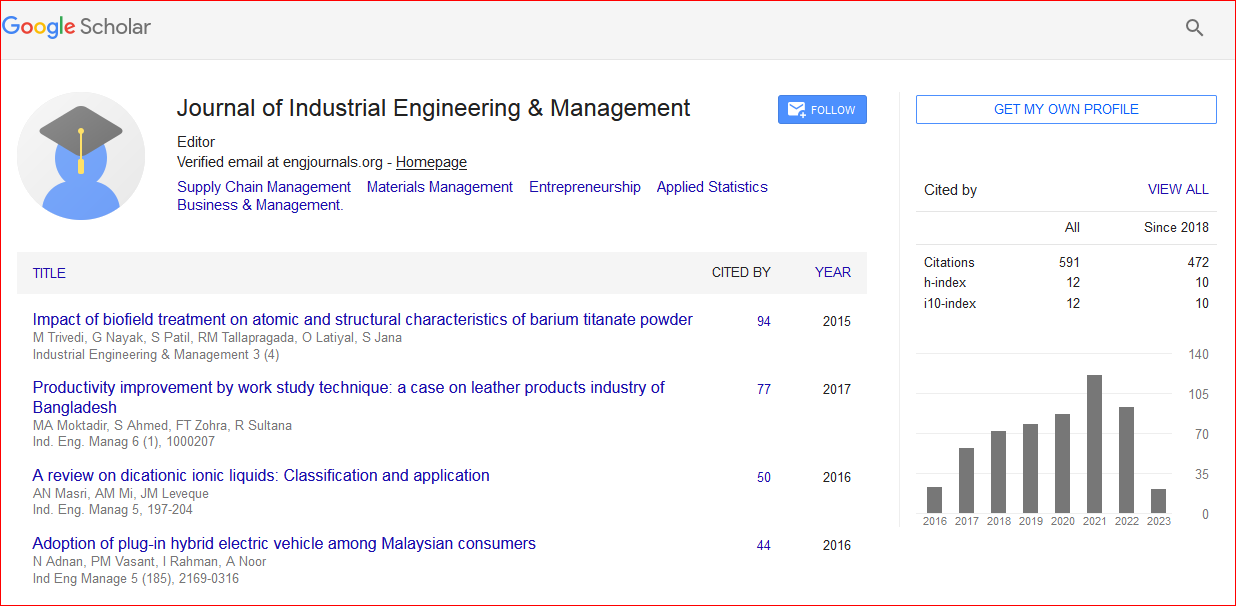
Industrial Engineering & Management received 739 citations as per Google Scholar report