Short Communication - (2025) Volume 10, Issue 6
Received: 01-Dec-2025, Manuscript No. jcct-26-183284;
Editor assigned: 03-Dec-2025, Pre QC No. P-183284;
Reviewed: 17-Dec-2025, QC No. Q-183284;
Revised: 22-Dec-2025, Manuscript No. R-183284;
Published:
29-Dec-2025
, DOI: 10.37421/2577-0535.2025.9.347
Citation: Fuentes, Diego R.. ”Evolving Cancer Trials: Precision, Efficiency, and Patient Focus.” J Cancer Clin Trials 10 (2025):347.
Copyright: © 2025 Fuentes R. Diego This is an open-access article distributed under the terms of the Creative Commons Attribution License, which permits unrestricted use, distribution and reproduction in any medium, provided the original author and source are credited.
The landscape of cancer clinical trials is undergoing a significant transformation, driven by the imperative to develop more efficient, personalized, and adaptive research methodologies. This evolution aims to accelerate the delivery of novel therapeutics to patients by refining existing approaches and embracing innovative designs. The integration of real-world data, sophisticated analytical techniques, and novel trial structures such as basket and platform trials are at the forefront of these advancements, promising to streamline drug development and reduce associated costs. The ultimate goal is to enhance patient outcomes by ensuring that the most appropriate treatments are matched to individuals with specific molecular profiles, making precision medicine and biomarker-driven strategies central to this paradigm shift. This will usher in an era of clinical trials that are not only more targeted but also considerably more informative for both researchers and clinicians alike [1].
Concurrent with these design innovations, the incorporation of real-world data (RWD) and real-world evidence (RWE) is becoming increasingly prevalent in cancer clinical trials. This integration provides invaluable insights into treatment effectiveness and safety within diverse patient populations, extending beyond the controlled environments of traditional trials. Methodologies for the collection and analysis of RWD are continuously being refined to guarantee its validity and utility. This ensures that RWD can robustly support regulatory decision-making and effectively inform the design of future clinical trials, contributing to a more comprehensive evidence generation framework [2].
Adaptive trial designs are emerging as a critical component of modern clinical research due to their inherent flexibility. These designs permit modifications to key trial parameters, such as sample size or the inclusion/exclusion of specific treatment arms, based on the ongoing accumulation of data. This dynamic approach facilitates the expedited identification of effective treatments while allowing for the early termination of ineffective ones. Consequently, adaptive designs optimize resource allocation and accelerate the overall drug development timeline, all while upholding the highest standards of scientific rigor [3].
Biomarker-driven trial designs, notably basket and umbrella trials, are revolutionizing the field of precision oncology. These innovative approaches categorize patients based on specific molecular alterations rather than solely on traditional cancer types. This stratification enables the evaluation of targeted therapies across different histological subtypes that share a common molecular driver. Such a strategy leads to more efficient drug development for well-defined patient subgroups who are most likely to benefit from a particular therapy [4].
Decentralized clinical trials (DCTs) and remote monitoring technologies represent significant innovations aimed at improving patient access and participation in clinical research. By leveraging telemedicine, wearable devices, and the infrastructure of local healthcare providers, DCTs seek to alleviate the logistical burdens on both patients and trial sites. This ultimately has the potential to broaden the reach and diversity of clinical trial participation, though it necessitates new approaches to data management and regulatory oversight [5].
Artificial intelligence (AI) and machine learning (ML) are poised to fundamentally transform the operational and analytical aspects of cancer clinical trials. Their applications span the optimization of patient selection criteria, the prediction of treatment response, the identification of novel clinical endpoints, and the streamlining of complex data analysis processes. These advanced technologies hold immense promise for making clinical trials more predictive, efficient, and insightful, leading to faster discoveries and better patient care [6].
The development of novel clinical trial endpoints is essential for accurately reflecting meaningful clinical benefit, particularly in the context of rapidly evolving targeted therapies and immunotherapies. These new endpoints encompass patient-reported outcomes (PROs), surrogate markers, and dynamic measures that capture treatment effects over time. The overarching aim is to provide a more comprehensive and holistic assessment of a treatment's efficacy and its impact on a patient's quality of life [7].
Platform trials offer a highly adaptable framework for the simultaneous evaluation of multiple investigational agents. This design utilizes a common control arm against which various treatment arms can be assessed concurrently. The inherent flexibility of platform trials allows for the dynamic addition or removal of treatment arms as new drugs become available or as existing ones demonstrate varying levels of efficacy. This model significantly streamlines the evaluation process for new cancer therapies [8].
Patient centricity is increasingly recognized as a driving force behind successful clinical trial innovation. This principle emphasizes the active engagement of patients throughout the entire trial lifecycle, from initial design and conduct to the selection of meaningful outcomes. Ensuring that trials are relevant, accessible, and aligned with patient needs and preferences is paramount. Enhanced patient involvement has been shown to improve recruitment rates, patient retention, and the overall value and impact of trial results [9].
The integration of multi-omics data, including genomics, proteomics, and other molecular profiling techniques, is indispensable for identifying novel therapeutic targets and elucidating mechanisms of treatment resistance. Advanced bioinformatics tools and sophisticated data integration platforms are critical for analyzing these complex, high-dimensional datasets. The effective translation of findings from such analyses into novel clinical trial strategies is essential for realizing the promise of truly personalized cancer care [10].
The field of cancer clinical trials is undergoing a profound evolution, marked by a growing emphasis on efficiency, personalization, and adaptability. Innovations are increasingly focused on harnessing the power of real-world data, integrating advanced analytical methodologies, and exploring novel trial designs such as basket and platform trials. These strategic shifts are collectively aimed at accelerating the pace of drug development, mitigating costs, and ultimately enhancing patient outcomes through more effective matching of treatments to individual patient profiles. Precision medicine and biomarker-driven approaches are fundamental to these advancements, paving the way for a future where clinical trials are more precisely targeted and yield richer, more informative data [1].
There is a notable and growing trend towards the integration of real-world data (RWD) and real-world evidence (RWE) into the fabric of cancer clinical trials. This incorporation enables a more nuanced understanding of treatment efficacy and safety across a wider spectrum of patient populations, extending beyond the confines of highly controlled trial settings. Significant efforts are being directed towards refining the methodologies used for collecting and analyzing RWD to ensure its reliability and applicability. This rigorous approach is vital for supporting regulatory decisions and for informing the design of future clinical investigations, thereby fostering a more holistic approach to evidence generation [2].
Adaptive trial designs are steadily gaining prominence within the clinical research landscape due to their inherent flexibility and efficiency. These innovative designs allow for real-time modifications to trial parameters, such as sample size adjustments or the introduction or discontinuation of treatment arms, based on the data as it emerges. This dynamic capability enables faster identification of effective interventions and more rapid cessation of ineffective ones. Consequently, adaptive designs contribute to optimized resource utilization and can shorten the drug development timeline while maintaining stringent scientific validity [3].
Biomarker-driven trial designs, encompassing methodologies like basket and umbrella trials, are at the vanguard of revolutionizing precision oncology. These designs facilitate the grouping of patients based on specific molecular alterations rather than solely on traditional cancer classifications. This targeted patient selection allows for the efficient evaluation of therapies designed to target these molecular drivers across diverse histological types of cancer that share these common genetic or molecular features, thereby accelerating drug development for specific patient subgroups [4].
Decentralized clinical trials (DCTs) and the implementation of remote monitoring strategies are emerging as key innovations designed to improve patient accessibility and engagement in clinical research. By utilizing technologies such as telemedicine, wearable biosensors, and the involvement of local healthcare facilities, DCTs aim to reduce the logistical and travel burdens typically associated with trial participation. This approach has the potential to significantly expand the reach and diversity of trial participants, although it necessitates careful consideration of new frameworks for data management and regulatory oversight [5].
Artificial intelligence (AI) and machine learning (ML) technologies are poised to fundamentally reshape the landscape of cancer clinical trials. Their potential applications are broad, ranging from optimizing patient selection algorithms and predicting treatment responses to identifying novel endpoints and streamlining complex data analysis workflows. The integration of AI and ML offers the promise of making clinical trials more predictive, efficient, and capable of generating deeper insights into disease mechanisms and treatment effects [6].
The development and adoption of novel endpoints in cancer clinical trials are crucial for better assessing meaningful clinical benefit, especially in the context of targeted therapies and immunotherapies. These evolving endpoints include patient-reported outcomes (PROs) that capture the patient's experience, sensitive surrogate markers that predict clinical outcomes, and dynamic endpoints that track treatment effects over time. The objective is to achieve a more comprehensive and patient-centered evaluation of treatment efficacy and its overall impact on quality of life [7].
Platform trials represent a highly efficient and flexible trial design paradigm for simultaneously evaluating multiple investigational agents. A key characteristic is the use of a common control arm against which several experimental treatments can be compared. This framework allows for the dynamic addition of new treatment arms as promising drugs become available or the removal of arms if they prove ineffective, thus significantly streamlining the process of evaluating new cancer therapies [8].
Patient centricity is increasingly becoming a central guiding principle in the innovation of cancer clinical trials. This involves the active collaboration with patients in the design, conduct, and outcome definition phases of trials to ensure that studies are relevant, accessible, and aligned with the needs and preferences of those participating. Enhanced patient involvement is consistently linked to improved recruitment, better retention rates, and ultimately, trial results that hold greater real-world value [9].
The integration of comprehensive multi-omics data, encompassing genomics, proteomics, and other molecular profiling information, is fundamental to discovering new therapeutic targets and understanding the complex mechanisms underlying treatment resistance. Sophisticated bioinformatics tools and robust data integration platforms are essential for effectively analyzing these intricate datasets. The successful translation of insights derived from multi-omics data into novel clinical trial strategies is a critical step towards achieving truly personalized cancer care [10].
Cancer clinical trials are evolving with a focus on efficiency, personalization, and adaptive approaches. Key innovations include the integration of real-world data, advanced analytics, and novel trial designs like basket and platform trials to accelerate drug development and improve patient outcomes through precision medicine. Real-world data enhances understanding of treatment effectiveness in diverse populations. Adaptive designs offer flexibility by allowing modifications based on accumulating data, optimizing resource allocation. Biomarker-driven trials, such as basket and umbrella trials, group patients by molecular alterations for targeted therapy evaluation. Decentralized clinical trials and remote monitoring aim to improve patient access and participation. Artificial intelligence and machine learning are being applied to optimize patient selection, predict responses, and streamline analysis. Novel endpoints are being developed to better reflect clinical benefit, including patient-reported outcomes. Platform trials efficiently evaluate multiple agents simultaneously. Patient centricity is crucial, involving patients in trial design and conduct. Multi-omics data integration is essential for identifying targets and understanding resistance, driving personalized cancer care.
None
None
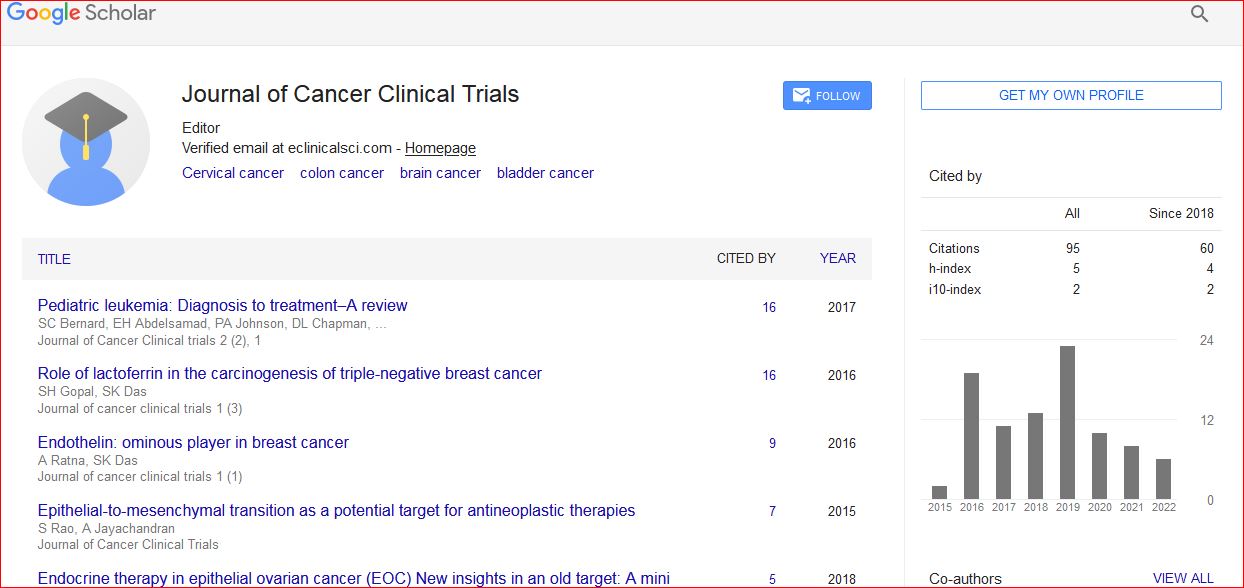
Journal of Cancer Clinical Trials received 95 citations as per Google Scholar report