Brief Report - (2025) Volume 10, Issue 2
Received: 01-Apr-2025, Manuscript No. jcct-26-183200;
Editor assigned: 03-Apr-2025, Pre QC No. P-183200;
Reviewed: 17-Apr-2025, QC No. Q-183200;
Revised: 22-Apr-2025, Manuscript No. R-183200;
Published:
29-Apr-2025
, DOI: 10.37421/2577-0535.2025.9.298
Citation: Thompson, Amelia R.. ”Evolving Cancer Trials: Design, Precision, and Real-World Data.” J Cancer Clin Trials 10 (2025):298.
Copyright: © 2025 Thompson R. Amelia This is an open-access article distributed under the terms of the Creative Commons Attribution License, which permits unrestricted use, distribution and reproduction in any medium, provided the original author and source are credited.
The landscape of cancer clinical trials has evolved significantly, demanding rigorous design and methodological considerations across all phases of drug development. Phase I trials are pivotal for establishing initial safety profiles and determining optimal dose ranges for novel anticancer agents. These early-stage studies focus on identifying the Maximum Tolerated Dose (MTD) and understanding dose-limiting toxicities, laying the groundwork for subsequent research [1].
Building upon the safety data from Phase I, Phase II trials are designed to assess the preliminary efficacy of investigational treatments and further refine dosing strategies. These studies often employ a variety of designs to efficiently evaluate therapeutic activity and identify patient populations most likely to respond [10].
Phase III trials represent large-scale, randomized, controlled studies aimed at confirming the efficacy and safety of a new treatment compared to the current standard of care. These trials are crucial for generating robust evidence to support regulatory approval and establish new clinical practice guidelines [1].
Adaptive trial designs have gained prominence, particularly in Phase II and III settings, offering enhanced flexibility and efficiency. These designs allow for pre-specified modifications based on accumulating data, such as adjusting sample sizes or dropping non-performing treatment arms, thereby optimizing resource utilization and accelerating the drug development process [2].
Precision medicine approaches are increasingly integrated into cancer clinical trials, leveraging molecular profiling and biomarker identification to select patient subgroups who are most likely to benefit from targeted therapies. Innovative trial designs like basket and umbrella studies facilitate the efficient evaluation of these agents across diverse cancer types [4].
The robust application of statistical principles is paramount to the success of cancer clinical trials, especially in Phase III. Key statistical concepts, including hypothesis testing, power calculations, and appropriate endpoint selection, are critical for ensuring the validity and interpretability of trial results [3].
Ethical considerations are a cornerstone of cancer clinical trial conduct, with particular attention paid to vulnerable populations. Ensuring informed consent, protecting patient autonomy and privacy, and promoting equitable access to investigational therapies are essential ethical imperatives [5].
Phase I cancer trials require specific design strategies, including dose escalation methods and toxicity assessment, to safely explore novel agents. The development of model-based designs aims to improve the efficiency and ethical considerations of these early-phase studies [6].
Patient-reported outcomes (PROs) are gaining recognition for their importance in capturing the patient's experience with cancer treatments. Incorporating PROs provides valuable insights into treatment efficacy, toxicity, and quality of life, offering a more holistic view of therapeutic benefit [7].
Conducting global cancer clinical trials presents unique challenges related to regulatory harmonization, cultural differences, and logistical complexities. Ensuring diverse patient representation is vital for the generalizability of trial findings and the equitable development of cancer therapies worldwide [8].
The multifaceted nature of cancer clinical trials necessitates a comprehensive understanding of their design and methodology across distinct phases. Phase I trials are foundational, primarily focused on evaluating the safety and tolerability of investigational drugs, establishing the Maximum Tolerated Dose (MTD), and characterizing pharmacokinetic and pharmacodynamic profiles. These early-stage investigations are critical for guiding the progression of promising therapies into later-stage studies [1].
Phase II trials build upon the safety data from Phase I, shifting the focus to preliminary efficacy evaluation. These studies are instrumental in identifying potential therapeutic benefits, determining optimal dosing for subsequent trials, and selecting patient populations that may respond favorably to the treatment. Various Phase II designs exist, including single-arm studies, randomized trials, and adaptive approaches, each offering specific advantages for assessing early signals of activity [10].
Phase III trials are the cornerstone of drug development, designed to provide definitive evidence of a new treatment's efficacy and safety compared to existing standards of care. These large-scale, randomized, and often double-blinded studies are essential for regulatory approval and subsequent adoption into clinical practice, influencing the standard of care for various cancers [1].
Adaptive trial designs represent a paradigm shift in clinical trial methodology, allowing for pre-planned modifications to trial parameters based on interim analyses of accumulating data. This flexibility can lead to increased efficiency, reduced sample sizes, and faster identification of effective treatments, while maintaining scientific rigor and ethical standards [2].
Precision medicine has revolutionized cancer treatment and clinical trial design. By integrating molecular profiling and biomarker discovery, trials can now identify specific patient subgroups most likely to benefit from targeted therapies. Innovative designs such as basket and umbrella trials are tailored to efficiently evaluate these targeted agents across a spectrum of cancer types [4].
Statistical rigor is indispensable in cancer clinical trial design and interpretation. The careful selection of endpoints (e.g., overall survival, progression-free survival), appropriate statistical methods for hypothesis testing, power calculations, and the management of potential biases are critical for drawing valid conclusions [3].
Ethical considerations are paramount throughout the cancer clinical trial process. Ensuring that participants provide fully informed consent, respecting patient autonomy, safeguarding data privacy, and promoting equitable access to investigational treatments are fundamental ethical obligations. Oversight by Institutional Review Boards (IRBs) and Data Safety Monitoring Boards (DSMBs) is crucial [5].
Designing and conducting Phase I cancer trials involves specialized strategies for dose escalation, such as the 3+3 design or accelerated titration, and rigorous toxicity assessment. The pursuit of novel Phase I designs, including model-based approaches, aims to enhance efficiency and ethical conduct in early-phase drug development [6].
Patient-reported outcomes (PROs) have become increasingly important in capturing the patient's perspective on treatment efficacy and impact on quality of life. The integration and analysis of PRO data provide a more comprehensive understanding of a treatment's benefits and burdens, informing clinical decision-making and regulatory evaluations [7].
Conducting global cancer clinical trials presents complex challenges, including navigating diverse regulatory landscapes, addressing cultural variations, and managing logistical intricacies. The imperative for global collaboration lies in ensuring that trial results are generalizable and reflect the diverse populations affected by cancer [8].
This compilation of research highlights key aspects of cancer clinical trials, from early-phase safety and dose-finding to large-scale efficacy confirmation. It emphasizes the importance of rigorous design and statistical methodology, including the adoption of adaptive designs and precision medicine approaches to enhance efficiency and target treatments effectively. Ethical considerations, patient-reported outcomes, and the challenges of global trial conduct are also thoroughly addressed. The integration of real-world data is explored as a complementary tool to traditional trial methodologies, providing a comprehensive view of treatment effectiveness and safety in clinical practice. Overall, the research underscores the continuous evolution of cancer clinical trials aimed at accelerating the development of innovative and patient-centered therapies.
None
None
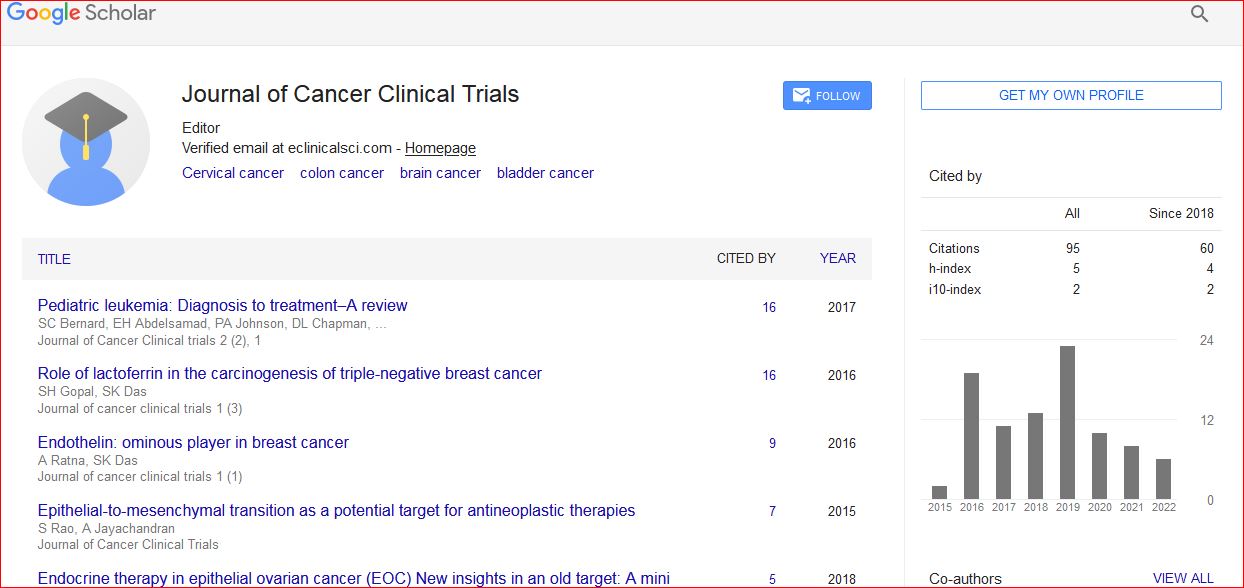
Journal of Cancer Clinical Trials received 95 citations as per Google Scholar report