Brief Report - (2025) Volume 14, Issue 1
Received: 01-Jan-2025, Manuscript No. jtm-25-172810;
Editor assigned: 03-Jan-2025, Pre QC No. P-172810;
Reviewed: 17-Jan-2025, QC No. Q-172810;
Revised: 22-Jan-2025, Manuscript No. R-172810;
Published:
29-Jan-2025
, DOI: 10.37421/2167-1222.2025.14.660
Citation: Soliman, Ahmed. ”Evidence-Based Orthopedic Trauma Management.” J Trauma Treat 14 (2025):660.
Copyright: © 2025 Soliman A. This is an open-access article distributed under the terms of the Creative Commons Attribution License, which permits unrestricted use, distribution and reproduction in any medium, provided the original author and source are credited.
Orthopedic trauma management continually evolves, with ongoing research refining treatment strategies for a diverse range of fractures and patient populations. A significant area of focus involves comparing different surgical techniques to optimize patient outcomes. For instance, a recent meta-analysis meticulously compared intramedullary nailing and plate osteosynthesis for distal femoral fractures in adult patients. The findings suggest that intramedullary nailing might offer superior results for certain outcomes, highlighting an active debate in managing these complex injuries effectively[1].
This kind of comparative analysis is crucial for guiding evidence-based practice in complex orthopedic cases. Addressing the unique challenges presented by an aging population, studies have specifically investigated optimal care pathways for elderly patients. A systematic review and meta-analysis evaluated surgical versus conservative management for pelvic ring fractures in the elderly. This research provides essential insights into developing optimal treatment strategies that carefully consider age-related complexities and overall outcomes, ensuring tailored care for this vulnerable demographic[2].
Similarly, managing distal radius fractures in elderly patients is a dynamic field, with evolving surgical and non-surgical approaches constantly being explored. A systematic review on this topic sheds light on current trends, emphasizing the critical need for patient-specific considerations to optimize functional outcomes for this particular population[5].
Furthermore, the broader scope of care for older patients extends to those experiencing multiple severe injuries. A systematic review and meta-analysis on outcomes in elderly polytrauma patients highlights age-specific challenges, identifying influential factors affecting morbidity and mortality. This work is pivotal in guiding the development of tailored treatment strategies to improve survival and recovery in this vulnerable group[8].
Preventing and managing complications remains a cornerstone of orthopedic care. One area of innovation is in wound management, with a meta-analysis exploring the effect of negative pressure wound therapy in reducing surgical site infections in open tibia fractures. This study offers valuable, evidence-based recommendations aimed at improving post-operative care and infection control, which are undeniably critical for successful patient recovery[3].
Beyond infection, early complications, especially in pediatric populations, demand focused attention. A systematic review and meta-analysis meticulously identified factors contributing to early complications in pediatric supracondylar humerus fractures. This provides crucial insights for clinical management, with the goal of preventing adverse outcomes and thereby enhancing the recovery trajectory for children[4].
For more specific and reconstructive procedures, research offers detailed evaluations. A systematic review and meta-analysis focused on functional outcomes and complications following reverse total shoulder arthroplasty for proximal humerus fractures. This provides invaluable data, assisting in surgical decision-making and patient counseling, particularly in cases involving complex fracture patterns[6].
When considering degenerative conditions stemming from trauma, such as post-traumatic ankle arthritis, surgical choices are carefully weighed. A systematic review and meta-analysis compared total ankle arthroplasty and ankle arthrodesis, offering evidence-based guidance to optimize pain relief and functional restoration for patients suffering from this debilitating condition[9].
Beyond treatment modalities, diagnostic and classification systems are also subject to critical review and refinement. For instance, a narrative review critically examined the utility and inherent limitations of the Gustilo-Anderson classification system for open fractures. This discussion is vital for understanding its continued relevance in guiding treatment decisions and predicting outcomes within contemporary orthopedic trauma care[7].
Finally, the advancement of biological approaches to enhance healing is another key research area. A systematic review and meta-analysis explored the use of bone morphogenetic proteins in treating long bone nonunion. This research rigorously assesses their efficacy and safety in promoting fracture healing and addressing complex reconstructive challenges, thereby offering significant insights into ongoing treatment advancements for difficult-to-heal fractures[10].
Collectively, these studies underscore a dynamic field dedicated to improving patient care through rigorous evidence and innovative approaches.
This body of orthopedic literature presents a detailed examination of contemporary fracture management, encompassing a spectrum of injuries, patient demographics, and therapeutic interventions. Recent findings provide critical insights into optimizing care for complex long bone fractures. For example, a meta-analysis comparing intramedullary nailing and plate osteosynthesis for distal femoral fractures in adults indicates that intramedullary nailing may offer superior outcomes in specific scenarios. This ongoing debate significantly influences evidence-based approaches to managing these challenging injuries effectively[1]. Further contributing to long bone healing, a systematic review and meta-analysis investigates the application of bone morphogenetic proteins in treating long bone nonunion. This research assesses both the efficacy and safety of these proteins in promoting fracture healing and tackling complex reconstructive challenges, signaling advancements in treatment options for persistent nonunions[10].
Specialized considerations for different patient groups, particularly the elderly and children, are a prominent theme. For older adults, optimal treatment for pelvic ring fractures is thoroughly evaluated in a systematic review and meta-analysis comparing surgical and conservative management. This work is essential for developing treatment strategies that account for age-related complexities and ensure the best possible overall outcomes for senior patients[2]. Similarly, managing distal radius fractures in elderly patients demands careful attention, with a systematic review highlighting current trends in both surgical and non-surgical approaches. This review underscores the importance of patient-specific care to achieve optimal functional recovery for this demographic[5]. The broader impact of age on trauma outcomes is further explored in a systematic review and meta-analysis focusing on elderly polytrauma patients. It identifies age-specific challenges and factors influencing morbidity and mortality, which is crucial for guiding tailored treatment strategies in this vulnerable population[8]. In contrast, pediatric trauma is addressed through a systematic review and meta-analysis identifying factors contributing to early complications in supracondylar humerus fractures in children. These insights are vital for refining clinical management and preventing adverse events, thereby enhancing recovery for young patients[4].
Infection control and specific surgical interventions are also rigorously examined. A meta-analysis delves into the critical role of negative pressure wound therapy in reducing surgical site infections following open tibia fractures. The findings offer evidence-based recommendations that are instrumental for improving post-operative care and infection control, which are fundamentally important for successful patient recovery and minimizing long-term sequelae[3]. For complex joint injuries, surgical options are often intricate. A systematic review and meta-analysis evaluates functional outcomes and complications after reverse total shoulder arthroplasty for proximal humerus fractures. This provides valuable data to inform surgical decision-making and patient counseling in these challenging cases, helping clinicians weigh the benefits and risks effectively[6]. Furthermore, for post-traumatic ankle arthritis, surgical choices are compared in a systematic review and meta-analysis, specifically contrasting total ankle arthroplasty with ankle arthrodesis. This guidance is vital for optimizing pain relief and functional restoration, empowering patients and surgeons to make informed decisions for long-term joint health[9].
Beyond direct treatment comparisons, fundamental aspects of trauma care, such as classification systems, are critically reviewed. A narrative review critically examines the utility and limitations of the Gustilo-Anderson classification system for open fractures. This discussion is significant for understanding its continued relevance in guiding contemporary treatment decisions and predicting outcomes in orthopedic trauma, ensuring its appropriate application[7]. Across all these specialized studies, a consistent thread of evidence-based practice emerges, emphasizing systematic reviews and meta-analyses to consolidate existing knowledge, resolve clinical ambiguities, and advance orthopedic trauma care. The collective aim is always to enhance patient safety, accelerate recovery, and improve the functional lives of individuals affected by a wide range of musculoskeletal injuries.
This compilation of recent orthopedic research offers a wide lens on trauma management, covering various fracture types and patient populations. Studies explore optimal treatment strategies for adult distal femoral fractures, comparing intramedullary nailing and plate osteosynthesis, often suggesting superiority for nailing in specific contexts. For elderly patients, research focuses on effective management of pelvic ring and distal radius fractures, evaluating surgical versus conservative approaches and identifying current trends to optimize functional outcomes. Key insights are provided into preventing complications, such as reducing surgical site infections in open tibia fractures through negative pressure wound therapy, and understanding factors leading to early complications in pediatric supracondylar humerus fractures. Further analyses assess functional outcomes and complications following reverse total shoulder arthroplasty for proximal humerus fractures. The utility of the Gustilo-Anderson classification system for open fractures is critically examined, alongside challenges in managing elderly polytrauma patients and factors affecting their morbidity and mortality. Comparisons are drawn between total ankle arthroplasty and ankle arthrodesis for post-traumatic ankle arthritis. Additionally, the efficacy of bone morphogenetic proteins in treating long bone nonunion is investigated, contributing to advancements in fracture healing. This body of work collectively emphasizes evidence-based practices to enhance patient recovery and refine care for complex musculoskeletal injuries.
None
None
Indexed at, Google Scholar, Crossref
Indexed at, Google Scholar, Crossref
Indexed at, Google Scholar, Crossref
Indexed at, Google Scholar, Crossref
Indexed at, Google Scholar, Crossref
Indexed at, Google Scholar, Crossref
Indexed at, Google Scholar, Crossref
Indexed at, Google Scholar, Crossref
Indexed at, Google Scholar, Crossref
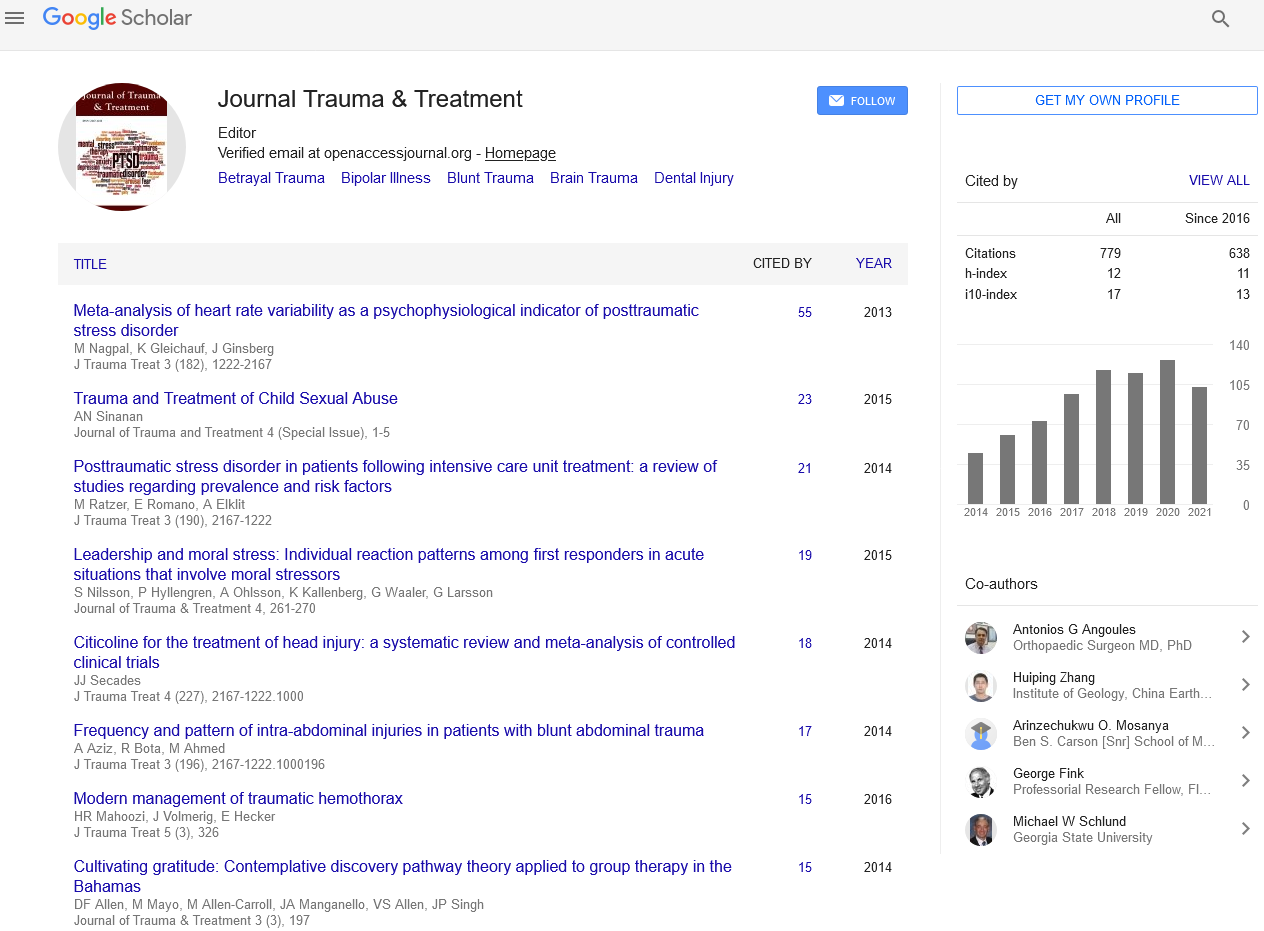
Journal of Trauma & Treatment received 1048 citations as per Google Scholar report