Short Communication - (2025) Volume 14, Issue 5
Received: 01-Sep-2025, Manuscript No. mcce-26-190189;
Editor assigned: 03-Sep-2025, Pre QC No. P-190189;
Reviewed: 17-Sep-2025, QC No. Q-190189;
Revised: 22-Sep-2025, Manuscript No. R-190189;
Published:
29-Sep-2025
, DOI: 10.37421/2470-6965.2025.14.423
Citation: Hernandez, Sofia. ”Equity-Focused Malaria Control: Reaching All.” Malar Contr Elimination 14 (2025):423.
Copyright: © 2025 Hernandez S. This is an open-access article distributed under the terms of the Creative Commons Attribution License, which permits unrestricted use, distribution and reproduction in any medium, provided the original author and source are credited.
Equity-focused approaches to malaria control are paramount for achieving universal health coverage and reducing health disparities. These strategies specifically aim to reach vulnerable populations, including pregnant women, children under five, and individuals residing in remote or underserved areas, by tailoring interventions and improving access to diagnostics and treatment. Addressing the social determinants of health that exacerbate malaria's burden is a key component of these equitable strategies, seeking to reduce incidence and mortality uniformly and ensure that the benefits of control efforts are shared by all, particularly those most at risk [1].
Understanding and actively addressing the social determinants of malaria is fundamental for achieving equitable control outcomes. Factors such as poverty, the quality of housing, access to educational opportunities, and the presence of gender inequality significantly influence an individual's or a community's susceptibility to malaria and their capacity to access necessary health services. Consequently, interventions must adopt a multi-sectoral approach, integrating public health programs with broader development initiatives to foster sustainable equity [2].
Community engagement and active participation are essential pillars of equity-focused malaria control efforts. Empowering local communities to take an active role in the planning, implementation, and ongoing monitoring of malaria interventions ensures that these programs are not only culturally appropriate but also highly responsive to specific local needs and contexts. This participatory approach fosters a sense of ownership and enhances program sustainability, particularly within hard-to-reach populations [3].
Successfully reaching the final stages of malaria elimination necessitates the development and deployment of targeted strategies designed specifically for mobile and migrant populations. These groups are often at a heightened risk of malaria infection and face significant barriers in accessing essential healthcare services. Innovative approaches, such as the deployment of mobile clinics, the establishment of robust community health worker networks, and the fostering of cross-border collaboration, are crucial to ensure that these vulnerable populations are not inadvertently left behind in ongoing control efforts [4].
Gender is a critical factor that significantly influences malaria vulnerability and the accessibility of healthcare services. Women, due to a complex interplay of biological, social, and economic factors, frequently bear a disproportionately heavy burden of malaria. Therefore, equity-focused strategies must explicitly address these gender-specific needs, which includes ensuring universal access to effective malaria in pregnancy interventions and actively empowering women within community health initiatives [5].
The integration of malaria control programs within broader health system strengthening initiatives is vital for achieving equitable and sustainable health outcomes. This comprehensive approach requires ensuring adequate financial resources, a sufficient and well-trained human resource base, and robust infrastructure to deliver malaria services universally and effectively. Strengthening primary healthcare systems, in particular, can significantly improve access for marginalized groups and underpin sustained progress towards malaria elimination goals [6].
Innovative financing mechanisms are increasingly recognized as essential for ensuring equitable malaria control, especially in low-resource settings where financial constraints are most acute. This involves exploring a variety of avenues, including the development of strategic public-private partnerships, the implementation of results-based financing models, and the allocation of targeted funding specifically designed to reach underserved populations and sustain long-term control efforts effectively [7].
The application of spatial epidemiology and advanced data analytics offers powerful tools for identifying malaria hotspots and pinpointing vulnerable populations. This allows for the development and implementation of more precisely targeted and equitable interventions. Geospatial tools are instrumental in mapping complex transmission patterns, identifying critical access barriers to healthcare, and guiding the strategic allocation of resources to the geographic areas exhibiting the greatest need [8].
Addressing the growing challenge of drug resistance in malaria parasites is a critical component of any equitable malaria control strategy. Ensuring that all individuals, particularly those in remote and low-resource settings, have access to effective antimalarial treatments is paramount to prevent treatment failures and to curb the further spread of resistant parasite strains. Continuous surveillance of resistance patterns and the prompt adaptation of treatment guidelines are therefore absolutely necessary [9].
Equity-focused malaria control strategies must also proactively consider the profound and evolving impact of climate change. Variations in climate patterns can significantly alter the distribution of mosquito vectors and their biting behaviors, potentially leading to an increased risk of malaria in areas previously unaffected or exacerbating transmission dynamics in already endemic regions. Consequently, the development and implementation of adaptation strategies that thoughtfully consider these climatic shifts are essential for achieving long-term, equitable malaria control [10].
Malaria control strategies that prioritize equity focus on reaching vulnerable segments of the population, such as pregnant women, young children, and those in remote or underserved areas. This involves adapting interventions, enhancing access to diagnostics and treatments, and addressing social factors that worsen the malaria burden, aiming for equitable reductions in incidence and mortality. Such approaches ensure that control efforts benefit everyone, especially those at highest risk [1].
Understanding and tackling the social determinants of malaria is crucial for equitable control. Issues like poverty, poor housing, limited education, and gender inequality directly affect an individual's or community's risk and their ability to access malaria services. Therefore, interventions need to be comprehensive, linking health programs with broader development efforts for lasting equity [2].
Community engagement and participation are fundamental to equitable malaria control. When local communities are involved in planning, implementing, and monitoring interventions, programs become more culturally relevant and responsive to local needs, fostering ownership and sustainability, particularly in hard-to-reach areas [3].
Reaching the last mile in malaria elimination requires specific strategies for mobile and migrant populations, who often face higher risks and healthcare access barriers. Innovative solutions like mobile clinics, community health worker networks, and cross-border cooperation are essential to ensure these groups are included in control efforts [4].
Gender significantly impacts malaria vulnerability and access to care. Women often bear a greater malaria burden due to biological, social, and economic factors. Equitable strategies must address gender-specific needs, including access to malaria in pregnancy interventions and empowering women in health initiatives [5].
Integrating malaria control within broader health system strengthening is key for equitable results. This includes securing adequate funding, human resources, and infrastructure for universal service delivery. Stronger primary healthcare systems improve access for marginalized groups and ensure sustained progress toward elimination [6].
Innovative financing is essential for equitable malaria control, especially in low-resource settings. Exploring public-private partnerships, results-based financing, and targeted funding can help reach underserved populations and sustain long-term control [7].
Spatial epidemiology and data analytics are valuable for identifying malaria hotspots and vulnerable groups, enabling more targeted and equitable interventions. Geospatial tools can map transmission, identify access barriers, and guide resource allocation to areas with the greatest need [8].
Addressing drug resistance in malaria parasites is vital for equitable control. Ensuring access to effective antimalarial treatments for everyone, particularly in remote and low-resource settings, is critical to prevent treatment failures and the spread of resistance. Continuous surveillance and prompt adaptation of treatment guidelines are necessary [9].
Equity-focused malaria control must also consider climate change impacts. Climate variations can alter vector distribution and biting patterns, potentially increasing malaria risk in new areas or worsening transmission in existing ones. Adaptation strategies addressing these shifts are crucial for long-term, equitable control [10].
Equity-focused malaria control emphasizes reaching vulnerable populations like pregnant women and children by tailoring interventions and improving access to diagnostics and treatment. Addressing social determinants such as poverty and gender inequality is crucial, requiring multi-sectoral approaches and community engagement for effective and sustainable programs. Innovative strategies are needed for mobile and migrant populations, and strengthening health systems is vital for universal service delivery. Advanced tools like spatial epidemiology help target interventions, while combating drug resistance and adapting to climate change are essential for long-term, equitable control. Securing adequate financing through innovative mechanisms is also paramount.
None
None
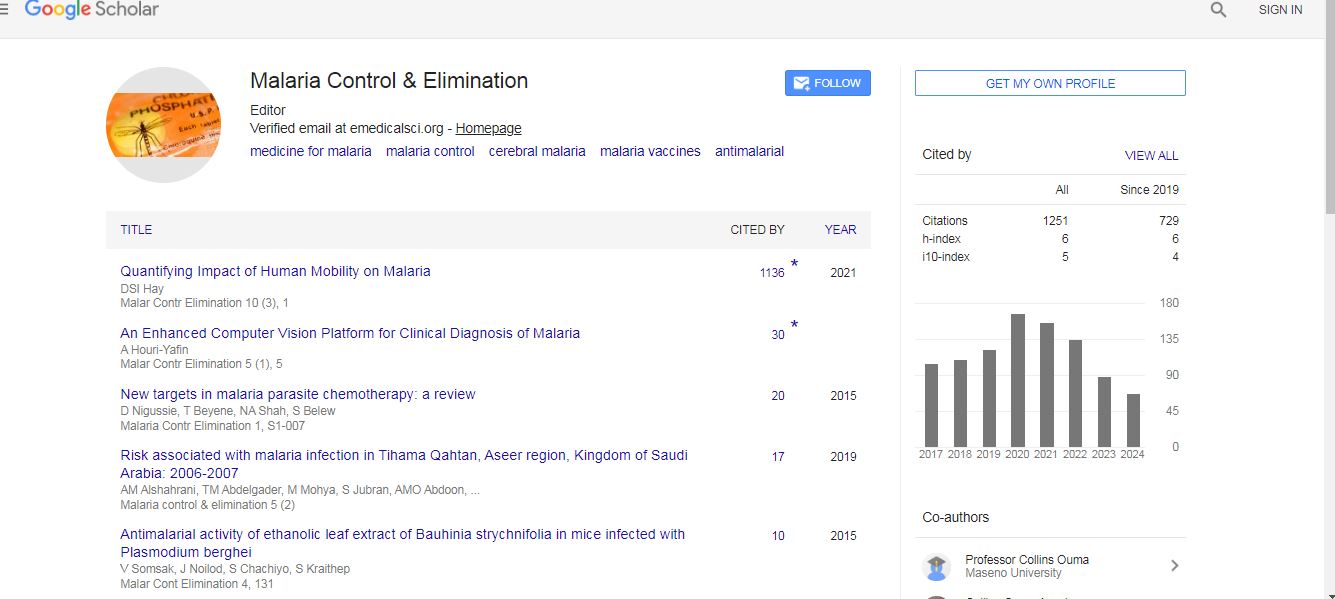
Malaria Control & Elimination received 1187 citations as per Google Scholar report