Brief Report - (2025) Volume 10, Issue 5
Received: 01-Sep-2025, Manuscript No. JPNM-26-185753;
Editor assigned: 03-Sep-2025, Pre QC No. P-185753;
Reviewed: 17-Sep-2025, QC No. Q-185753;
Revised: 22-Sep-2025, Manuscript No. R-185753;
Published:
29-Sep-2025
, DOI: 10.37421/2472-100X.2025.10.371
Citation: Muller, Thomas. ”Epileptic Encephalopathies: Diagnosis, Treatment, and Outcomes.” J Pediatr Neurol Med 10 (2025):371.
Copyright: © 2025 Muller T. This is an open-access article distributed under the terms of the Creative Commons Attribution License, which permits unrestricted use, distribution and reproduction in any medium, provided the original author and source are credited.
Epileptic encephalopathies in children represent a complex group of severe neurological disorders characterized by frequent, intractable seizures and significant cognitive and developmental impairments. The early and accurate diagnosis of these conditions is paramount to initiating timely interventions aimed at mitigating cognitive decline and improving seizure control, underscoring the critical need for effective diagnostic strategies [1].
The heterogeneity in clinical presentations and underlying etiologies presents substantial diagnostic and therapeutic hurdles for clinicians managing these challenging cases. Recognizing this complexity, researchers have focused on unraveling the genetic underpinnings of these disorders, leading to significant advancements in diagnostic precision and the potential for targeted therapies [2].
The therapeutic landscape for pediatric epileptic encephalopathies is often multimodal, encompassing anti-seizure medications, specialized dietary interventions such as the ketogenic diet, and in some instances, surgical approaches, with a primary goal of addressing the root cause whenever feasible [3].
Pharmacological management, while central to seizure control, is frequently complicated by the diverse etiologies and the often-refractory nature of these conditions. Identifying the most effective anti-seizure medication or combination requires a nuanced approach, frequently involving a trial-and-error process that can delay optimal outcomes [4].
Surgical interventions, including procedures like focal resections and corpus callosotomy, have emerged as viable options for a select group of children with intractable epilepsy stemming from specific lesions or developmental abnormalities, necessitating rigorous pre-surgical evaluations to maximize efficacy and minimize neurological deficits [5].
Beyond seizure control, the long-term neurodevelopmental outcomes in children affected by epileptic encephalopathies are a profound concern, with early and effective management significantly influencing cognitive, motor, and behavioral trajectories [6].
Specific genetic mutations leading to channelopathies, which affect ion channel function, necessitate tailored treatment strategies that target the precise molecular dysfunction, thereby enhancing therapeutic efficacy and reducing adverse effects [7].
The diagnostic journey for children with these conditions can be protracted, often involving extensive investigations and numerous consultations, highlighting the critical importance of streamlining diagnostic pathways to avoid delays in crucial early interventions [8].
In parallel with advancements in understanding the genetic basis of these disorders, novel therapeutic approaches, including gene therapy and the development of small molecule inhibitors, are showing considerable promise for treating specific genetic forms of epileptic encephalopathy, offering new hope for previously intractable conditions [9].
Ultimately, the effective management of pediatric epileptic encephalopathies demands a comprehensive, multidisciplinary approach, integrating the expertise of neurologists, geneticists, neuropsychologists, and rehabilitation specialists to optimize patient care and enhance the quality of life for affected children and their families [10].
Epileptic encephalopathies in children present a significant clinical challenge due to their profound impact on neurological development and the difficulty in achieving adequate seizure control. Early and accurate diagnosis is foundational for timely intervention, aiming to preserve cognitive function and improve overall seizure management. The inherent heterogeneity in clinical manifestations necessitates a thorough diagnostic workup, often involving advanced genetic testing to identify specific underlying causes [1].
The advent of advanced genetic sequencing technologies has revolutionized the diagnostic paradigm for pediatric epileptic encephalopathies. Identifying specific genetic variants allows for a more precise classification of these heterogeneous disorders, which in turn informs prognosis and guides the selection of appropriate treatment strategies, paving the way for personalized medicine approaches [2].
Treatment strategies for these complex conditions are typically multimodal, reflecting the diverse etiologies and clinical presentations. Key components include the judicious use of anti-seizure medications, alongside dietary therapies like the ketogenic diet, and in some refractory cases, surgical interventions. A central tenet of management is to address the underlying cause of the encephalopathy whenever possible [3].
The pharmacological management of pediatric epileptic encephalopathies is particularly intricate. The wide array of anti-seizure medications available, coupled with the often-treatment-resistant nature of these epilepsies, necessitates a systematic approach to identify the most effective agent or combination. This process can be time-consuming and may delay optimal seizure control, potentially exacerbating neurodevelopmental comorbidities [4].
For children with intractable epilepsy that is clearly localized and attributable to specific identifiable lesions or developmental anomalies, surgical interventions such as focal resections or corpus callosotomy can offer significant benefits. However, these procedures require extensive pre-surgical evaluation to accurately pinpoint the epileptogenic zone while meticulously preserving neurological function [5].
A major concern for children diagnosed with epileptic encephalopathies is their long-term neurodevelopmental trajectory. Early and effective seizure control, coupled with appropriate developmental support and therapies, plays a crucial role in shaping cognitive, motor, and behavioral outcomes. A sustained multidisciplinary approach is therefore essential to address these multifaceted needs [6].
In cases where epileptic encephalopathies are associated with specific channelopathies, a detailed understanding of the particular ion channel dysfunction is critical for guiding treatment. This knowledge allows for the selection of anti-seizure medications that specifically target these underlying molecular mechanisms, potentially leading to improved treatment efficacy and a reduction in treatment-related side effects [7].
The diagnostic process for children suspected of having epileptic encephalopathies can be lengthy and arduous, often involving a prolonged period of investigations, specialist consultations, and diagnostic uncertainty. Such delays can result in missed opportunities for early intervention, thereby negatively impacting long-term outcomes. Efforts to streamline diagnostic pathways through integrated care models and advanced diagnostic technologies are vital [8].
Emerging therapeutic avenues, particularly for genetically defined forms of epileptic encephalopathy, hold substantial promise for the future. These innovative therapies, including gene therapy and novel small molecule inhibitors, aim to correct the primary molecular defect or modulate aberrant neuronal excitability, offering new hope for conditions that were previously considered intractable [9].
The optimal management of pediatric epileptic encephalopathies necessitates a coordinated and comprehensive multidisciplinary team approach. This collaborative effort typically involves neurologists, geneticists, neuropsychologists, developmental pediatricians, and rehabilitation specialists, ensuring holistic care and improved quality of life for the affected children and their families [10].
Epileptic encephalopathies in children are severe neurological disorders characterized by intractable seizures and significant developmental impairments. Early and accurate diagnosis is critical for timely intervention, aiming to mitigate cognitive decline and improve seizure control. Treatment strategies are often multimodal, involving anti-seizure medications, dietary therapies like the ketogenic diet, and sometimes surgery, with a focus on addressing the underlying cause. Advances in genetic testing have revolutionized diagnosis, allowing for precise classification and guiding treatment. Pharmacological management is complex due to diverse etiologies and treatment resistance. Surgical interventions are beneficial for select cases with identifiable lesions. Long-term neurodevelopmental outcomes are a major concern, influenced by early and effective seizure control and multidisciplinary care. Emerging therapies like gene therapy offer new hope for specific genetic forms. Comprehensive, multidisciplinary care involving various specialists is vital for optimizing patient outcomes and quality of life.
None
None
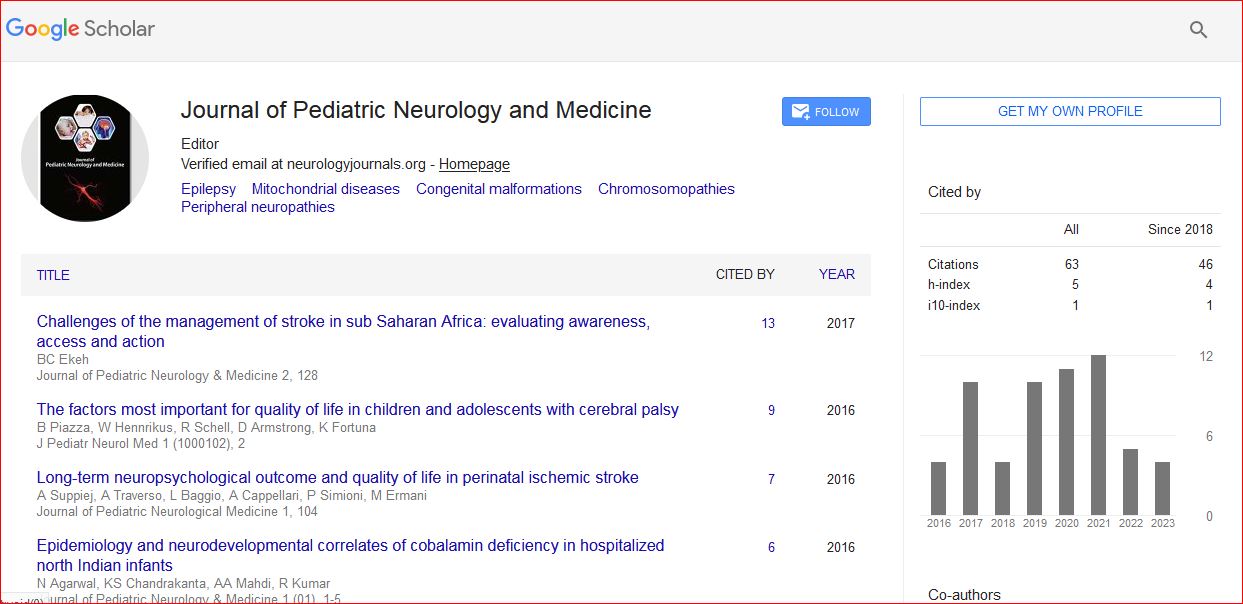
Journal of Pediatric Neurology and Medicine received 68 citations as per Google Scholar report