Opinion - (2025) Volume 10, Issue 4
Received: 01-Aug-2025, Manuscript No. jomp-26-185101;
Editor assigned: 04-Aug-2025, Pre QC No. P-185101;
Reviewed: 18-Aug-2025, QC No. Q-185101;
Revised: 22-Aug-2025, Manuscript No. R-185101;
Published:
29-Aug-2025
, DOI: 10.37421/2576-3857.2025.10.318
Citation: El-Mahdy, Youssef. ”Epigenetic Signatures: Predicting Breast Cancer Prognosis and Therapy.” J Oncol Med and Pract 10 (2025):318.
Copyright: © 2025 El-Mahdy Y. This is an open-access article distributed under the terms of the Creative Commons Attribution License, which permits unrestricted use, distribution and reproduction in any medium, provided the original author and source are credited.
Epigenomic modifications, encompassing alterations in DNA methylation and histone modifications, are fundamentally recognized as significant drivers in the development and progression of breast cancer. These epigenetic changes exert their influence by modifying gene expression patterns without altering the underlying DNA sequence, ultimately leading to the establishment of distinct cellular phenotypes and contributing to the pathogenesis of the disease. Aberrant DNA methylation patterns occurring within the promoter regions of specific genes have emerged as potent indicators for predicting the prognosis of breast cancer patients. For example, the hypermethylation of critical tumor suppressor genes, such as BRCA1 or PTEN, can lead to their transcriptional silencing, thereby abrogating their protective functions and correlating with more aggressive forms of the disease. Histone modifications, including processes like acetylation and methylation, are integral to the regulation of gene accessibility and expression within the context of breast cancer. Specific patterns of histone marks identified at the loci of oncogenes and tumor suppressor genes have demonstrated the ability to predict disease aggressiveness and patient survival outcomes. Non-coding RNAs, with a particular emphasis on microRNAs (miRNAs) and long non-coding RNAs (lncRNAs), are increasingly implicated in the pathogenesis of breast cancer and are known to be subject to epigenetic regulation. The dysregulated expression of specific miRNAs and lncRNAs has been significantly associated with diverse clinical outcomes in breast cancer patients. The intricate interplay between the tumor microenvironment and epigenetic reprogramming plays a pivotal role in the progression of breast cancer. Factors such as immune cell infiltration, the composition of the stromal compartment, and the remodeling of the extracellular matrix are all influenced by epigenetic mechanisms, underscoring their systemic impact. Significant advancements in high-throughput sequencing technologies have paved the way for the comprehensive profiling of the epigenome in breast cancer. This technological progress has facilitated the identification of distinct DNA methylation and histone modification signatures that are intrinsically linked to specific molecular subtypes and clinical outcomes. Circulating cell-free DNA (cfDNA) that carries epigenetic modifications, notably aberrant methylation patterns, presents a promising avenue for the development of liquid biopsy-based methods for cancer detection and prognostication. The methylation patterns found in cfDNA fragments shed from tumors can serve as a reflection of the tumor's overall epigenetic landscape. The exploration of DNA demethylating agents and histone deacetylase inhibitors is actively underway as a therapeutic strategy aimed at overcoming epigenetic silencing and restoring the functional capacity of tumor suppressor genes. Understanding the mechanisms by which these epigenetic alterations drive resistance to conventional therapies is paramount for developing more effective treatment regimens. Chromatin accessibility, a measure of the dynamic nature of the epigenome, can be assessed using techniques such as ATAC-seq. These analyses reveal dynamic changes in the epigenome that profoundly influence gene expression and cell fate decisions within breast cancer cells, highlighting the structural basis of epigenetic control. The integration of diverse epigenomic datasets, including information on DNA methylation, histone modifications, and chromatin accessibility, offers a pathway to a more holistic understanding of the epigenetic landscape within breast cancer. This multi-omic approach has the potential to uncover complex epigenetic signatures with augmented prognostic power, leading to more refined patient stratification.
Epigenomic modifications, particularly DNA methylation and histone modifications, are increasingly recognized as critical drivers in breast cancer development and progression. These changes can alter gene expression without changing the underlying DNA sequence, leading to distinct cellular phenotypes. This review highlights how specific epigenomic signatures, such as aberrant methylation patterns in tumor suppressor genes or oncogenes, can serve as reliable prognostic markers. Understanding these signatures can aid in predicting patient outcomes, guiding treatment decisions, and identifying potential therapeutic targets [1].
Aberrant DNA methylation patterns within specific gene promoters are emerging as powerful prognostic indicators in breast cancer. For instance, hypermethylation of tumor suppressor genes like BRCA1 or PTEN can silence their protective function, correlating with more aggressive disease. Conversely, hypomethylation can lead to oncogene activation. Identifying these methylation profiles offers a non-invasive or minimally invasive approach to stratify patients and predict their likelihood of recurrence or response to therapy, as detailed in this study [2].
Histone modifications, such as acetylation and methylation, play a crucial role in regulating gene accessibility and expression in breast cancer. Specific patterns of histone marks at oncogenes and tumor suppressor loci can predict disease aggressiveness and patient survival. Research indicates that alterations in enzymes that govern these modifications can serve as therapeutic targets. This work explores how these dynamic epigenetic changes can be leveraged for prognostic assessment [3].
Non-coding RNAs, particularly microRNAs (miRNAs) and long non-coding RNAs (lncRNAs), are increasingly implicated in breast cancer pathogenesis and can be regulated by epigenetic mechanisms. Dysregulated expression of specific miRNAs and lncRNAs has been associated with various clinical outcomes. This article investigates how these non-coding RNAs, influenced by epigenetic modifications, can act as valuable prognostic biomarkers, offering insights into tumor behavior and patient prognosis [4].
The interplay between the tumor microenvironment and epigenetic reprogramming is critical in breast cancer progression. Immune cell infiltration, stromal composition, and extracellular matrix remodeling are all influenced by epigenetic factors. This study explores how epigenetic signatures within both tumor cells and the surrounding microenvironment can predict treatment response and patient survival, suggesting a more comprehensive prognostic approach [5].
Advances in high-throughput sequencing technologies have enabled the comprehensive profiling of the epigenome in breast cancer. This has led to the identification of specific DNA methylation and histone modification signatures associated with distinct molecular subtypes and clinical outcomes. This paper discusses the utility of these genome-wide epigenetic profiles in refining prognostication beyond traditional clinical and pathological factors [6].
Circulating cell-free DNA (cfDNA) carrying epigenetic modifications, such as methylation patterns, offers a promising avenue for liquid biopsy-based cancer detection and prognostication. Aberrant methylation in cfDNA fragments shed from tumors can reflect the tumor's epigenetic landscape. This research evaluates the potential of cfDNA methylation signatures as non-invasive prognostic markers for breast cancer patients [7].
The role of DNA demethylating agents and histone deacetylase inhibitors in overcoming epigenetic silencing and restoring tumor suppressor gene function is being explored as a therapeutic strategy. Understanding how these epigenetic alterations drive resistance to conventional therapies is crucial. This study investigates specific epigenetic signatures that predict response or resistance to epigenetic-modifying drugs in breast cancer [8].
Chromatin accessibility, measured through techniques like ATAC-seq, reveals dynamic changes in the epigenome that influence gene expression and cell fate in breast cancer. Altered chromatin landscapes can lead to the activation of oncogenic pathways or suppression of tumor suppressors. This review examines how changes in chromatin structure and accessibility serve as prognostic markers, reflecting the underlying transcriptional state of the tumor [9].
The integration of multiple epigenomic datasets, such as DNA methylation, histone modifications, and chromatin accessibility, provides a more comprehensive understanding of the epigenetic landscape of breast cancer. This multi-omic approach can uncover complex epigenetic signatures with enhanced prognostic power. The article discusses the challenges and opportunities in integrating these diverse datasets for accurate patient stratification [10].
Epigenetic modifications, including DNA methylation and histone alterations, are key drivers in breast cancer development and progression, influencing gene expression and cellular phenotypes. Specific epigenomic signatures, such as aberrant methylation of tumor suppressor genes or oncogenes, serve as reliable prognostic markers, aiding in predicting patient outcomes and identifying therapeutic targets. Aberrant DNA methylation profiles can stratify patients and predict recurrence or treatment response. Histone modifications regulate gene accessibility and expression, with specific patterns predicting disease aggressiveness and survival. Non-coding RNAs, influenced by epigenetic mechanisms, also act as prognostic biomarkers. The tumor microenvironment's interaction with epigenetic reprogramming is critical, impacting treatment response and survival. High-throughput sequencing allows for comprehensive epigenome profiling, identifying signatures linked to molecular subtypes and clinical outcomes. Circulating cell-free DNA with epigenetic modifications offers potential for liquid biopsy-based prognostication. Epigenetic therapies target DNA methylation and histone modifications to restore tumor suppressor function. Chromatin accessibility changes reflect tumor transcriptional state and serve as prognostic markers. Integrating multi-omic epigenomic datasets enhances prognostic power for more accurate patient stratification.
None
None
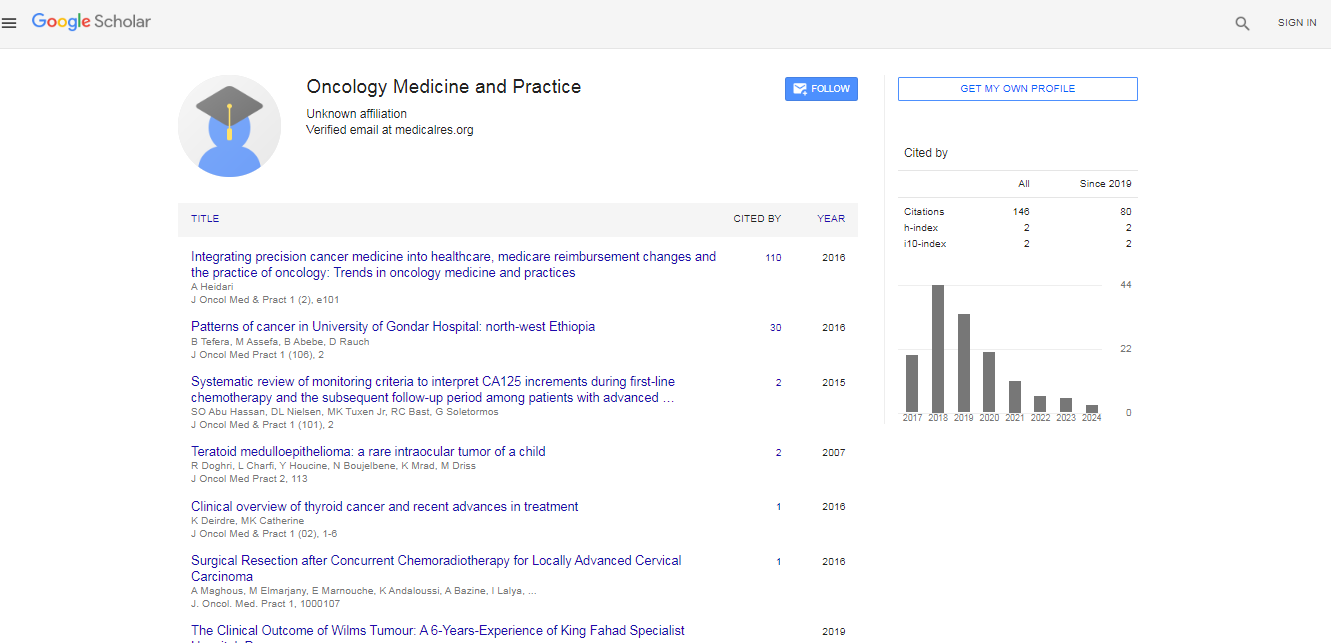
Journal of Oncology Medicine & Practice received 142 citations as per Google Scholar report