Brief Report - (2025) Volume 8, Issue 4
Received: 28-Nov-2025, Manuscript No. pollution-25-176611;
Editor assigned: 01-Dec-2025, Pre QC No. P-176611;
Reviewed: 15-Dec-2025, QC No. Q-176611;
Revised: 22-Dec-2025, Manuscript No. R-176611;
Published:
29-Dec-2025
, DOI: 10.37421/2684-4958.2025.8.390
Citation: Wei, Liang,. ”Environmental Degradation: Causes, Impacts, Solutions.” Pollution 08 (2025):390.
Copyright: © 2025 Wei L. This is an open-access article distributed under the terms of the Creative Commons Attribution License, which permits unrestricted use, distribution
and reproduction in any medium, provided the original author and source are credited.
Environmental degradation profoundly impacts human well-being, with key drivers including habitat destruction, escalating climate change, and widespread resource overexploitation [1]. Understanding these fundamental root causes is crucial for developing effective conservation strategies that benefit both ecosystems and human societies. It's clear that addressing these drivers comprehensively is vital for our collective future. Pollution is another major factor contributing to environmental degradation, directly harming essential ecosystem services that underpin human life, such as the provision of clean air and water [2].
This degradation, in turn, circles back, negatively impacting human health through a variety of complex pathways. What this really means is that our reliance on healthy ecosystems makes combating pollution a direct and essential investment in human health. The undeniable connection between climate change and land degradation carries significant repercussions for global agriculture and, consequently, food security [3]. Climate shifts intensify detrimental processes like desertification and soil erosion, making it increasingly difficult to grow food effectively. Addressing these intertwined issues is fundamental to sustainably feeding a growing global population. Globally, freshwater systems face severe degradation, primarily as a direct result of human activities [4]. This widespread degradation challenges both the availability and quality of water, making a strong case for implementing nature-based solutions. Here's the thing: protecting and restoring natural water cycles proves far more effective and sustainable in the long term than relying solely on engineered approaches. Forest degradation is a widespread and pressing problem, driven by numerous factors including illegal logging, unsustainable agricultural practices, and the overarching influence of climate change [5].
This degradation leads to reduced biodiversity, altered climate patterns, and significantly diminished ecosystem services. Effective solutions necessarily involve a strategic mix of policy interventions, meaningful community engagement, and the implementation of sustainable forest management practices. Soil degradation poses a serious and immediate threat to food security worldwide, significantly reducing agricultural productivity and the overall resilience of ecosystems [6]. Adopting sustainable agricultural practices, such as conservation tillage and crop rotation, is paramount to counteracting this threat. These methods are vital for helping to restore soil health, thereby ensuring long-term food production and maintaining environmental balance. Oceanic pollution, which encompasses plastics, various chemicals, and nutrient runoff, profoundly degrades marine ecosystems [7]. This extensive degradation disrupts marine food webs, harms invaluable biodiversity, and negatively impacts coastal communities that depend on healthy oceans. Protecting our oceans requires concerted global efforts aimed at reducing pollution at its source and actively restoring damaged habitats. Urban environmental degradation, particularly stemming from pervasive air pollution, has direct and severe consequences for human health [8].
Studies consistently demonstrate clear links between this pollution and respiratory illnesses, cardiovascular disease, along with other chronic conditions. Effective interventions demand integrated urban planning coupled with robust policies to improve air quality and create healthier, more livable spaces. Biodiversity loss is deeply intertwined with the phenomenon of climate change, collectively creating a vicious cycle of accelerating environmental degradation [9]. Here’s the thing: strategies specifically aimed at mitigating climate change, such as reducing greenhouse gas emissions, also inherently help protect biodiversity. Likewise, conserving biodiversity enhances ecosystems’ natural ability to adapt to a changing climate, making these efforts mutually beneficial and synergistic. Finally, the improper management of industrial waste contributes significantly to environmental degradation, negatively impacting the quality of air, water, and soil [10]. Effective waste management practices, including reduction at the source, reuse, comprehensive recycling, and safe disposal, are absolutely critical. What this really means is that industries bear a massive responsibility to adopt cleaner production methods and diligently work to minimize their ecological footprint.
Environmental degradation is a multifaceted global crisis with profound implications for both natural systems and human societies. Its pervasive impacts stem from a combination of anthropogenic pressures, fundamentally altering ecosystems and jeopardizing human well-being [1]. The insidious nature of pollution, for instance, significantly undermines vital ecosystem services, such as clean air and water, creating a direct feedback loop that detrimentally affects human health [2]. This intricate connection emphasizes that proactive measures against environmental pollution are critical investments in public health and sustainable living.
The intricate interlinkages between climate change and land degradation present an alarming threat to global agriculture and, by extension, food security [3]. Climate shifts exacerbate processes like desertification and soil erosion, making the cultivation of food crops increasingly challenging and uncertain. Beyond land, freshwater systems worldwide are undergoing severe degradation, primarily due to various human activities, impacting water availability and quality [4]. Here's the thing: embracing nature-based solutions—like restoring natural water cycles—offers a more effective and sustainable path forward than solely relying on engineered interventions. Similarly, soil degradation poses a serious threat to food security by diminishing agricultural productivity and ecosystem resilience [6]. Adopting sustainable agricultural practices, such as conservation tillage and crop rotation, becomes paramount for restoring soil health and ensuring long-term food production and environmental balance.
Forest degradation stands as another widespread environmental challenge, driven by factors such as illegal logging, unsustainable agriculture, and the broader effects of climate change [5]. The consequences are far-reaching, encompassing reduced biodiversity, altered local and regional climate patterns, and a significant reduction in essential ecosystem services. Effective solutions demand a multifaceted approach, blending robust policy interventions with active community engagement and the widespread adoption of sustainable forest management practices. Meanwhile, our oceans are suffering from extensive pollution, ranging from plastics and chemicals to nutrient runoff, which severely degrades marine ecosystems [7]. This oceanic degradation disrupts delicate marine food webs, diminishes crucial biodiversity, and negatively impacts coastal communities reliant on healthy marine environments. Protecting these vital oceanic systems necessitates concerted global efforts to curb pollution at its source and to actively restore damaged habitats.
Urban environments, too, grapple with significant environmental degradation, most notably in the form of pervasive air pollution [8]. Studies consistently reveal clear and severe consequences for human health, establishing links to respiratory illnesses, cardiovascular diseases, and various other chronic conditions. Effective interventions in these settings demand integrated urban planning strategies coupled with stringent policies designed to enhance air quality and foster healthier living spaces. What this really means is that thoughtful urban design and regulatory frameworks are essential for mitigating health risks in densely populated areas.
Finally, biodiversity loss is inextricably linked with climate change, forming a perilous cycle of accelerating environmental decline [9]. Strategies focused on mitigating climate change, such as reducing carbon emissions, offer the dual benefit of protecting biodiversity. Conversely, conserving biodiversity strengthens ecosystems' inherent capacity to adapt to a changing climate, creating a synergistic relationship where efforts are mutually beneficial. This overarching challenge is further compounded by the improper management of industrial waste, which significantly degrades air, water, and soil quality [10]. Therefore, implementing comprehensive waste management practices—emphasizing reduction, reuse, recycling, and safe disposal—is absolutely critical. Industries, in particular, bear a substantial responsibility to adopt cleaner production methods and strive to minimize their ecological footprint, contributing to a broader paradigm of environmental stewardship.
Environmental degradation is a pervasive global challenge, primarily driven by human activities like habitat destruction, climate change, resource overexploitation, and various forms of pollution. These interconnected drivers lead to significant impacts across diverse ecosystems, including freshwater systems, forests, oceans, and urban environments. The consequences are far-reaching, affecting human well-being, public health, and global food security. Specifically, climate change exacerbates land degradation, intensifying issues like desertification and soil erosion, which directly threaten agricultural productivity. Forest degradation, caused by illegal logging and unsustainable agriculture, reduces biodiversity and alters climate patterns. Oceanic pollution severely disrupts marine ecosystems, harming biodiversity and coastal communities. Urban areas face unique challenges from air pollution, leading to respiratory and cardiovascular diseases. Moreover, the improper management of industrial waste contributes significantly to degrading air, water, and soil quality. Addressing these complex issues necessitates integrated approaches. Effective solutions involve adopting nature-based strategies for water conservation, implementing sustainable agricultural practices like conservation tillage and crop rotation to restore soil health, and engaging in sustainable forest management. Crucially, combating pollution through cleaner production methods and effective waste management, alongside comprehensive climate change mitigation and biodiversity conservation strategies, is vital for fostering healthier ecosystems and securing a sustainable future for humanity.
None
None
Eduardo SB, Sandra D, H. TN. "Drivers of biodiversity loss and their links to human well-being: A global perspective.".Science Advances 8 (2022):eabl8769.
Indexed at, Google Scholar, Crossref
P. KS, S. PS, R. PS. "Environmental pollution and degradation: Its impact on ecosystem services and human health.".Environmental Pollution 286 (2021):117282.
Indexed at, Google Scholar, Crossref
J. MSS, R. JPG, A. MTL. "Climate change and land degradation: a global review of their interlinkages with agriculture and food security.".Science of The Total Environment 741 (2020):140228.
Indexed at, Google Scholar, Crossref
A. MCJS, B. JCJ, D. CKL. "Global freshwater degradation: The pressing need for nature-based solutions.".Nature Water 1 (2023):10-14.
Indexed at, Google Scholar, Crossref
X. L, Y. C, S. M. "Forest degradation: a review of causes, consequences, and solutions.".Journal of Environmental Management 309 (2022):114631.
Indexed at, Google Scholar, Crossref
M. L, R. KS, V. PS. "Soil degradation and sustainable agricultural practices for food security: A global perspective.".Land Degradation & Development 31 (2020):1735-1748.
Indexed at, Google Scholar, Crossref
C. RS, S. KS, R. PG. "Oceanic pollution and its impact on marine ecosystems: A critical review.".Marine Pollution Bulletin 195 (2023):115454.
Indexed at, Google Scholar, Crossref
D. ACTB, S. JCG, P. MCT. "Urban environmental degradation and human health: a systematic review of links and interventions.".Environmental Health Perspectives 129 (2021):116001.
Indexed at, Google Scholar, Crossref
K. LE, M. JW, R. SJ. "Addressing biodiversity loss through climate change mitigation and adaptation strategies: A review.".Biological Conservation 278 (2023):109910.
Indexed at, Google Scholar, Crossref
S. AK, F. MA, A. RC. "Industrial waste management and its impact on environmental quality: A review of global practices.".Journal of Cleaner Production 211 (2019):1017-1029.
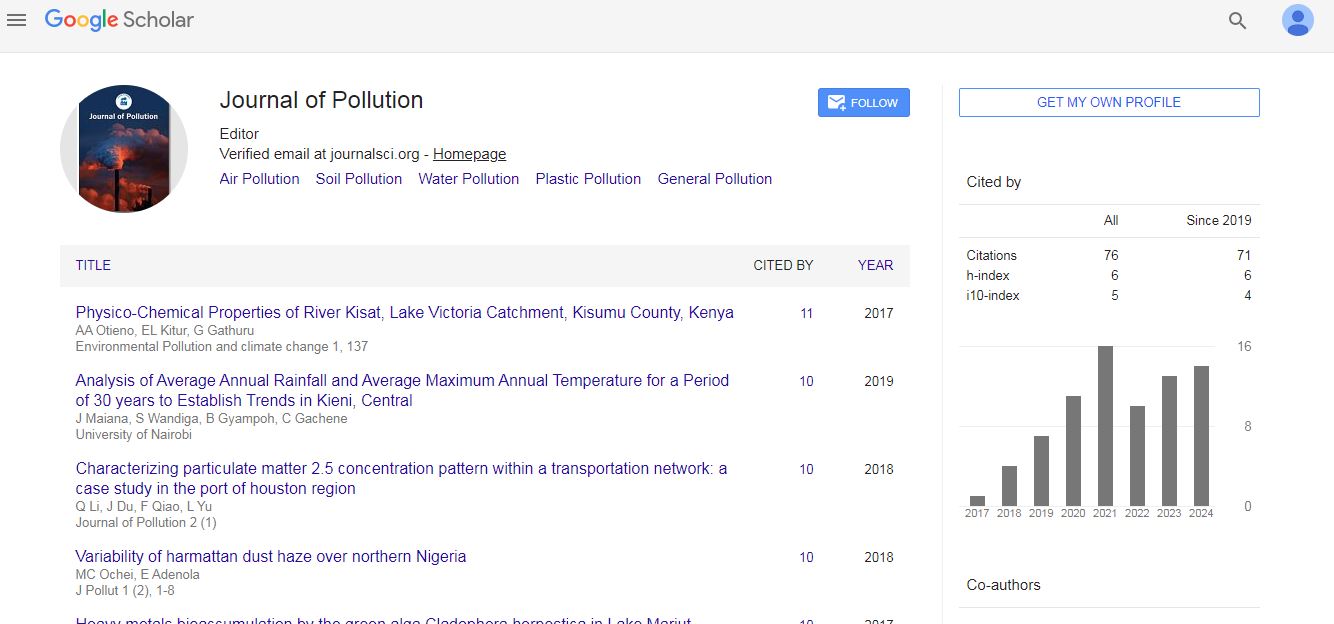
Journal of Pollution received 64 citations as per Google Scholar report