Perspective - (2025) Volume 14, Issue 5
Received: 01-Sep-2025, Manuscript No. jtsm-26-179583;
Editor assigned: 03-Sep-2025, Pre QC No. P-179583;
Reviewed: 17-Sep-2025, QC No. Q-179583;
Revised: 22-Sep-2025, Manuscript No. R-179583;
Published:
29-Sep-2025
, DOI: 10.37421/2167-0919.2025.14.515
Citation: Carter, Benjamin. ”Enhancing Customer Experience: Proactive, Personalized, Digital Strategies.” J Telecommun Syst Manage 14 (2025):515.
Copyright: © 2025 Carter B. This is an open-access article distributed under the terms of the Creative Commons Attribution License, which permits unrestricted use, distribution
and reproduction in any medium, provided the original author and source are credited.
The telecommunications industry is undergoing a profound transformation, driven by evolving customer expectations and rapid technological advancements. Enhancing customer experience has emerged as a paramount strategic imperative for telecom providers aiming to thrive in this competitive landscape. Proactive issue identification and personalized communication strategies are central to achieving this, leveraging data analytics to anticipate customer needs and potential dissatisfaction, thereby fostering loyalty [1].
The digital evolution has reshaped customer interactions, making a deep understanding of the digital customer journey crucial for optimization. This involves identifying key touchpoints and implementing innovative digital solutions like AI-powered chatbots and self-service portals to ensure a seamless and engaging experience [2].
In parallel, personalization has become a cornerstone of effective customer relationship management. By employing sophisticated data mining techniques, telecom companies can gain insights into individual customer preferences, enabling them to offer tailored product recommendations and service plans. This approach is highly effective in reducing customer churn and increasing lifetime value [3].
Furthermore, the strategic integration of multiple communication channels into an omnichannel approach is vital for delivering a consistent and convenient customer experience. This seamless integration across mobile apps, web platforms, social media, and physical stores is key to improving customer satisfaction and operational efficiency [4].
The application of artificial intelligence (AI) and machine learning (ML) is revolutionizing the way telecom companies address customer retention. Predictive models, built upon extensive datasets of customer interactions and service usage, are instrumental in identifying customers at risk of churning. This allows for targeted retention efforts to mitigate subscriber attrition effectively [5].
Beyond digital interactions and personalized offers, the fundamental aspects of network quality and service reliability remain critical drivers of customer satisfaction. Consistent high-performance networks and minimal service disruptions significantly influence customer perception, purchasing decisions, and overall brand advocacy [6].
Customer service centers are also being transformed by advanced technologies. The integration of virtual assistants and sentiment analysis tools can significantly enhance agent efficiency and provide deeper insights into customer emotions. This leads to more empathetic and effective customer support, improving the overall service experience [7].
The influence of social media engagement cannot be overstated. Responsive and interactive social media strategies are essential for building customer communities, resolving issues promptly, and fostering positive relationships, thereby strengthening brand loyalty and advocacy [8].
Effective management of customer feedback and complaints is another critical component of service quality improvement. Implementing robust methodologies for collecting, analyzing, and acting upon customer feedback is crucial for driving continuous service enhancements. This directly impacts customer satisfaction and retention through responsive complaint resolution [9].
Finally, the strategic deployment of self-service technologies empowers customers with tools for independent account management, troubleshooting, and information access. This not only boosts customer satisfaction and reduces operational costs but also enhances the overall perception of service quality [10].
Telecommunications companies are increasingly focused on enhancing customer experience through proactive measures and personalized engagement. The proactive identification of potential issues before they impact customers, coupled with tailored communication, is highlighted as a key strategy. This approach relies heavily on data analytics to understand customer behavior, predict dissatisfaction, and implement timely interventions, ultimately aiming to improve customer loyalty [1].
Digital transformation is fundamentally altering the customer journey, necessitating the mapping of key touchpoints and the optimization of digital interactions. Strategies such as AI-powered chatbots and sophisticated self-service portals are crucial for creating a seamless digital experience, which is vital for customer retention and maintaining a competitive edge [2].
Personalization plays a pivotal role in cultivating customer loyalty within the telecom sector. By leveraging advanced data mining techniques to understand individual customer preferences, providers can develop highly targeted product and service offerings. This tailored approach is instrumental in significantly reducing customer churn and maximizing customer lifetime value [3].
Complementing these efforts, the implementation of omnichannel customer service strategies ensures a consistent and convenient experience across all touchpoints. Integrating various communication channels, including mobile applications, websites, social media, and in-store interactions, is essential for enhancing both customer satisfaction and operational efficiency [4].
The strategic application of artificial intelligence and machine learning is proving indispensable in predicting and preventing customer churn. By analyzing vast amounts of data from customer interactions and service usage, predictive models can accurately identify customers who are likely to leave. This enables telecom operators to implement targeted retention initiatives, thereby decreasing subscriber attrition rates [5].
Simultaneously, the foundational elements of network quality and service reliability continue to be paramount in shaping customer satisfaction. Empirical evidence strongly suggests that a consistently high-performing network and minimal service disruptions are core determinants of positive customer perception, directly influencing purchasing decisions and fostering brand advocacy [6].
Modern customer service centers in the telecommunications industry are being reshaped by the integration of cutting-edge technologies. The adoption of virtual assistants and advanced sentiment analysis tools enhances the efficiency of customer service agents and provides deeper insights into customer emotions. This technological integration facilitates more empathetic and effective customer support, leading to improved customer interactions [7].
Furthermore, a strong emphasis is placed on social media engagement as a tool for enhancing customer experience and brand perception. Responsive and interactive social media strategies are vital for building online communities, efficiently resolving customer issues, and cultivating positive relationships, which in turn drives brand loyalty and advocacy [8].
Effective management of customer feedback and complaints is a critical determinant of service quality in telecommunications. The paper outlines methodologies for systematically collecting, analyzing, and acting upon customer feedback to drive continuous improvements in service delivery. This focus on responsive complaint resolution is directly linked to enhanced customer retention [9].
Lastly, the strategic implementation of self-service technologies empowers customers to manage their accounts, troubleshoot issues, and access information independently. This empowerment not only leads to increased customer satisfaction and reduced operational costs but also contributes to a more positive overall perception of the telecom service [10].
Telecommunications companies are increasingly focusing on enhancing customer experience through proactive issue identification, personalized communication, and digital transformation. Leveraging data analytics to predict customer behavior and dissatisfaction is crucial for improving loyalty. Tailored marketing and service offerings, along with seamless omnichannel strategies, are key to reducing churn. The integration of AI and machine learning aids in predicting and mitigating customer churn, while network quality and service reliability remain fundamental drivers of satisfaction. Advanced technologies are transforming customer service centers, and effective social media engagement builds brand loyalty. Finally, robust customer feedback and complaint management systems, along with empowering self-service technologies, are vital for continuous service improvement and customer retention.
None
None
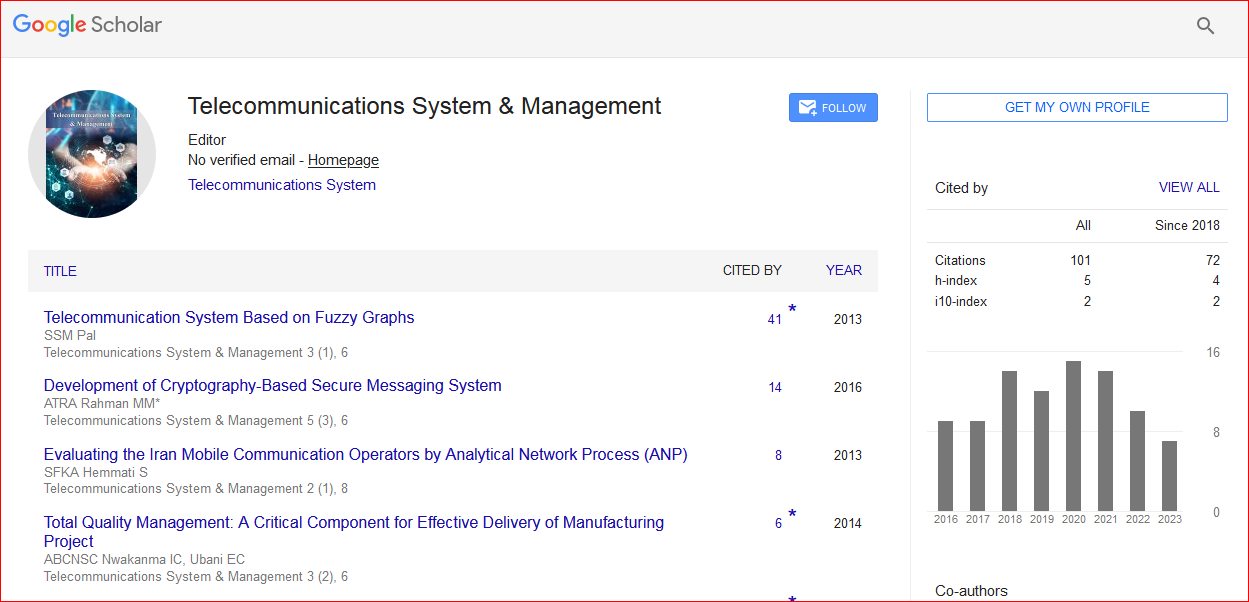
Telecommunications System & Management received 109 citations as per Google Scholar report