Opinion - (2025) Volume 14, Issue 5
Received: 01-Oct-2025, Manuscript No. idse-26-183624;
Editor assigned: 03-Oct-2025, Pre QC No. P-183624;
Reviewed: 17-Oct-2025, QC No. Q-183624;
Revised: 22-Oct-2025, Manuscript No. R-183624;
Published:
29-Oct-2025
, DOI: 10.37421/2168-9768.2025.14.511
Citation: Haddad, Yara. "Engineering Irrigation and Drainage:
Design Considerations." Irrigat Drainage Sys Eng 14 (2025):511.
Copyright: © 2025 Haddad Y. This is an open-access article distributed under the terms of the Creative Commons Attribution License, which permits unrestricted use,
distribution and reproduction in any medium, provided the original author and source are credited.
The engineering planning and design of irrigation and drainage projects are critical for sustainable agriculture and effective water resource management. These endeavors require a holistic approach, integrating various technical, environmental, and socio-economic considerations to ensure long-term viability and benefit.[1]
The foundational elements of such projects often involve detailed hydrological analyses, a thorough understanding of soil characteristics, precise topographical surveys, and a realistic assessment of water resource availability. These factors collectively inform the formulation of effective and efficient designs tailored to specific agricultural contexts. [2]The integration of sustainable practices is paramount, necessitating comprehensive environmental impact assessments to mitigate potential negative consequences. Furthermore, socio-economic factors play a crucial role, influencing project acceptance, equitable distribution of benefits, and overall community engagement. The design process itself is multifaceted, encompassing the selection of appropriate irrigation techniques, the engineering of conveyance structures, and the implementation of suitable drainage systems. [3]The overarching goal is to optimize water use efficiency, thereby preventing waterlogging and the detrimental effects of soil salinization, which can severely impair agricultural productivity. The development of robust irrigation and drainage infrastructure is a cornerstone for enhancing food security and supporting rural livelihoods. The field is dynamic, with continuous advancements in technology and methodologies aimed at improving system performance and sustainability. [4]This includes sophisticated modeling tools and precision agriculture techniques that allow for more targeted water application and resource management. Moreover, the economic aspects of these projects are significant, requiring careful cost-benefit analyses to justify investments and ensure financial sustainability over the project lifecycle. The implementation of effective irrigation and drainage strategies is a complex but essential undertaking for modern agriculture. Addressing the challenges associated with water scarcity and land degradation through well-engineered solutions is vital for global agricultural resilience.[5] The interdisciplinary nature of these projects demands collaboration among engineers, agronomists, environmental scientists, and social scientists to achieve optimal outcomes. The engineering design of these systems must also consider the adaptability to changing climatic conditions and evolving agricultural practices, ensuring their relevance and effectiveness for future generations.[6] The continuous improvement of irrigation and drainage technologies is driven by the need to conserve water resources, protect the environment, and increase agricultural productivity in a sustainable manner. The proper engineering of these systems underpins the success of agricultural endeavors worldwide. The evolution of design principles reflects a growing understanding of complex hydrological processes and their interactions with agricultural landscapes. [7]The planning and design stages are therefore crucial for setting the trajectory of a project towards success and sustainability. The ultimate aim is to create systems that are not only technically sound but also environmentally responsible and socio-economically beneficial.[8] The engineering of irrigation and drainage systems is a cornerstone of agricultural development and sustainability. This includes a deep understanding of the water cycle and its management within agricultural landscapes. [9]The integration of advanced technologies has further refined the capabilities and efficiency of these systems. Careful consideration of site-specific conditions is essential for successful design. The commitment to sustainability guides the development of these critical agricultural infrastructures.[10]The engineering planning and design of irrigation and drainage projects are complex undertakings that necessitate a deep understanding of numerous scientific and technical principles. A fundamental aspect involves conducting thorough hydrological analyses to accurately assess water availability, flow rates, and rainfall patterns, which are crucial for determining the scale and type of irrigation and drainage infrastructure required. [1]
This forms the bedrock upon which all subsequent design decisions are made. Concurrently, detailed investigations into soil characteristics are essential to understand their water-holding capacity, permeability, and susceptibility to erosion and salinization, guiding the selection of appropriate materials and methods. [2]Topographical surveys play a vital role in mapping the land's contours, identifying natural drainage paths, and determining the optimal layout for canals, pipes, and ditches to ensure efficient water distribution and removal. [3]The availability of water resources, whether from surface water bodies, groundwater, or harvested rainwater, is a primary constraint that dictates the feasibility and design parameters of any irrigation project. The integration of sustainable practices is increasingly important, emphasizing the need to minimize environmental footprints and conserve natural resources for future generations. [4]Environmental impact assessments are conducted to identify and mitigate potential adverse effects on ecosystems, water quality, and biodiversity. Socio-economic factors, including community needs, land tenure, and local economies, are also integral to the planning process, ensuring that projects are socially acceptable and contribute to poverty reduction and equitable development. [5]The design process itself involves the selection of appropriate irrigation techniques, such as surface, sprinkler, or drip irrigation, each with its own set of engineering requirements and operational considerations. Conveyance structures, including canals, pipelines, and pumps, must be hydraulically designed to transport water efficiently with minimal energy losses and sedimentation. [6]Drainage systems, whether surface or subsurface, are engineered to remove excess water from the root zone, preventing waterlogging and creating favorable conditions for crop growth. The application of Geographic Information Systems (GIS) and Remote Sensing (RS) technologies has revolutionized irrigation project planning by enabling detailed land suitability assessments, precise water resource mapping, and the identification of optimal locations for infrastructure, thereby enhancing the efficiency of water distribution networks. [7]The performance of subsurface drainage systems is influenced by factors such as soil properties, groundwater levels, and specific crop water requirements, necessitating careful design calculations for depth, spacing, and slope to ensure effective soil aeration and prevent root zone saturation. The environmental implications of drainage systems, particularly the potential for nutrient and pesticide transport into water bodies, require the development of mitigation strategies, including constructed wetlands and buffer strips, to protect water quality and aquatic ecosystems. [8]Economic feasibility assessments, including cost-benefit analyses, are crucial for evaluating the financial viability of projects, considering factors like increased crop yields and improved water security against implementation and maintenance costs. The choice of irrigation technologies is critical for efficient water resource management, with comparative analyses of different systems helping to determine suitability based on site-specific conditions and water availability, ultimately optimizing irrigation performance and crop productivity.[9] On-farm irrigation system design focuses on maximizing water application uniformity and minimizing losses through careful emitter selection, pipe sizing, and pressure regulation, often incorporating automation and smart technologies for optimized scheduling and management. Storm drainage systems in agricultural catchments are engineered using hydrological modeling and hydraulic calculations to manage excess rainfall, reduce flood damage, and improve water quality through effective conveyance and treatment of storm runoff. Water harvesting techniques, such as contour bunds and check dams, are designed to augment irrigation water supply, particularly in arid regions, by capturing and storing rainfall to improve soil moisture and recharge groundwater, thereby supporting agricultural production with minimal reliance on external water sources.[10]This research synthesis explores the multifaceted engineering considerations in planning and designing irrigation and drainage projects. It emphasizes the crucial role of hydrological analysis, soil characteristics, topography, and water resource availability in formulating effective designs. The integration of sustainable practices, environmental impact assessment, and socio-economic factors is highlighted to ensure project viability and long-term benefits. The design process involves selecting appropriate irrigation techniques, conveyance structures, and drainage systems to optimize water use efficiency and prevent issues like waterlogging and salinization. The application of GIS and remote sensing technologies aids in land suitability assessment and infrastructure placement. Subsurface drainage system design is influenced by soil properties and crop needs, while environmental impacts of drainage require mitigation strategies. Economic feasibility and socio-economic impacts are assessed through cost-benefit analyses. Comparative analysis of irrigation technologies helps in efficient water resource management, and on-farm system design focuses on uniformity and minimizing losses. Storm drainage systems are engineered using hydrological modeling, and water harvesting techniques are explored for augmenting water supply in arid regions.
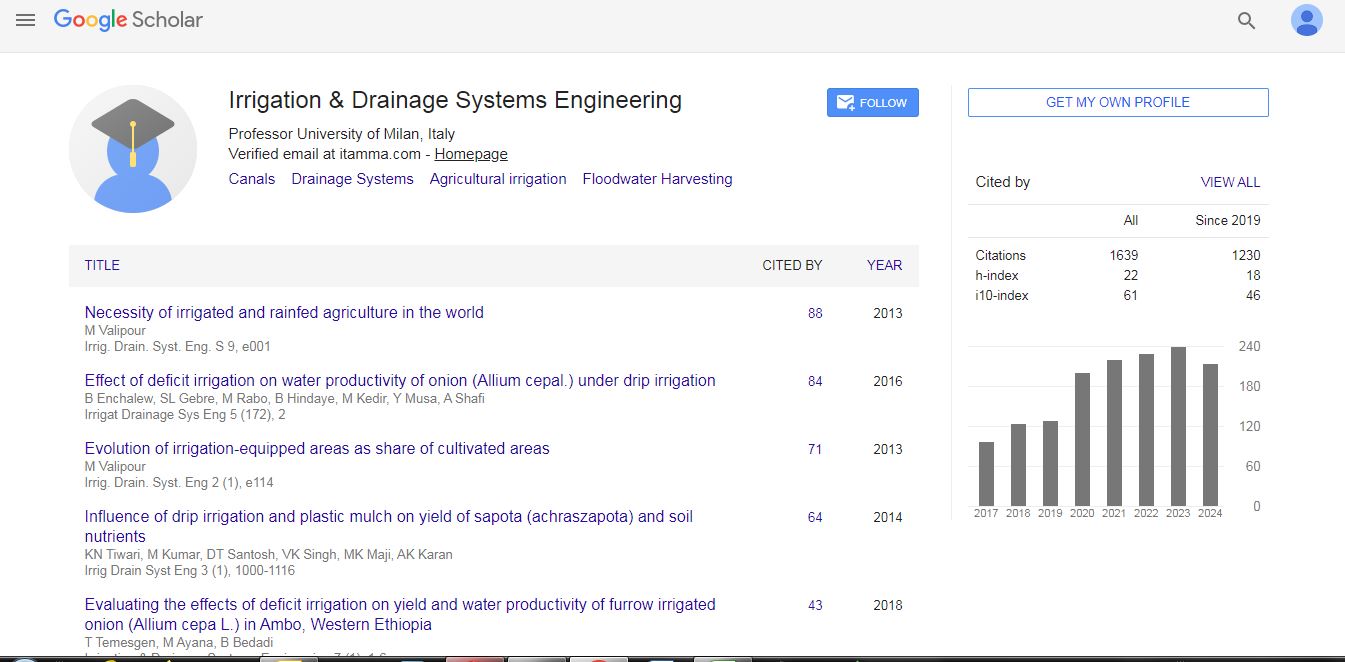
Irrigation & Drainage Systems Engineering received 835 citations as per Google Scholar report