Commentary - (2025) Volume 11, Issue 4
Received: 01-Jul-2025, Manuscript No. ohcr-25-174287;
Editor assigned: 03-Jul-2025, Pre QC No. P-174287;
Reviewed: 17-Jul-2025, QC No. Q-174287;
Revised: 22-Jul-2025, Manuscript No. R-174287;
Published:
29-Jul-2025
, DOI: 10.37421/2471-8726.2025.11.202
Citation: Rahman, Aisha. ”Effective Orthodontics for Complex Adult Malocclusions.” Oral Health Case Rep 11 (2025):202.
Copyright: © 2025 Rahman A. This is an open-access article distributed under the terms of the Creative Commons Attribution License, which permits unrestricted use, distribution and reproduction in any medium, provided the original author and source are credited.
Addressing severe Class II malocclusion in adults often presents significant challenges. One successful non-surgical strategy employed skeletal anchorage, specifically palatal TADs, alongside clear aligners to achieve precise sagittal and vertical control in an adult patient. This innovative method showcases an aesthetic and efficient pathway for complex adult orthodontic needs, especially when surgical intervention is not the patient's preference[1].
The management of impacted teeth, particularly maxillary canines with complex root morphology, demands a multidisciplinary perspective in patients with Class I malocclusion. A case study illustrated a successful approach involving careful surgical exposure followed by orthodontic traction, highlighting the critical role of detailed interdisciplinary planning and coordination to ensure optimal functional and aesthetic outcomes[2].
Skeletal anterior open bite accompanied by a gummy smile in adult patients can significantly impact facial aesthetics and function. A non-surgical correction strategy demonstrated the effective use of orthodontic mini-implants. This treatment achieved substantial vertical control through molar intrusion and anterior autorotation of the mandible, ultimately enhancing both facial aesthetics and occlusal function, thereby underscoring the adaptability of temporary anchorage devices in challenging adult orthodontic scenarios[3].
Adult patients presenting with both missing anterior teeth and an anterior open bite require comprehensive rehabilitation. A successful multidisciplinary treatment integrated orthodontics, prosthodontics, and periodontics. This collaborative method ensured the precise creation of prosthetic space, effective bite correction, and a notable improvement in aesthetics, affirming the essential nature of interdisciplinary cooperation for intricate dental cases[4].
Managing severe anterior crowding and Bolton discrepancy often requires judicious treatment planning. One case demonstrated effective management through the asymmetric extraction of a single mandibular incisor. This conservative yet impactful approach resulted in significant dental alignment and a harmonious occlusion, all while preserving facial aesthetics and minimizing unnecessary tooth loss for specific malocclusion patterns[5].
Severe skeletal Class III malocclusion and transverse discrepancy in adults frequently necessitate orthognathic surgery for definitive correction. A surgical-orthodontic approach successfully addressed these issues in an adult patient. This combined modality led to profound improvements in facial aesthetics, occlusal function, and the patient's quality of life, emphasizing that some complex skeletal imbalances require surgical intervention beyond what orthodontics alone can achieve[6].
The correction of severe bimaxillary proclination in adult patients can be aesthetically challenging with traditional braces. Clear aligners were effectively utilized in one such case, achieving significant retraction and torque control. This showcases the evolving capabilities of clear aligner therapy to manage more complex malocclusions, provided appropriate biomechanics, attachments, and interproximal reduction are applied, presenting an appealing aesthetic alternative[7].
Patients with unilateral cleft lip and palate often present with complex Class III malocclusion, demanding specialized orthodontic care. Comprehensive management in such a case focused on correcting the sagittal discrepancy, improving the arch form, and preparing optimal conditions for future prosthetic rehabilitation. This highlights the intricate nature and ultimate success of long-term, multidisciplinary care, which often involves sequential treatment phases for cleft patients[8].
Skeletal Class II malocclusion with excessive overjet in adults can be effectively managed without surgery. A non-surgical correction using mini-screw anchorage demonstrated significant retraction of the maxillary anterior teeth and enhanced occlusal relationships. This approach highlights the efficiency and predictability of skeletal anchorage in adult orthodontics, frequently eliminating the need for extractions or major surgical procedures[9].
Severe skeletal Class III malocclusion in adult patients, when surgery is not an option, can still be managed successfully. A non-surgical approach focused on comprehensive dentoalveolar compensation. This strategy utilized specific biomechanics to effectively camouflage the underlying skeletal discrepancy, resulting in a functional occlusion and acceptable aesthetics, thus offering a viable alternative for patients who cannot or prefer not to undergo orthognathic surgery[10].
Orthodontic interventions in adult patients demand innovative, tailored strategies to meet both functional and aesthetic goals. Recent case reports highlight the successful non-surgical correction of severe Class II malocclusion in an adult patient, employing skeletal anchorage, specifically palatal Temporary Anchorage Devices (TADs), and clear aligners [1]. This approach achieved precise sagittal and vertical control, demonstrating an aesthetic and efficient pathway for complex adult orthodontic needs, particularly when surgical intervention is not preferred. Similarly, other non-surgical strategies have effectively tackled severe skeletal Class II malocclusion with excessive overjet through mini-screw anchorage [9]. These cases showed remarkable retraction of maxillary anterior teeth and substantial improvements in occlusal relationships. The efficiency and predictability of skeletal anchorage in adult orthodontics often allow for avoiding tooth extractions or major surgeries, providing a conservative yet impactful solution.
Complex dental issues necessitate a robust multidisciplinary approach for optimal and comprehensive patient outcomes. The management of an impacted maxillary canine with complex root morphology in a Class I malocclusion patient illustrates the critical importance of careful surgical exposure combined with precise orthodontic traction [2]. Such cases underscore the need for detailed planning and seamless coordination among specialists. Furthermore, adult patients presenting with both missing anterior teeth and an anterior open bite have benefited from integrated multidisciplinary treatment involving orthodontics, prosthodontics, and periodontics [4]. This collaborative effort is instrumental in creating prosthetic space, achieving effective bite correction, and delivering significant aesthetic enhancements, affirming the essential nature of interdisciplinary collaboration for intricate dental rehabilitation. Another demanding area is the comprehensive orthodontic management of Class III malocclusion in patients with unilateral cleft lip and palate, where treatment focuses on correcting sagittal discrepancy, improving arch form, and creating optimal conditions for prosthetic rehabilitation over long-term, sequential phases [8].
Beyond sagittal discrepancies, significant vertical irregularities like skeletal anterior open bite and an accompanying gummy smile can be corrected non-surgically in adults. The skillful utilization of orthodontic mini-implants has achieved significant vertical control [3]. This technique enables crucial molar intrusion and subsequent anterior autorotation of the mandible, leading to substantial improvements in both facial aesthetics and occlusal function. This highlights the versatility of temporary anchorage devices in managing complex adult orthodontic cases. Furthermore, proactively addressing severe anterior crowding and Bolton discrepancy sometimes calls for unconventional yet effective strategies, such as the asymmetric extraction of a single mandibular incisor [5]. This conservative method has been shown to result in significant dental alignment and harmonious occlusion, all while diligently preserving facial aesthetics and minimizing unnecessary tooth loss.
The continually expanding capabilities of clear aligner therapy represent a profound advancement in adult orthodontics. These modern aligners have demonstrated remarkable effectiveness in managing severe bimaxillary proclination, successfully achieving significant retraction and precise torque control [7]. This showcases that with appropriate biomechanics, strategically placed attachments, and judicious interproximal reduction, clear aligners can competently treat more challenging malocclusions, offering a highly appealing aesthetic alternative to traditional fixed braces. The consistent reliance on advanced anchorage systems, whether skeletal mini-implants or palatal TADs, recurrently emerges as a critical common thread underpinning many of these non-surgical successes, continually pushing the boundaries of what is achievable without orthognathic surgery.
While non-surgical options are diverse and sophisticated, orthognathic surgery remains indispensable for certain severe skeletal imbalances beyond orthodontic camouflage. A compelling surgical-orthodontic approach successfully addressed severe skeletal Class III malocclusion alongside a transverse discrepancy in an adult patient, leading to profound and transformative improvements in facial aesthetics, occlusal function, and overall quality of life [6]. This illustrates the benefits and, at times, the necessity of such combined interventions for conditions rooted in significant skeletal discrepancies that orthodontics alone cannot resolve. Conversely, for adult patients unwilling or medically unable to undergo orthognathic surgery, comprehensive dentoalveolar compensation offers a viable non-surgical alternative for managing severe skeletal Class III malocclusion [10]. This ingenious method employs specific biomechanics to camouflage the underlying skeletal discrepancy, achieving functional occlusion and aesthetically acceptable results.
This collection of case reports highlights diverse and effective orthodontic treatment strategies for various complex malocclusions in adult patients. Many cases emphasize non-surgical corrections, such as the management of severe Class II malocclusion using skeletal anchorage and clear aligners, or the use of mini-implants for skeletal anterior open bite and gummy smile. Skeletal anchorage, including palatal TADs and mini-screws, emerges as a key tool for achieving significant tooth movement and occlusal improvements, often avoiding extractions or orthognathic surgery. Clear aligners are also shown to be effective for challenging conditions like severe bimaxillary proclination, demonstrating their expanding capabilities beyond simple cases. Multidisciplinary approaches are frequently showcased, particularly for issues like impacted maxillary canines or cases involving missing anterior teeth and open bites, where collaboration between orthodontics, prosthodontics, and periodontics is crucial for optimal functional and aesthetic outcomes. Surgical-orthodontic interventions are detailed for severe skeletal Class III malocclusion and transverse discrepancy, underscoring the necessity of surgery for significant skeletal imbalances. Other reports cover specific challenges like severe anterior crowding managed by asymmetric incisor extraction, and complex Class III malocclusion in cleft lip and palate patients requiring long-term, sequential care. The overall theme is the successful restoration of facial aesthetics, occlusal function, and improved patient quality of life through tailored and often innovative orthodontic techniques.
None
None
1. Min-Joo C, Eun-Young L, Seong-Min H. "Nonsurgical management of severe Class II malocclusion with skeletal anchorage and clear aligners in an adult: A case report.".Korean J Orthod 54 (2024):63-74.
Indexed at, Google Scholar, Crossref
2. Camila HBC, Thâmara CB, Marcela CGR. "Orthodontic-surgical management of an impacted maxillary canine with a complex radicular morphology in a patient with a Class I malocclusion: A case report.".Dent Press J Orthod 28 (2023):e23sc192.
Indexed at, Google Scholar, Crossref
3. Jianan L, Yanni W, Ying W. "Correction of a skeletal anterior open bite in an adult patient with a severe gummy smile using orthodontic mini-implants: A case report.".J Oral Maxillofac Surg Med Pathol 35 (2023):125-131.
Indexed at, Google Scholar, Crossref
4. Ece E, Pelin G, Cemile S. "Multidisciplinary approach in an adult patient with missing anterior teeth and anterior open bite: A case report.".Eur J Orthod 44 (2022):708-715.
Indexed at, Google Scholar, Crossref
5. Samin K, Abdulrahman A, Haneen T. "Asymmetric extraction of a mandibular incisor for severe anterior crowding and Bolton discrepancy: A case report.".J Orthod Sci 11 (2022):16.
Indexed at, Google Scholar, Crossref
6. Seul-Ji K, Min-Ji K, Ki-Seok K. "Orthognathic treatment of an adult patient with severe skeletal Class III malocclusion and transverse discrepancy: A case report.".Korean J Orthod 51 (2021):409-421.
Indexed at, Google Scholar, Crossref
7. Mohammed N, Harish K, Sumit A. "Successful management of severe bimaxillary proclination using clear aligners: A case report.".Contemp Clin Dent 12 (2021):433-437.
Indexed at, Google Scholar, Crossref
8. Xiaotian D, Yun Z, Weihua G. "Orthodontic treatment of Class III malocclusion in a patient with unilateral cleft lip and palate: A case report.".J Stomatol Oral Maxillofac Surg 121 (2020):737-742.
Indexed at, Google Scholar, Crossref
9. Ming-Ju H, Chun-Liang L, Li-Yu C. "Correction of a skeletal Class II malocclusion with excessive overjet using mini-screw anchorage in an adult: A case report.".Clin Oral Invest 24 (2020):541-549.
Indexed at, Google Scholar, Crossref
10. Hyung-Seok C, Seul-Ji K, Jae-Won K. "Nonsurgical management of severe skeletal Class III malocclusion with dentoalveolar compensation in an adult: A case report.".Am J Orthod Dentofacial Orthop 156 (2019):822-831.
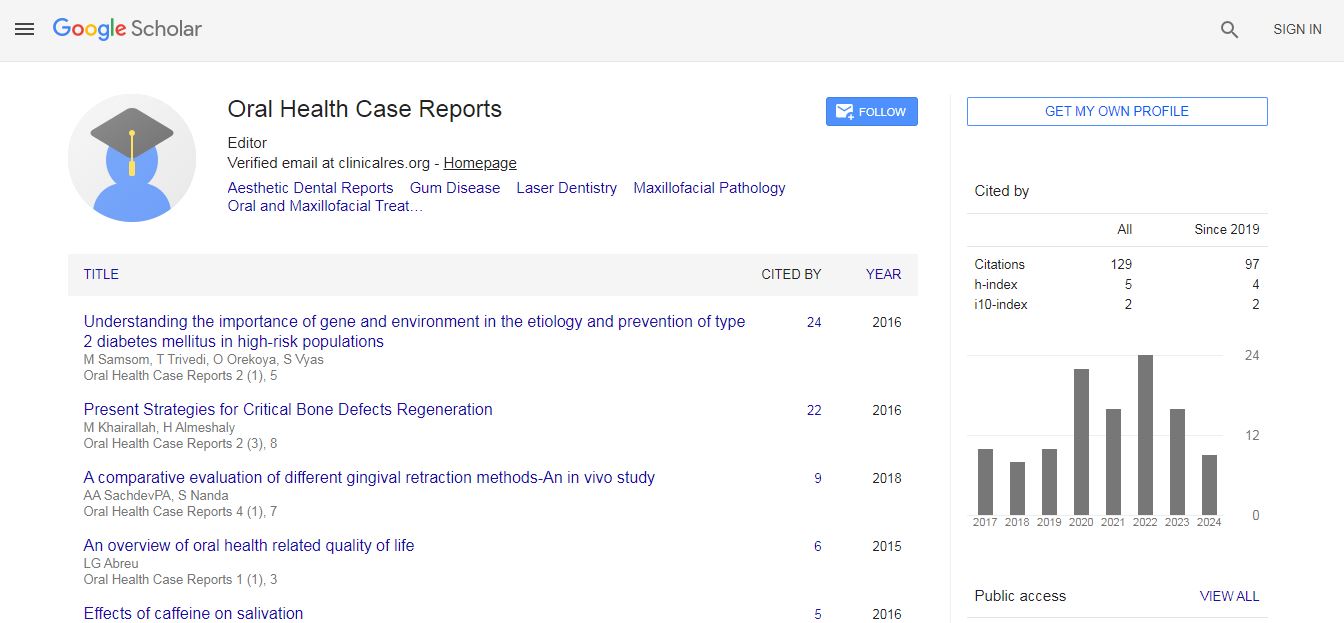
Oral Health Case Reports received 120 citations as per Google Scholar report